Plummeting import bookings out of China are leading more ocean carriers to cancel sailings on the trans-Pacific trade lane as U.S. businesses scramble to avoid 145-percent tariffs slapped on the country’s goods.
As much as 28 percent of weekly cargo capacity on the Asia-to-U.S. West Coast route is expecting to be blanked, with 10 services set to be canceled on the week of April 28-May 3, according to data from Sea-Intelligence.
This would mark the highest percentage of the year thus far, with the May 12-18 week also expecting 10 blank sailings, which would equate to 25 percent of overall capacity on the trade lane. But that week could still see more as container shipping lines rethink deploying their vessels on the voyage.
Related Stories
The 25-percent cancellation rate further suggests that overall inbound cargo volumes in the U.S. are set to fall off a cliff. The National Retail Federation’s Global Port Tracker expects imports into U.S. ports to tumble 20.8 percent year over year in May, before tanking another 26.6 percent in June.
Across all worldwide trade routes, blank sailings are becoming more of the norm, signaling an alarming trend for global trade.
Container shipping companies have blanked at least 80 sailings this month, compared to 51 in March 2020, when volumes crashed amid early Covid-19 lockdowns, Sea-Intelligence said.
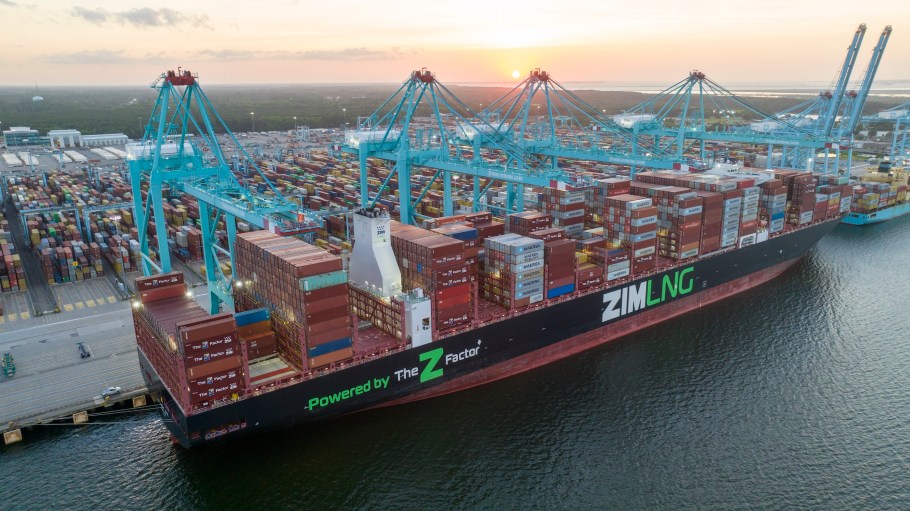
Israeli ocean carrier ZIM is ending one of its services on the route, according to a report from container shipping analysis firm Linerlytica.
ZIM has withdrawn the ZIM Central China Xpress (ZX2) service, which traveled eastbound from Ningbo to Los Angeles, and westbound from L.A. to Shanghai. The last departure from the Port of Ningbo took place April 10, according to the report, and is expected to make its last call at the Port of Los Angeles on Thursday.
Sourcing Journal reached out to ZIM, which has not yet confirmed the withdrawal. The last arrival publicly confirmed by the ocean carrier occurred on March 22.
The premium service used five ships between 4,500 and 5,300 20-foot equivalent units (TEUs), and took 13 days on average to cross the Pacific Ocean. ZIM will transfer three of the ships from the ZX2 service to its ZIM Ecommerce Xpress (ZEX) service between Vietnam and the U.S. West Coast, according to Alphaliner data.
ZIM unveiled ZX2 in July 2024 in response to heightened demand during last summer, when freight rates had peaked due to worldwide port congestion spurred on by the Red Sea crisis, which forced container shipping companies to open up more capacity worldwide.
But as the supply chain often goes, the pendulum of demand has swung the other way in in response to the steep drop in Chinese exports to the U.S.
“Clearly, such an increase illustrates a dramatic change in the market, partly from the perspective of the magnitude of the blank sailings, which are more akin to what we tend to see seasonally, following Chinese New Year in January/February and China’s Golden Week in October,” said Alan Murphy, CEO of Sea-Intelligence, in its weekly report. “And partly from the perspective that many of these blank sailings have been announced with very limited advance warning to the shippers.
The drastic reduction in trans-Pacific sailings is expected to flutter over to the East Coast in a big way. Importers using ports on the East and Gulf Coasts are expected to see a bigger capacity cut from May 5-11, in which nine services have already been scrapped. That amounts to a whopping 42 percent of cargo capacity blanked on the route, according to Sea-Intelligence.
Drewry’s numbers haven’t appeared to be as bearish on the Sea-Intelligence figures, but the maritime supply chain advisory shares the same sentiment on the future of sailings across the Pacific in the wake of the high import duties.
Across four major trade lanes—trans-Pacific, trans-Atlantic and Asia-to-North Europe and Mediterranean—72 sailings have been cancelled between weeks 17 (April 21-27) and 21 (May 19-25), out of a total of 713 scheduled sailings, according to Drewry. This represents a 10 percent cancellation rate across the lanes, which weren’t broken out individually.
“A rise in cancelled sailings is expected in coming weeks, predominantly in the trans-Pacific eastbound, booking cancellations continue to climb, with some vessels potentially departing China with significant empty space through May,” said Drewry in a weekly analysis posted Friday. “Ongoing uncertainty surrounding U.S.-China tariffs has left cargo owners scrambling to offset rising costs, leading many to cancel shipments or halt cargo at the point of origin.”
Most East-West cancellations will hit the trans-Pacific eastbound (56 percent), followed by 31 percent on the Asia-to-North Europe and Mediterranean routes and 14 percent on the trans-Atlantic westbound.
However, Drewry expects the frequency of sailings to improve over that time frame, with its forecast indicating approximatively 90 percent of weekly departures will happen as scheduled.
“Among the major players, Gemini is expected to reach a perfect sailing schedule adherence,” said Drewry. “However, this is likely to change if carriers introduce more blank sailings to reduce overcapacity in an attempt to boost rates and adapt to lowering demand, particularly from China to USA.”