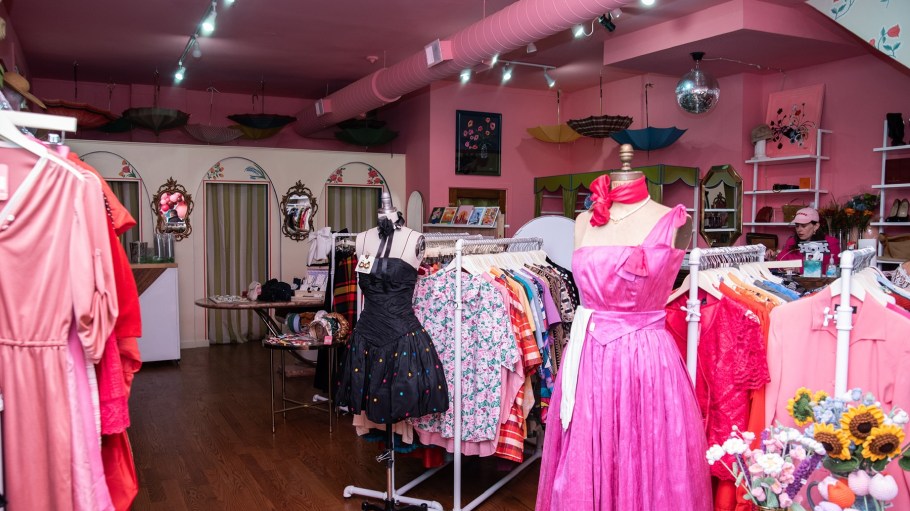
Outside Lost Girls Vintage on Chicago’s Division Street, a trolley waits to shuttle shoppers between independent vintage stores across the city. Inside, customers collect passport stamps, browse racks of worn leather and faded denim and line up for limited-edition tote bags tied to the second annual Vintage Store Day.
What began last year as a grassroots effort among a handful of Chicago secondhand shop owners has quickly expanded into a retail event involving more than 1,100 vintage stores across North America. Inspired by Record Store Day and Indie Bookstore Day, Vintage Store Day arrives at a moment when resale culture is booming online, even as many independent vintage stores remain financially fragile offline.
Related Stories
Founded by Emma Lewis, Sarah Azzouzi and Kyla Embrey, the initiative is designed to drive foot traffic and visibility toward independent vintage retailers by encouraging stores to operate collectively rather than in isolation—an intention that aligns seamlessly with the event’s rapid expansion.
“I think the experience and the human interaction is what people are really craving so much right now,” Embrey told Sourcing Journal.
Vintage Store Day borrows from the retail-holiday playbook popularized by Record Store Day and Indie Bookstore Day, using concentrated programming and coordinated promotions to drive shoppers into independent stores.
The strategy has already proven effective for other retail categories. Record Store Day helped push annual vinyl revenue past $1 billion in 2025 for the first time since 1983, according to the Recording Industry Association of America, while Indie Bookstore Day drew participation from more than 1,600 stores last year, according to the American Booksellers Association.
Last year’s debut saw more than 900 shops across 46 states participating, with 60 percent reporting increased foot traffic or sales.
“The idea is that a rising tide lifts all boats,” Embrey said.
Vintage Store Day invites shoppers to explore brick-and-mortar stores through passport crawls, trolley tours, and shopping circuits, turning vintage districts into destination events.
Participating stores host everything from live DJs and limited-edition merchandise to neighborhood shopping events and in-store promotions. In Chicago, a ticketed Vintage Trolley Tour takes shoppers on a guided crawl through some of the city’s best-known vintage spots, while the Passport Program rewards customers for visiting multiple stores.
The idea for Vintage Store Day came out of tough conversations about survival. Store owners were up against rising costs, unpredictable foot traffic and new competition from online resale giants and big retailers moving into secondhand. Lost Girls Vintage, for example, is a minority-owned shop with locations in Logan Square and West Town. Lewis, who trained as an art historian, opened Rare Form in Andersonville and specializes in antique prints and vintage decor.
Earlier this year, those pressures became personal for Embrey when a car crashed through Lost Girls Vintage’s Division Street storefront after an elderly driver exiting a nearby drive-thru mistook the gas pedal for the brake.
“It was the best possible outcome for a worst-case scenario,” Embrey said. Before the Lost Girls team had arrived, neighboring business owners and community members had already gathered outside the damaged storefront.
“We had so much support by the time we even got to the scene,” she added.
That sense of neighborhood interdependence also shapes how organizers talk about vintage retail itself. It’s why the holiday distinguishes curated vintage from general thrift retail, emphasizing the labor involved in sourcing, repairing, preserving and contextualizing older garments and home goods.
“I feel like we are the custodians of these pieces that have so much history and have their own stories tied to them; so much of my wardrobe had a life before I existed,” Embrey said. “I imagine it will have a life long after I exist, if I do my part and I take care of it, and I respect the labor that went into creating it.”
The philosophy reflects growing consumer interest in tactile shopping and in-person discovery, even as more retail is shaped by algorithms, personalization and AI tools. In that sense, the vintage “treasure hunt” becomes an antidote to algorithmic shopping—replacing automated recommendations with real-world relationships between shop owners and customers.
“You’re not going to get that sort of connection and interaction at a big box store,” Embrey said.
“I don’t think big corporations bring joy and lightness to people’s lives in the same way that independent retail can,” she added. “We know our customers. I know Chunk, the French bulldog, who comes in every day for a treat, but his mom brings his own treats because he’s on a diet.”
For organizers, the goal goes beyond a single weekend of sales. As resale increasingly shifts online and retail grows more automated, Vintage Store Day is ultimately betting that shoppers still want discovery to feel personal, local and a bit unpredictable.
“We don’t just exist here to make a profit off of people,” Embrey said. “We are giving back and we are offering something different.”