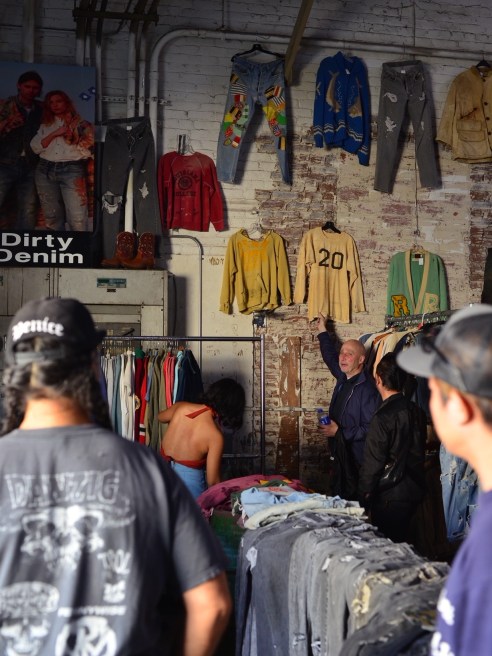
Consumers’ love for worn-in jeans shows no signs of fading. From festivals to bespoke studios to revival workshops and curated boutiques, vintage and secondhand denim cemented itself as one of the year’s most powerful cultural and commercial forces.
Events like Distressed Fest and Manhattan Vintage are welcoming a new generation of consumers—many of whom now see pre-loved fashion as both a style statement and planet-friendly choice. Retailers are transforming their passion for preserving fashion history into unique shopping experiences, while entrepreneurs such as Ali Grace and Lindsey Davidson-Paley are creating business opportunities out of their love for vintage jeans that actually fit.
Related Stories
Look back the stories and individuals keeping the vintage and resale denim market alive and what can be done to scale it.
How Vintage Fashion Festivals Reveal Today’s Consumer Mindset
Once a niche pursuit for collectors and creative outliers, vintage fashion has exploded into the mainstream—driven by new festivals and markets that showcase secondhand style and promote sustainable consumption.
“Vintage used to be this very eclectic, off-the-beaten-path interest like folk art and craft. And now we’re seeing young bro types who would have been into sneakers five or 10 years ago now getting into vintage,” said Abe Lange, founder of Distressed Fest.
Find out how events like Distressed Fest, Manhattan Vintage, Time Travelers Vintage Expo, Pensacola Vintage Collective and Threadbare are tapping into this thirsty market. Read more.
This LA Studio Offers Vintage Jeans with a Custom Fit
Los Angeles–based Lenny is redefining how vintage denim can serve as the cornerstone of a bespoke luxury experience. “I wanted to find a way to create a sustainable company that also focuses on custom fit,” founder Lindsey Davidson-Paley told SJ Denim. “I’ve always loved vintage denim—the silhouettes, the materials. The quality is always better than modern day denim, not to say I don’t love modern day denim as well, but what I really love is the aspect of sustainability and not having to create something entirely new.”
Out of this love for vintage denim, Davidson-Paley founded Lenny in 2021—a peak time for secondhand denim as the pandemic flashed a spotlight on the fashion industry’s negative impact on the environment. Read more.

Rising Prices, Falling Confidence: Secondhand Retail Steps Up
Conversations about shopping secondhand are growing as consumers begin to revisit the savings hacks that helped their wallets during the height of the pandemic and the Great Recession. “Secondhand is tariff-free, local and sustainable. It’s going to be an even better option than ever moving forward,” said Aarian Frye, marketing coordinator at Buffalo Exchange. Find out how economic uncertainty may impact the resale and thrift market. Read more.
Denim Revival Keeps Hollywood’s Jeans Looking Good
Anahit Anny Adamyan has been repairing Angelenos’ jeans since Y2K was trending the first time.
Denim Revival, formally known as Denim Doctors, launched in 2000 providing simple and basic denim repairs. Adamyan, who began sewing at age 14 and worked as a head pattern maker and head pattern cutter in a factory in her native Albania before coming to the U.S., had more denim knowledge and skills to offer, however. In 2006, she was named Denim Revival’s “original tailor” and in 2010 she bought the business.
Denim Revival now serves as a workshop where customers can peruse the front of the store filled with band tees, military surplus and “essential vintage denim that never goes out of style” and have them altered to their liken in the back. Most bring in their favorite pairs for a wide range of repair and customization services offered by Adamyan and her team. Read more.
Resale’s Growth Outpaces Broader Apparel and Footwear Market
As consumers become more aware of the impact of their purchases, both on the environment and their budgets, the clothing resale industry has seen significant growth. Data from consumer research group Consumer Edge shows that sector is now outpacing the growth of the overall apparel, accessories and footwear industry. Read more.
Time Capsules: Meet the Vintage Shop Owners Preserving American Fashion
In a fashion world increasingly dominated by fast trends and fleeting styles, vintage curators are pushing back—championing quality, history, and individuality. Across the U.S., a growing number of boutique owners and collectors are redefining what it means to dress with intention—one worn-in T-shirt, selvedge jean, and chainstitched jacket at a time.
From New York’s East Village to Seattle’s oldest neighborhood and New Orleans’ eclectic Bywater community, meet the vintage retailers aren’t just selling clothes—they’re preserving culture, telling stories, and encouraging consumers to slow down and value garments that were made to last. Read more.
Ali Grace on Building a Denim Brand Rooted in Custom Fit and Inclusivity
“It’s an absolute nightmare shopping for jeans.”
In 2018, Ali Grace, founder and CEO of her namesake brand, was sitting in her dorm room at the University of Massachusetts Amherst when the frustration of finding jeans that fit finally hit a tipping point. Instead of settling, though, she decided to launch a brand dedicated to giving women the perfect fit (something she’d been yearning for). For the brand, Grace reworks vintage Levi’s—hand-selected from thrift stores—and tailors them to fit “every body and every size.” Read more.
Report Identifies Common Resale and Repair Challenges
Circular fashion represents a $700 billion opportunity for brands and retailers, but some may be on the path of overpromising and underdelivering.
A report by the British Fashion Council explores the work it will take for repair and resale programs to transform fashion brands’ business models. “Customer-Centric Growth: A Playbook for Scaling Repair and Resale in Fashion,” by the British Fashion Council’s Institute of Positive Fashion in collaboration with business management consultancy Clarasys, warns that while circularity is gaining momentum, the sector faces major barriers, including low customer awareness, convenience gaps and unclear value propositions. Read more.