When stepping into the world of the “American Old West,” particularly workwear from before 1900, every collector and even the archives of various brands are likely familiar with the importance of fragments in this domain. This is primarily because fully intact examples are either extremely rare or entirely non-existent. Moreover, the variations in designs at the time were vast. Even fragments provide us with a wealth of information, revealing how people lived and worked during that era.
Since clothing production at the time relied heavily on manual labor and lacked standardized management, every piece of clothing had notable differences. For example, take Levi’s. During the same period, some samples featured leather washers, some had tool pockets, and others used hand-sewn buttonholes, among other distinct characteristics.
Related Stories
Though 152 years ago may not seem like an especially distant past in the grand timeline of history, workwear back then served as true utilitarian clothing. Considering the remote and resource-scarce workplaces, each piece of workwear was used until it was completely worn out before being retired.
Additionally, the extreme working and storage conditions of the time meant that even fragments are exceedingly rare today. Most surviving samples have been unearthed from mining shafts dozens of meters deep. As a result, information and books discussing pre-1900 workwear are incredibly scarce. Since pants are a relatively straightforward type of garment, even something as simple as the waistband can provide sufficient information to narrow down the production year to within a single year.
What made Levi’s in the Old West era special was durability—a defining characteristic of the era—and the rivet design was truly irreplaceable.
When Levi’s patent expired after 17 years in 1890, most other brands began implementing rivet designs. In fact, Levi’s valued the design of their work pants so highly that, beyond applying for patent protection, they also added design elements like the iconic arcuate stitching on the back pockets as decoration. Levi’s branded every possible element that could signify their brand, including labels, buttons and rivets. This practice ensured that their workwear was unmistakably marked as Levi’s.
History debates
The earlier 1870s period, when Levis Strauss and Jacob Davis patented the rivet, is an era in denim history which has many holes. The prices these garments are sold reflect their rarity and historical importance.
And it’s where many denim historians disagree. In fact, it gets heated especially when it comes to the earliest pieces. Common disagreements are on dates and when certain details like duck canvas and indigo appeared for the first time, or whether brown cotton or hemp were used. (There’s no evidence on hemp being used, but I think we could end up finding one in a wall or down a mineshaft one day soon.)
In most cases, denim historians like Brit Eaton (a.k.a Indiana Jeans) and Mike Harris are doing the work of archaeologists, though maybe not being as careful as Howard Carter, the archaeologist who found King Tut in 1922. They are doing their best to document and record all the artifacts and how they are found. I honestly trust someone who has spent years going down dangerous mineshafts, in most cases hundreds of feet down.
When the Triple Pleat jacket—Levi’s earliest jacket and the forefather of the modern Trucker—was found by Harris (and sold via many hands in short period of time before ending up in Levi’s Archive in San Francisco), he always said he found it in a pile of items from 1874. Levi’s, with is records, dated it to 1880.
This six-year discrepancy has been a sore point. In archaeology, when dating objects, you go plus or minus 50 years, but in the denim workwear world so much work has been done. We can practically date garments to the month and even the year through patents, sales catalogues and other garments.
Some of the best historical pieces are not in the Levi’s or Lee and Wrangler archives. Most are in the hands of denim enthusiasts and denim collectors with deep pockets. I was asked recently what I thought about rich collectors buying up important pieces. My answer? These brands are billon dollar companies—they could buy these pieces if they wanted them.
Something I’ve found in recent years is the bitterness and soreness between collectors and historians who represent the large brands, leading to important pieces going directly into the hands of private collectors and not being documented.
There are examples of important pieces of denim workwear pieces being rejected for “not being right” or “not verified” and change hands very quicky. When art is changing hands, provenance and historical context is very important. There are several instances in last 20 years in which rare early denim pieces are discovered, after which potential buyers consult with other collectors and denim historians to determine if the item aligns with the historical timelines.
Levi’s lost their entire archive in the Great San Francisco Earthquake and Fire of 1906, so even their famous back packet arcuate origins are lost. What does the shape represent? An eagle? The Golden Gate Bridge, perhaps?
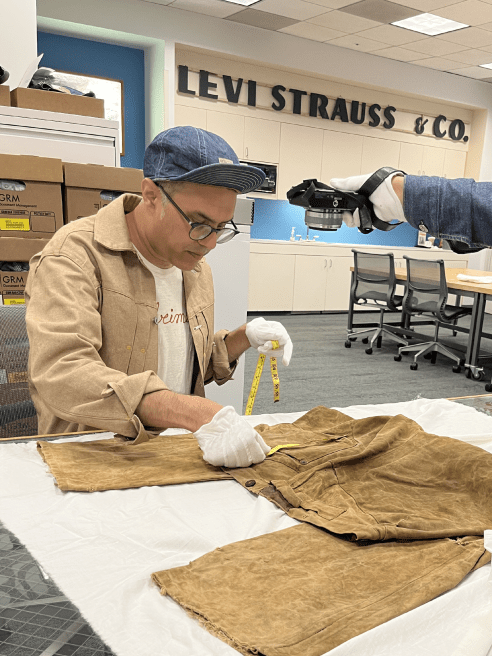
My fascination of this early period has led me to research over 300 workwear patents and all manners how these garments were created, from what sewing machines were used and finding their patents to crosschecking if that certain buttonhole was made with that machine.

I recently had a two-hour conversation with Harris about if a certain jean had handmade buttonholes or machine buttonholes. If machine, then the jean was made after 1883. Then, with garments being made fast, details like pockets and sewing constructions are missing in sales catalogs. In some cases, historians coming up with theories.
This has led me to become a specialist in this field with many other historians asking for my opinion. As a denim designer, who can make a period correct 1870s replica garment—in most cases with the very same sewing machines Levi’s and Davis used—this has led to even me being periocular to the type of linen thread used and fiber combination on the weave on my historical denim collections.
This obsession and pursuit have led to my company owning 30 period correct sewing machines, so I can better understand the past and put correct dates on these many garments. In fact, we know what sewing machine Levi’s and Davis used in 1873 period were the Singer No. 2 and Grover and Baker No.1 from a newspaper advert targeting women.
Collecting history
I’ve been a denim designer close to 25 years. In that time my fascination of vintage denim and its origins have led to me to see many vintage collections all over the world, from the U.S., Japan, all over Europe, Hong Kong, Thailand and even Pakistan. I’ve visited nearly all four corners of the earth in the pursuit to see best and worst factories where denim is made. I’ve seen how cotton is grown, spun and woven, how natural indigo is harvested and how chemical indigo is produced. Additionally, I’ve been lucky to visit most of the best and the leading denim specialists.
In recent years, my company, Endrime, has led to work such as lyocell and hemp denim designs and promoting sustainable and circular ways of making collections each season. Through these experiences, I’ve gained a reputation for documenting and preserving stories for archival purposes.
Denim, even though its American, is a European story. A Jewish immigrant tailoring story, to be specific. Denim and workwear’s early tailoring roots are not well documented, but it will be book I hope to tackle in a few years’ time.
The early period from the 1840s to invention of the fly front in the 1850s—and of course the patent of the rivet on May 20, 1873 and the important date of 1890 when the patent ended—are the dates that that have been etched in my mind.
Personally, the period from 1872 to 1890 is the most fascinating in early denim and workwear. When Levi’s patent was in full force, some early workwear brands tried to use rivets but were stopped in their tracks. The best innovation—from innovative pocket shapes to ingenious ways to add strength on pocket edges without using rivets—was taking place in the time.
Denim historians like Harris have released books on the subject. “Jeans of the Old West” is his most popular and a go-to book featuring garments, scraps and artifacts he’s found in down mine shafts with his wife and father-in-law.
His close friend Viktor Fredbäck, author of “True Fit: A Collected History of Denim” and star of documentary “Denim Hunters” has also found notable pieces. Other denim historians like Eaton has made headlines for his popular denim festival and his denim finds, including jeans selling for over $200,000.
Later this month, my company will publish “Worker,” the first book from collector Cory Piehowicz. The tome features over 300 rare pieces he has sourced over the years.
I also have a vintage denim archive of over 3,000 pieces. I’ve been collecting vintage denim and early workwear mostly to educate myself and the students I teach in various denim education projects across U.K. universities for the last 20 years.
Additionally, I’ve published books on the subject, including “Endrime Archive Vol 1,” which features 200 pieces from my archive, and “Vintage Style Research Vol 1,” a book that highlights 75 pieces collected by six Hong Kong denim collectors. Up next, I’m planning a book about denim and workwear patents and another on making jeans—a step by step tutorial on every possible construction I’ve come across.
I’m not talking just Levi’s method. Levi’s by 1922 was already using cheaper ways to make garments and far removed from the single needle tailored patented overall they made in 1870s. This book will cover the denim masterclass I teach every three months at UAL: London College of Fashion.
There are many other well-known specialists who I’ve become friendly with, including collectors from the U.S. who keep a lower profile and just want to document and preserve denim history. Other notable specialists like Dean Hashimoto in Boston and Saleem Ghanchi and his son Umer Ghanchi based in Bangkok.
I have agreements with many of these collectors and hope in the years to come to document their archives for students and denim enthusiasts to enjoy. Many of these denim archives have not been seen in public and are behind closed doors. It is now the job of collectors to keep denim’s history.
Mohsin Sajid is a U.K.-based denim designer, lecturer, historian and publisher. He is also the creative director and owner of the denim design consultancy, Endrime.