In an era of contracting attention spans and algorithm-driven feeds, is the Cannes Film Festival becoming more valuable to luxury brands — or less?
For executives across fashion, beauty and media analytics, the jury is still out. While it remains one of luxury’s most powerful visibility engines, it has also become its most saturated.
According to Launchmetrics data, last year’s festival generated more than $1 billion in Media Impact Value (MIV), outperforming the combined visibility generated by New York, London, Milan and Paris fashion weeks during its 12-day red carpet run.
Related Articles
“But MIV only measures visibility,” Launchmetrics chief executive officer Michael Jais told WWD. “The question is more if that MIV settles into brand equity – it’s not automatic. There is a chain between visibility, memorability, preference, intent and loyalty.”
You May Also Like
That distinction is the crux of the matter for luxury brands, already beset by the overall luxury slowdown, pushback on rising prices, and growing influencer oversaturation.
For decades, Cannes followed a relatively simple formula: dress a major actress, secure global press coverage, and dominate the fashion conversation for days. It was one of fashion’s most reliable moments alongside the Oscars and the Met Gala.
A Different Landscape
But now? “There are so many moments, and they barely have any longevity unless it is the right person, the right time and the right dress,” said one luxury PR executive who handles VIP dressing and strategy for major French fashion houses.
Even recalling standout looks has become difficult. “I barely even remember any Oscar gowns, maybe one if I try really hard,” she added, citing Chanel’s colorful coup on best actress winner Jessie Buckley.
The issue is not visibility but saturation. Despite enormous engagement across editorial and social channels, it all gets lost in the feed.
Part of that stems from just how large the entire universe around the festival has grown.
Once dominated by film stars and luxury brands, it now spans influencers, TikTok creators, beauty ambassadors who come for the branded content trips, yacht activations, and hospitality suites layered over the traditional film festival.
That saturation has fundamentally changed how brands evaluate participation.
Increasingly, luxury groups are questioning whether pure visibility is enough, and how to create longevity after the festival rolls up the red carpet.
“The spike itself is sometimes actually the least interesting metric,” said Lucy Robertson, global head of brand marketing influencer agency Buttermilk, who works with brands including Prada and Giorgio Armani’s beauty arms, and on brand activations such as Gap at Coachella. “It’s what happens in the weeks, months and years after that.”
Brands now track search lift, site traffic, retail signals, and long-tail engagement. In some cases, executives report branded search increases of 20 to 40 percent following strong red carpet activations, she said.
Bella and Schiaparelli Stand Out
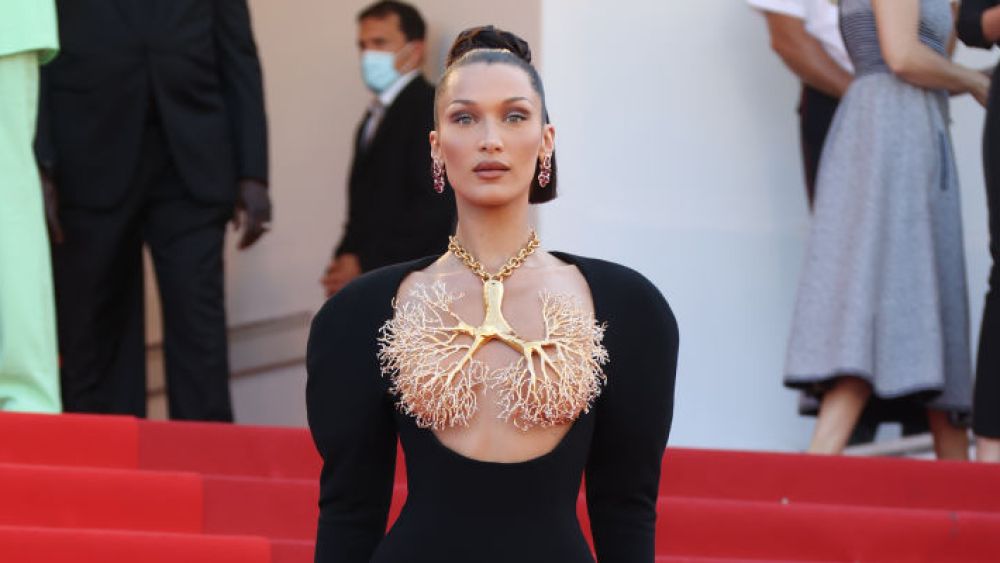
A frequently cited example remains Bella Hadid’s 2021 appearance in Schiaparelli’s Surrealist gold “lungs” chest covering by Daniel Roseberry, paired with Chopard earrings.
“That was a single look, and it was just one moment,” said Robertson. Photos from that event (though, who remembers the film?) continue to resurface in “best Cannes looks” roundups and retrospectives five years later, she noted. “The value of that has compounded over time.”
Virality is no longer sufficient, the executives agreed.
“High-profile placements without continuity generate fatigue,” said Launchmetrics’ Jais.
In contrast, long-term value emerges when a moment is embedded in a broader system of storytelling, editorial repetition, and brand-owned amplification.
Jais cited Chopard as the clearest example of this model. Through its long-standing association with the Palme d’Or, red carpet jewelry placements, and festival-adjacent events, including its own Trophée Chopard award, the Swiss brand and official festival partner for decades has effectively put its stamp all over Cannes.
“The MIV per placement may not even be exceptional,” he said. “What is exceptional is that the baseline never drops. It becomes institutional rather than event-driven.”
In fact, Chopard benefited from Schiaparelli’s big moment — perhaps even more so than the brand itself.
The fashion house generated enormous short-term attention from the appearance, yet since the brand lacks the long-standing Cannes infrastructure, the look is often credited as Chopard, a confusion further compounded by Hadid’s role as the face of the jewelry house.
“The brands that create long-term equity are the ones that extend the moment beyond the red carpet,” Jais added.
Saint Laurent’s Winning Strategy
More recently, he noted that Saint Laurent has been successful with its new film production model, including backing “Emilia Pérez,” which took prizes in Cannes and went on to Oscar wins. Its stars wore the brand throughout awards season.

For Jais, the question is no longer how to maximize red carpet exposure but “how [to] become a legitimate cultural actor in a space where fashion and cinema intersect.”
This shift also reinforces pricing power at the top end of luxury.
“For ultra-premium fashion brands, red carpet equity is partly about permission,” the Launchmetrics CEO said. “Permission to hold price, permission to extend into new categories, permission to attract a certain type of creative talent.”
At a time when luxury consumers are more selective and resistant to repeated price increases, the “permission” given by big events has become important for the bottom line.
As a result, brands are moving away from influencer-heavy strategies that prioritize reach alone.
The VIP dressing executive named the multiplication of influencers as a challenge of the festival, with only the strongest profiles now worth the time, effort, and — most crucially — cost.
However, there is a clear distinction between influencer saturation and influencer strategy.
While Cannes has become crowded, brands are layering creators on top of the film festival not to generate immediate spikes, but to extend the lifespan of red carpet moments and overall interest in the event itself.
Even those with large audiences may not deliver luxury impact if their audience is misaligned with the premium tier. One criteria is whether a person “drives luxury conversation,” according to the VIP dressing executive.
For brands, the red carpet is no longer the endpoint of a campaign, but the beginning of a content chain. On platforms like TikTok, red carpet images are rapidly remixed, reposted and reinterpreted through reaction videos, commentary accounts, memes and creator analysis.
“It’s about how people interact with it,” said Robertson. “You need people talking about it.”
Beauty brands have been particularly aggressive in adapting to this shift.
Dior Beauty, for example, brings creators to Cannes who are not directly tied to film premieres, but who produce social-first content during the festival window.
“They’re not even attending the event,” said Robertson. “But they know there’s going to be eyes on the brand around that time.”
The strategy extends Cannes beyond the Palais red carpet into villas, suites and creator-led content ecosystems.
Despite saturation concerns, executives agree Cannes remains one of fashion’s most influential cultural platforms. But the value now lies less in a single red carpet moment and more in building an ecosystem that sustains momentum long after the festival.
“The best brands are thinking about how to extend it beyond the red-carpet moment,” said Robertson.