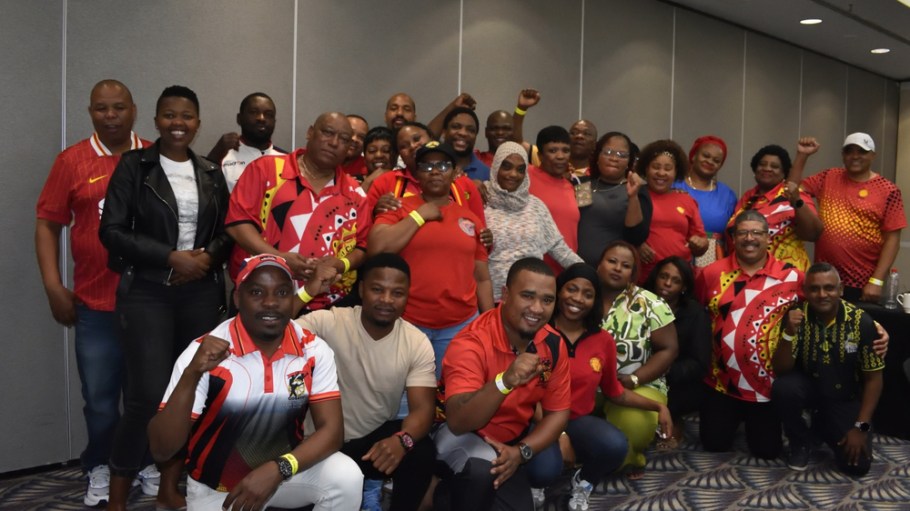
Apparel, footwear, leather and textile workers in Eswatini and South Africa are pushing for a just transition from fossil-fuel-reliant industries to low-carbon economies that promote fair and equitable employment.
Convening at a workshop in Durban, South Africa, last week, nearly three dozen union leaders, officials and shop stewards from the Amalgamated Trade Unions of Swaziland and the Southern African Clothing and Textile Workers’ Union, both IndustriALL Global Union affiliates, drew up a “common vision” for a future that moves away from the linear take-make-dispose model to a circular system that prioritizes resource efficiency, curbs waste and pollution and champions ethical production.
Related Stories
Despite the promise of ramped-up productivity, automation should “augment rather than displace” workers, the participants said. This requires investment in upskilling and reskilling programs that would leave no worker behind, as well as a form of shared sovereignty that redistributes profits in a more equitable way.
“As a union, we champion worker ownership of renewable energy assets, ensuring that the wealth generated by new production methods in the textile and garment industries is shared and green jobs created,” said Membinkosi Vilina, deputy general secretary of the Southern African Clothing and Textile Workers’ Union.
Just as important, they said, is mandatory supply chain due diligence that can hold multinational brands accountable while protecting workers’ rights. The dominance of women in the workplace also requires gender-inclusive policies that tackle issues such as gender-based violence and harassment, the gender pay gap, access to childcare and the need for a living wage.
With the United States imposing a “reciprocal” tariff of 30 percent on all South African goods entering the country—the highest rate in sub-Saharan Africa—unions pointed to the need for regional integration that shores up intra-African trade, such as under the African Continental Free Trade Area.
And while South Africa’s unemployment rate worsened by 0.3 percent of a percentage point to 33.2 percent in the second quarter of 2025, so-called “enhanced” industrialization could expand the apparel, footwear, leather and textile sectors’ manufacturing capacity, generating jobs that can counter the region’s acute poverty and inequality.
“As we navigate the just transition in Sub-Saharan Africa’s textile and garment industries, we must confront the broader impact of emerging technologies like automation and artificial intelligence on the future of work, while fiercely protecting decent working conditions,” said Paule-France Ndessomin, regional secretary at IndustriALL Sub-Saharan Africa.