While congressional hearings don’t usually solicit laughter, Enes Kanter Freedom drew a few chuckles from the Congressional-Executive Commission on China (CECC) on Wednesday as he described an ideological skirmish that he claims cost him his membership in the National Basketball Association (NBA) after an 11-year career, something that the organization itself has denied.
In Freedom’s telling, however, his vocal criticism of Beijing’s human rights abuses was the only reason he wasn’t tearing up and down a court that afternoon but rather suited and booted in front of a panel of politicians, including Representative Christopher H. Smith, a Republican from New Jersey, and Senator Jeff Merkley, a Democrat from Illinois, the bipartisan and bicameral body’s chair and co-chair. His audience was there not to see him pass a ball but to hear his testimony about corporate complicity in China’s agenda.
Related Stories
“I’m a basketball player,” Freedom, who last played for the Boston Celtics said. “But some of the things that happened in my life [took] me on a very different route.”

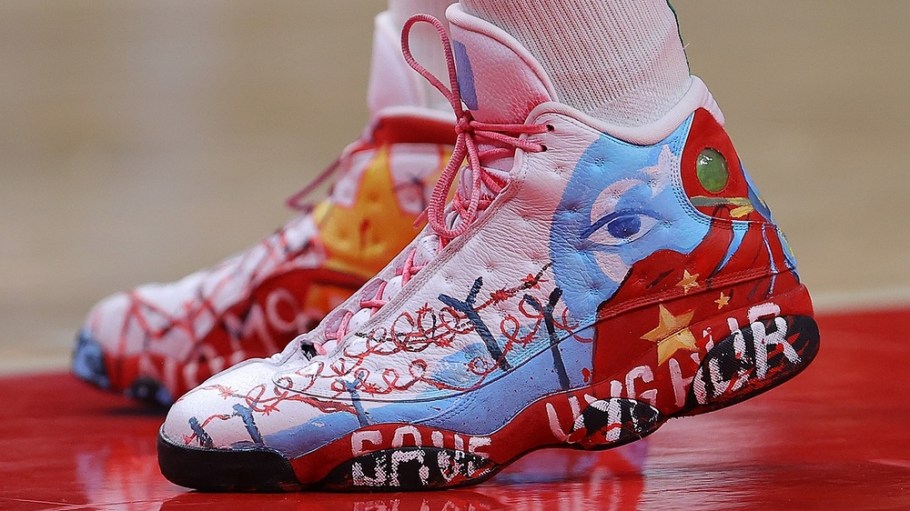
The problem, he said, began with a pair of shoes. His, in fact. Through the years, he watched his fellow players emblazon their kicks with slogans like “Black Lives Matter” without incident. On a day in October 2021, Freedom was getting ready to play against the New York Knicks at Madison Square Garden—“our biggest rivals”—when two men from his team told him to take off his shoes, which Chinese artist Badiucao had painted with the words “Free Tibet.” Freedom, who was studying for his American citizenship test, refused, asserting his First Amendment Rights. By the time halftime rolled around, every Boston Celtics game had been banned in China, even though he had been pulled from playing. His side lost the game, “obviously,” the 6-foot-10 center quipped.
Freedom said the NBA called him to tell him he could never wear the sneakers again. With his phone ringing every hour, he finally swore to leave the “Free Tibet” shoes behind. “I said ‘I promise, I promise,” Freedom said. “The next game, I wore ‘Free Uyghur’ shoes.” Cue more guffaws.
What happened next, however, was no laughing matter. Freedom later posted a video on Twitter chastizing Nike for what he said was its role in “injustice” in China. He trotted out more shoes, with phrases like “Modern Day Slavery” and “Hypocrite Nike” and red splatters meant to evoke bloodstains. A teammate drew him aside, asking him if he knew this was his last year “because if you criticize NBA and Nike, it’s over for you.” Freedom said that’s “pretty much” what happened. When February came, he was released from his contract and “it was all over.”
Freedom said that the NBA’s stance on his Chinese activism was vastly different from its position on the George Floyd protests or even its support of his criticism of Turkey, where his parents are from. The organization, he said, encouraged players to speak about social justice issues yet fumbled when it came to China. It boggled his mind. “How can the biggest dictatorship in the world—China—control a 100 percent American company and fire a U.S. citizen?” the Switzerland-born athlete asked.
He had equally harsh words for Nike. “Nike stands with Black Lives Matter in this country, they stand with the LGBTQ community, they stand with No Asian Hate, they keep preaching about how important social justice issues are,” Freedom said. “But when it comes to using slave labor, they’re one of the biggest companies that use slave labor.”
Nike maintains that it doesn’t source materials or products from Xinjiang and that it has zero tolerance for forced labor in any form.
The CECC has cast a gimlet eye on the NBA before, expressing concerns about basketball players and their endorsement deals with Chinese brands like Anta Sports, Li-Ning and Peak that tout their use of cotton from the Xinjiang Uyghur Autonomous Region, where reports of forced labor of persecuted Uyghurs and other ethnic minorities are rife. A letter that it wrote to the National Basketball Players Association (NBPA) in June 2021 urged the organization to use its leverage to press the companies to stop their use of Xinjiang cotton or, failing that, end their partnerships despite the money at stake.
Smith said he was surprised at the lack of response. “I can’t believe…the cowardice of the NBA in kowtowing to Xi Jinping and company,” he said, referring to the leader of the Chinese Communist Party. The CECC, he said, will be inviting Nike, along with the NBA and the NBPA to testify at a future hearing—though it’s up to them, of course, to accept.
The timing, he noted, would be apt. It’s been a year since the Uyghur Forced Labor Prevention Act (UFLPA), which presumes—with the opportunity for importers to rebut—that all goods made in whole or in part from Xinjiang are the products of forced labor and therefore inadmissible into the United States.
Smith called the law, which members of the CECC helped spearhead, one of the most important pieces of legislation of the past two decades.
“It is my hope that the legislation will prick the consciences of corporate actors, and that it will be my further hope that companies will determine that the bottom line concerns will motivate them to do the right thing,” he said.
The de minimis predictament
Speaking as a witness, Robert Silvers, undersecretary for policy at the Department of Homeland Security and chair of the interagency Forced Labor Enforcement Task Force, agreed that the UFLPA has brought a “sea change” to the way the United States approaches the eradication of forced labor, further calling its implementation “speedy, strong and surgical.”
Since June 2022, Customs and Border Protection (CBP) has targeted more than 4,200 shipments valued at over $1.4 billion, “sending a clear message to importers that we take our mandate seriously,” he said.
While the task force is still in the early stages of quantifying the legislation’s impact on private-sector behavior, other organizations have revealed some broad trends. Altana AI, a predictive supply chain platform, for instance, reports that transactions from entities potentially subject to enforcement under the law decreased by roughly 40 percent between June 2022 and March 2023.
“The same period also saw the overall value of transactions decrease by approximately 50 percent,” Silvers said. “Another supply chain mapping company has informed us that it has similar data. We are seeing similar trends from other providers, and these all support extensive anecdotal reporting that industry is taking UFLPA compliance seriously and taking steps to ensure it comes into line with the law’s requirements.”
Despite what Silvers characterized as the strength of early enforcement, DHS and CBP do face challenges, he said, including the risks posed by de minimis shipments valued under $800 and the need for further resources to fulfill their mandate, including expanding the Entity List of bad actors in the region.
“There is an active pipeline of referrals…and we anticipate more additions to the list in the coming months,” he said of the list, which currently comprises 22 entities.
De minimis has been a subject of great discussion on Capitol Hill, particularly as it relates to Chinese-founded e-commerce giants like Shein and Temu, which lawmakers say could be using the exception to skirt enforcement under the UFLPA despite evidence that might draw suspicions, such as the appearance of Xinjiang cotton in some products or the absence of compliance mechanisms.
“To be clear, the UFLPA does apply to de minimis shipments,” Silvers said. “We conduct our risk-based targeting in our other approaches on de minimis shipments. However, there are challenges. We get less data for de minimis shipments than we do for shipments valued at over $800, and that makes the targeting and the enforcement work more difficult.” Some 2 million packages are estimated to flow into the United States daily under the exception.
Not that CBP doesn’t have a plan, he said. The agency has a host of strategies to tackle the issue. In the short term, it’s adopting software “enhancements” to improve its ability to target on-demand shipments. In the medium term, it’s looking at regulatory changes that can enhance its data collection. And in the long term, it would like to work with Congress.
“You’re going to be hearing a lot over the coming months about what we are calling our 21st-century customs framework,” Silvers said. “This is an attempt to modernize the way we process cargo into this country so that it is both efficient and has integrity and security.”
Silvers declined to speak about potential enforcement actions on Anta, Li-Ning and Peak, though he said that Xinjiang cotton remains a priority for CBP “regardless of who the company is or what kind of label is on the product” because “it’s the law and it’s the only right thing to do.”
“We are going to enforce our forced labor laws wherever the facts lead, whether they lead to China or whether they lead to other countries where China may be exporting its forced labor practices,” he added. The latter involves working with countries such as Malaysia and Vietnam, where the bulk of detained shipments have so far originated. A united front is also being created with Canada and Mexico through the United States-Mexico-Canada Agreement. Ditto when it comes to engagement with the European Union, since there are “huge benefits to harmonized laws,” Silvers said.
‘Tortured’ to make gloves
Shi Minglei’s seven-year-old daughter knows by sight the model of work gloves that her father and Shi’s husband, human rights activist Cheng Yuan, might be making under duress at Hunan Chishan Prison in China’s Hunan province, where he is serving a five-year sentence. The little girl scans the aisles of retailers like Home Depot for the specific make of mitt, which bears the label of Milwaukee Tool, a subsidiary of Hong Kong-based Techtronic Industries that sells home-improvement gear.
Shi hasn’t seen Cheng since he was arrested, tortured and charged with “subversion of state power” in 2019, she said in her testimony. It was through Lee Mingche, a Taiwanese human rights activist who served time at Hunan Chishan Prison, that she learned of a scheme where prisoners were forced to make the gloves for up to 12 hours a day.
“One of Lee’s jobs was to cut materials into the shape of a glove. Lee said that there were three to four cutting machines devoted to cutting Milwaukee Tool gloves,” she said. “Another of Lee’s jobs was sewing the cut materials into actual gloves.”
Shi learned that her husband is being forced to do a “significant amount” of sewing. According to Lee, prisoners who refused to work or failed to meet quotas faced a variety of punishments, including solitary confinement, sleep and food deprivation and beatings with electric batons. Meanwhile, they’re paid what is the equivalent of 1 cent per hour.
“Due to the lack of rule of law in the PRC, however, it is extremely dangerous for former prisoners located there to speak publicly about these issues,” she said, using an acronym for the People’s Republic of China. “That is precisely why big companies like Milwaukee Tool are able to get away with benefiting from forced labor in the PRC. They know that the lack of human rights protections in the PRC means it is difficult, if not impossible, for victims to hold them accountable.”
The gloves, she noted, were removed by Walmart after she informed them of the issue. Amazon and Home Depot, however, continue to sell them, Shi said.
Milwaukee Tool said in an emailed statement that it does not tolerate the use of forced labor and has “strict” policies and procedures in place to ensure that no authorized Milwaukee Tool products are manufactured by using forced labor. “Milwaukee Tool only partners with suppliers that similarly commit to ethical labor practices throughout their supply chains, and who ensure that no forced labor is used,” it said. “Milwaukee Tool regularly conducts a complete and thorough review of our global operations and supply chain.”
Amazon declined to comment. Home Depot said that it investigated the allegations made against Milwaukee Tool but found no evidence that the gloves sold at its stores are made with forced labor.
“It is extremely beneficial to Milwaukee Tool’s bottom line if those who are actually making their gloves are paid only 1 cent per hour,” Shi said. “Of course, they would prefer to have their gloves manufactured in the PRC, rather than in the U.S., where they’d have to pay workers several thousand times more, and where the kinds of abuses people like Mr. Lee…suffered would not be tolerated. In this way, American workers can also be counted among the victims of Milwaukee Tool’s disregard for human rights.”
The CECC, following the hearing, sent a letter to Steve Richman, group president at Milwaukee Tool, to raise concerns about the allegations, as well as to seek answers about its due diligence processes, particularly regarding forced labor in China.
“We hope you can provide us with information about these reports and your company’s reaction to them,” Smith and Merkley wrote. “The issue of forced labor in China, and the unfair trade advantage it offers companies like yours, is one that has plagued the U.S. economy for decades. We understand that Milwaukee Tool may have strongly worded policies against the use of forced labor, as do most every company with global supply chains, but the evidence in this case is very compelling.”
Milwaukee Tool will be invited to testify, too, Smith said at the hearing. “Hopefully they’ll say yes,” he said. “And hopefully they’ll see that they can make an enormous difference.”
Merkley, in his opening remarks, said that businesses should consider themselves “on notice” that protecting their supply chains from being “tainted” by forced labor must be a “top-tier issue” of corporate compliance.
“But that’s only the start of the paradigm shift that we need,” he said. “We need businesses across the economy to diversify their supply chains to be less susceptible to Chinese coercion, to avoid complicity with human rights abuses. We need greater transparency about businesses’ data practices, exposure, the pressures coming from China and more. And defenders of freedom need to speak out so businesses know that there will be reputational costs for abetting human rights abuses.”
Freedom, for his part, would rather be getting ready for the season ahead. But he said he also knows that the current stakes are much bigger than a spot on the NBA roster.
“I will continue to be the voice of all those innocent people out there who don’t have a voice,” he said. And he will continue to have a sense of humor, which Smith praised. “You gotta laugh,” Freedom said. “If you lose [your] smile, you lose hope.”