Even as Xinjiang’s textile industry continues to expand despite international sanctions, the Chinese government consistently frames its regional labor transfers as voluntary initiatives for poverty alleviation.
However, new firsthand testimony from a former regional police officer directly contradicts this narrative, providing overwhelming evidence to substantiate long-standing allegations of state-imposed forced labor. His account details the coercive nature of these deployments, confirming that global apparel and other supply chains face systemic and unavoidable compliance risks.
Related Stories
The witness, a Han Chinese police officer who served in southern Xinjiang’s Uyghur heartland from 2014 to 2023, directly supervised forced labor deployments to the region’s cotton fields across two harvest seasons. In his role, he personally transported detainees to over 50 prisons and detention centers. Mr. Zhang provided extensive documentation and photographic evidence corroborating his service history. His account describes, in granular operational detail, the coercive mechanisms that Beijing continues to frame as voluntary poverty alleviation programs.
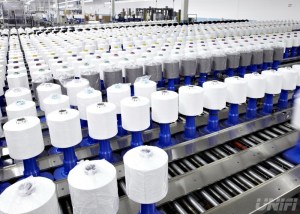
Despite international trade sanctions and heightened corporate scrutiny, forced labor transfers in Xinjiang continue to expand, including in its textile and garment sectors. According to officials, Xinjiang’s textile sector created 46,800 new jobs in 2025 alone, with yarn output rising over 20 percent and fabric production increasing 36 percent year on year. Concurrently, labor transfers accelerated following the end of Zero Covid policies in late 2022. By 2025, total transfers reached a record 3.4 million deployments, a figure encompassing over 3 million individuals, with some subjected to multiple transfers in a single year.

Coerced out-of-province deployments have expanded at an even greater rate. To illustrate the scale of this shift, the entire region transferred approximately 25,000 workers annually to other parts of China between 2017 and 2019. In contrast, Kashgar prefecture alone relocated over 20,000 rural laborers to external provinces in 2024.
While Xinjiang’s forced labor apparatus has been evolving since the 2000s, it systematically hardened alongside the campaign of mass internment implemented by former Party Secretary Chen Quanguo between 2017 and 2019. Under his administration, the region’s labor transfer programs became highly coercive, expanding concurrently with the internment drive and the strict enforcement of state poverty alleviation goals.
Xinjiang’s transfers of so-called rural surplus laborers must be distinguished from the forced labor of released re-education camp detainees. While the forced placement of former camp detainees has largely ceased, labor transfers of rural populations remain an active and expanding mechanism of coercion.
In December 2021, Ma Xingrui, a technocrat with extensive experience in economic development, took over leadership. While observers anticipated a shift toward development, Ma maintained the primacy of regional security. According to Zhang, Ma simply repackaged centralized, highly visible repression campaigns into mechanisms of coercion that are more decentralized and harder to detect. Under his leadership, forced labor did not become less coercive but rather more pervasive and less visible.
Mr. Zhang’s testimony offers a highly detailed account of how the security apparatus operationalizes labor mobilization for the seasonal cotton harvest. He supervised Uyghur laborers during two harvesting seasons in Aksu Prefecture between 2018 and early 2020. The transfers functioned as securitized operations overseen by a unified command structure of administrative officials and police forces.
According to the account, government convoys, escorted by cadres and armed security forces, transported laborers to the fields. Upon arrival at local checkpoints, officers confiscated the identity cards of the workers to ensure involuntary retention, returning them only after the harvest concluded. A pervasive surveillance network made unapproved movement impossible. Leaving the designated harvest zone required both an identity document and a specific leave permit that had to be verified by telephone at checkpoints.
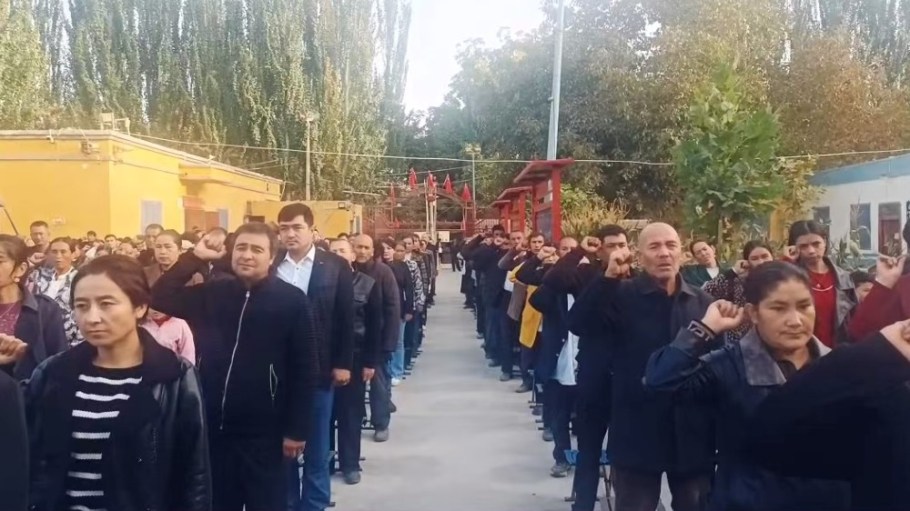
Living and working conditions were poor. Authorities confined workers in squalid, unheated rooms where up to 20 people slept on communal beds that also functioned as food preparation surfaces. The laborers faced ten-hour workdays and mandatory wake times of 5 a.m. Mr. Zhang assessed these living conditions as worse than those of an average Chinese prison. The environment was strictly controlled by accompanying cadres who conducted nightly dormitory inspections to perform headcounts and ensure the absence of religious activities. Explicit prohibitions were imposed on praying and wearing headscarves. Officials mandated weekly flag-raising ceremonies and constant propaganda lectures prohibiting religious expression.
Screenshots provided by Zhang from his village’s government work group confirm that in September 2023, Uyghurs were still being coercively mobilized by the state to pick cotton, directly contradicting Beijing’s repeated claims of a fully mechanized harvest.
The authorities ruthlessly enforced state-mandated work assignments within what Zhang vividly describes as a “pervasive atmosphere of fear.” Refusal to participate in labor transfers was exceptionally rare. When Uyghurs attempted to resist by citing domestic obligations, officials deployed “thought work” (coercive ideological pressure sessions) and explicit threats of detention in re-education camps.
Corporate social responsibility audits often seek evidence of voluntary employment. However, Mr. Zhang’s account outlines the exact, highly structured process of coercion and pressure applied to workers who refuse state labor transfers under the Ma administration. Village committees possess unilateral authority to order residents to accept work assignments regardless of personal preference, making the mobilization inherently compulsory.
Individuals who resist village committee directives face immediate and escalating punitive measures. Non-compliant households experience persistent visits by officials stationed in their homes to pressure them into compliance. Refusal also triggers daily summons to mandatory thought work meetings with the village committee, which can extend until 3 a.m. Additional penalties include mandatory night school for Chinese language instruction and forced assignment to unpaid communal labor.
Zhang confirmed that if residents continue to refuse labor assignments, the state relies on short-term administrative detention to enforce compliance. Following the cessation of pandemic restrictions in early 2023, authorities mandated rotating short-term detentions. Village-level meetings managed detainee selection through retrospective behavioral audits, penalizing individuals for prior non-compliance with state orders, including non-participation in state-organized labor transfers. Detentions last up to 15 days. Detainees are deliberately subjected to poor conditions to compel total submission to government orders.
The evidence presented by this insider account has profound implications for the global apparel sourcing sector. Under Ma Xingrui, the region integrated security mandates with economic governance. State-mandated labor transfers enforce a fundamental disruption of traditional social networks. Through agricultural land expropriation and enforcing wage dependency, the administration makes the dissolution of ethnic communities an enduring structural feature rather than a transient measure.
Mr. Zhang’s testimony, taken together with the broader findings, confirms that the cessation of high-profile internment campaigns did not end forced labor in Xinjiang. Instead, the coercion has become more clandestine and deeply embedded in the region’s administrative governance. The state dictates the employment pathways available to the population, penalizing refusal with detention and administrative harassment. In this environment, obtaining free and informed consent from workers is structurally impossible. Consequently, social audits cannot effectively verify labor conditions in or connected to the region.
For enforcement of the Uyghur Forced Labor Prevention Act (UFLPA), these structural realities validate the necessity of the legislation’s core rebuttable presumption. The recent surge in cross-provincial transfers expands UFLPA compliance risks far beyond Xinjiang’s borders. With one prefecture alone relocating over 20,000 rural laborers to other Chinese provinces, enforcement agencies and corporate auditors face a much greater need to scrutinize manufacturing facilities located in eastern China.
The new insider testimony leaves no credible basis for sourcing from Xinjiang. Apparel brands and supply chain professionals must treat any manufacturing or cotton sourcing tied to Xinjiang’s labor transfer programs as carrying a systemic risk of state-imposed forced labor. Compliance with the UFLPA or the European Union’s upcoming Forced Labour Regulation (EUFLR) requires complete and rigorous decoupling from these supply networks, regardless of where the final product assembly occurs.
Dr. Adrian Zenz is Director of China Studies at the Victims of Communism Memorial Foundation and a member of the European Commission’s Expert Group on Forced Labor. A leading researcher on China’s ethnic policy, his work focuses on mass internment and state-imposed forced labor in Xinjiang. Dr. Zenz’s investigations into coercive labor in Xinjiang’s cotton industry triggered the U.S. import ban for cotton from the region, while his broader documentation of forced labor systems in 2019 prompted the drafting of the Uyghur Forced Labor Prevention Act (UFLPA). He frequently analyzes leaked Chinese government documents and provides expert testimony on forced labor and human rights violations to governments across North America and Europe.