Just over a month ago, the central tenet of the Trump administration’s trade agenda came crashing down. With the Supreme Court’s decision to invalidate the International Emergency Economic Powers Act (IEEPA) tariffs, President Donald Trump lost a critical piece of leverage in his dealings with foreign trade partners.
Or did he? Even before the IEEPA duties met their legal fate, the administration had been teasing its plans to utilize other trade statutes in the event that the scales of the nation’s highest court tipped against it. The resurrection of duties was planned before they were cold in their grave.
Related Stories
But according to Kit Conklin, a former senior advisor to the U.S. House Select Committee on China who now serves as senior vice president of risk and compliance at supply chain AI firm Exiger, the recent investigations launched under Section 301 of the Trade Act of 1974 aren’t just cinderblocks being used to rebuild the administration’s crumbling tariff regime—they address structural issues within the foundation of the U.S. trade landscape.
“The scope of the recent Section 301 [investigations] into all of these countries is a pretty natural policy outcome coming from the Supreme Court ruling on tariffs,” he told Sourcing Journal.
When the IEEPA tariffs dissolved, the administration immediately leveraged Section 122 of the same piece of legislation to impose 10 percent duties on partners across the globe. That law, which deals with balance-of-payments issues, along with Section 232 of the Trade Expansion Act (currently being leveraged to levy duties on steel and aluminum) and Section 301 now make up the three legs of the trade policy stool. “The administration has three core policies that they can rely on—very well grounded, tight, legally constructed arguments that have been around for years,” Conklin said.
Earlier this month, the Office of the U.S. Trade Representative launched two separate Section 301 investigations into more than 60 countries, the first related to structural excess capacity and production in manufacturing sectors, and the second targeting forced labor. While dozens of nations are implicated, China—the sourcing powerhouse most often fingered for overproduction and human rights abuses by the U.S. government—remains a central focus.
Conklin set the stage for these investigations by recapping some of the events last year that led up to them.
“Because of the increased tariff rates in the United States, demand [for goods imported from China] just evaporated. American consumers weren’t going to pay the 50-100 percent tariff rate (depending on what week it was last year),” he said. “What ended up occurring was that over capacity needed to go somewhere—everything from EVs going to Europe to textiles going to Southeast Asia. These economies, globally, absorbed all that over capacity, and maybe they had the ability to consume it domestically, but frequently they didn’t.”
“You then develop this global incentive to take the dumped goods that China is losing money on and send them onward,” Conklin added. Onward to the U.S. through countries that may currently have trade agreements, or at least lower tariff rates than China.
That’s why the bilateral trade agreements brokered in 2025 almost unilaterally contained clauses about transshipment. “There are many different definitions of transshipment, and not all transshipment is illegal,” Conklin said—but a lot of what’s been happening is. “Transshipment could be things like tariff evasion, where you have a product that is made by, for example, a Chinese company, but it’s exported to Mexico and slapped with a made in Mexico sticker” before being sent to a customer in the U.S., he said by way of example.
Running parallel to the concern about creating a backdoor—or dozens of backdoors—for product dumping and tariff evasion is a long-running imperative to keep products made with forced labor out of the American market, Conklin said.
“What’s happened since the [Uyghur Forced Labor Prevention Act] went into force in June of 2022 is that supply chains have become bifurcated or prevaricated in some instances,” he added, noting that any given company could have, in effect, two supply chains—one for products being shipped to the U.S., and another for products destined for other markets.
“One of those supply chains, theoretically, will be free from Uyghur forced labor or the risks as outlined in the Xinjiang supply chain business advisory,” he added. “But all of those other products that are going from China to Indonesia or Malaysia or the [European Union] or Canada or Mexico or the [United Kingdom]—they may or may not have forced labor in them.”
Over the past 24 months, Conklin and Exiger have observed that billions of dollar’s worth of products potentially made with forced labor are pouring into the U.S. through third countries. “The 301s are designed as a policy tool to target some of those supply chains,” he said.
Prior to the launch of the investigations, language addressing forced labor was also being added to trade agreements brokered by the administration last year. However, those clauses have proved largely ineffectual, according to Conklin.
“They all had a stipulation within the trade agreement that those countries would implement a forced labor import ban. And just to be very candid, they didn’t,” he said. “So the administration is now thinking, ‘Since you are reneging on your commitment as part of the bilateral trade deal, we’re going to implement the Section 301 investigations, which are much more comprehensive than bilateral trade deals.’”
The ramp-up in methodology is necessary, Conklin believes, because transshipment—particularly the transshipment of goods made by people under duress or abuse—has escalated.
“It’s much harder to find, because the scale is has evolved, these supply chains have gotten more and more complex, there’s more middlemen and middle-tier suppliers,” he said. “And that’s not just to try to evade the UFLPA, it’s because the Chinese economy has overcapacity. There’s an opportunity for countries to receive those goods that China is dumping and then re-export them into the United States with preferential tariff rates.”
According to the Exiger executive, these developments were not wholly unexpected given the prolific nature of China’s manufacturing sector, which powers the second-largest population in the world. The shift in demand from the U.S.—the biggest overall consumer market— triggered a change in the way that huge volumes of product and cargo were distributed globally.
It’s no surprise, in some ways, that both banned and heavily tariffed products have found a way in.
“There’s always been an appreciation that these types of shifts would happen within global supply chains as a result of certain tariff regimes,” Conklin said. “But what the 301s will enable the administration to do is codify a way to target this type of activity.”
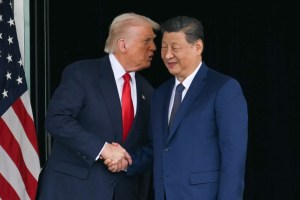
All this being said, with Trump slated to meet with Chinese President Xi Jinping sometime soon (an early April meeting has been postponed due to the war in Iran), Conklin believes the Section 301s are likely to be but a footnote in the conversation.
“The [investigations] will be one aspect of a larger trade agenda. I would expect the administration to focus on things that were originally agreed to in South Korea,” when the heads of state met last October, he said. “Has China kept up with its commitment to purchase U.S.-grown soybeans?” is a question the president will ask, for example.
“It’s kind of like a détente right now,” Conklin said. “I would expect to see more of an emphasis on whether what was previously agreed upon actually happened, versus launching into questions or contentiousness on super wonky things like 301s.”