
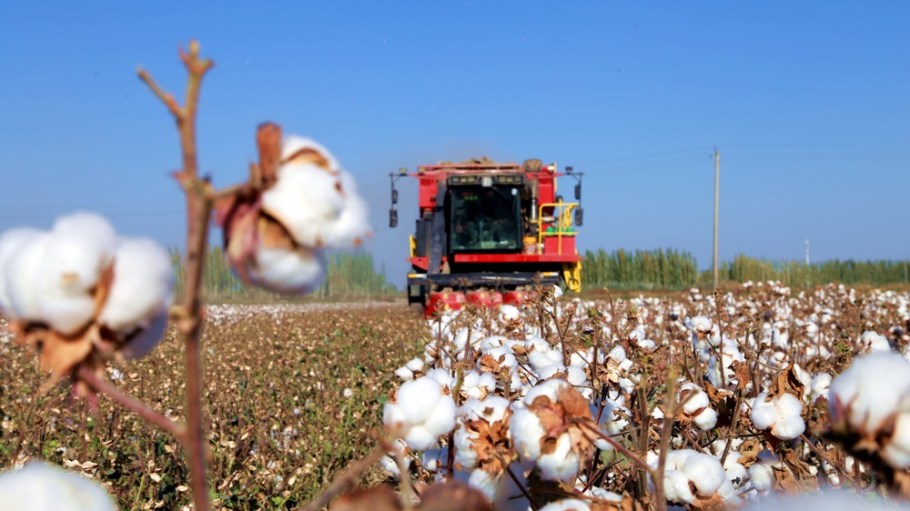
Chinese officials claimed last week that Xinjiang’s textile industry added tens of thousands of jobs last year, an upbeat assertion that sidesteps sweeping U.S. sanctions that have forced fashion brands to purge their supply chains of the region’s cotton or risk shipment seizures that could jeopardize time-sensitive inventories.
That’s a contradiction that lies at the heart of the Xinjiang‑cotton question. The same fiber that the broader industry is scrambling to disown is also winding deeper, tighter—and, indeed, faster—into the Chinese economy.
Related Stories
Speaking at a Xinjiang delegation meeting during China’s annual “two sessions,” Wang Kuiran, secretary general of the northwestern province’s government, said Xinjiang’s yarn output rose more than 20 percent in 2025, fabric production climbed 36 percent and 46,800 new jobs were created, in defiance of what he called “political manipulation and economic bullying” couched as human rights concerns.
While the outset of restrictions such as the Uyghur Forced Labor Prevention Act, signed into law by former President Joe Biden in 2021, caused initial shipping disruptions and job losses, Wang said Xinjiang has since recovered from what he described as “unreasonable suppression” by Western nations, including proposed measures from Australia, Canada and the European Union—the last of which recently concluded a call for evidence to help prepare guidelines.
“Our development has never depended on anyone’s charity, and we are not afraid of unfair pressure,” he said. “This spirit, deeply rooted in the Chinese people’s history, has helped build a resilience that makes us stronger under pressure.”
Scrutiny of Chinese cotton—more than 92 percent of which hails from Xinjiang—has intensified over recent years following credible reports of Beijing’s persecution of Uyghurs and other Muslim minorities through arbitrary detentions, forced separations, involuntary sterilization, forced labor and other human rights violations that the United Nations says could amount to crimes against humanity. Forced transfers of Uyghurs from Xinjiang to factories and other workplaces across China in the name of “poverty alleviation” and “vocational training” have also escalated.
It’s in this light that Adrian Zenz, a senior fellow in China studies at the Victims of Communism Memorial Foundation, a Washington think tank, views Xinjiang’s apparent bounce-back. For him, Wang’s figures align with signs he has observed of regional authorities “systematically accelerating forced labor transfers to maximize the Uyghur region’s share of economic output and exports.”
“The region has continued to subsidize labor-intensive industries, including the processing of cotton and garment-making,” he told Sourcing Journal. “The primary motive of these efforts is to demonstrate to both domestic and especially foreign constituencies that Beijing’s policies in the region are a resounding success.”
The Chinese government has struck back at the West with countermeasures such as the Foreign Relations Law, the Anti‑Foreign Sanctions Law, the Provisions on the Application of the Anti‑Foreign Sanctions Law and the Provisions on the Unreliable Entity List, all designed to target entities that comply with Xinjiang import bans and other restrictions.
A government white paper released in September said Xinjiang’s regional legislature had passed a resolution rejecting U.S. sanctions and backing the growth of blacklisted enterprises and related industries. It added that authorities were offering legal aid and other support to sanctioned firms, helping shore up affected sectors and creating new jobs for those affected by the trade curbs.
Wang said investment across the textile sector jumped 35 percent. The “value‑added output” of large‑scale industrial firms with annual revenue of 20 million yuan ($2.9 million) or more similarly climbed nearly 24 percent.
Critics will find it hard to square Wang’s optimistic picture with reality. Chinese academics have argued, for instance, that the UFLPA and similar measures have squeezed profits for Chinese firms in the short term while imposing broader economic damage on China over the longer haul. In 2025, U.S. Customs and Border Protection denied entry to apparel, footwear and textile shipments worth $55.6 million under the UFLPA. Yet Chinese cotton’s dominance—roughly 20 percent of global supply—makes full divestment difficult, if not impossible.
Sheng Lu, professor of fashion and apparel studies at the University of Delaware, also noted that despite gains in Xinjiang’s cotton output, China remains one of the world’s largest importers, according to a December 2025 U.S. Department of Agriculture report that pegged its 2025/26 import demand at 1.25 million metric tons. In another sign of the “decoupling” of U.S.–China trade ties, U.S. cotton exports to China plummeted 83 percent in 2024/25 as Chinese mills turned to suppliers in Australia and Brazil. U.S. cotton apparel imports from China also fell 33 percent in 2025, driving China’s market share below 8 percent for the first time in decades.
“It can be expected that the lasting impacts of UFLPA and concerns about the future of U.S.-China bilateral relations will continue to negatively affect bilateral trade flows,” Lu told Sourcing Journal. “Meanwhile, we might see different cotton apparel supply chains emerging, not necessarily to improve efficiency but largely to meet the regulatory and compliance requirements.”
At the same time, China is working to move cotton faster across its own territory. In January, China Railway Urumqi Group launched the country’s first express freight train service for cotton. Operating at 120 kilometers per hour, the train carried 1,395 metric tons of the fiber on its inaugural run from Aksu in Xinjiang to Binzhou in Shandong, slashing transit time from 15 days to three.
“That was designed specifically to move cotton faster from the production regions into the eastern textile hubs,” Gemma Lynch, chief customer officer at supply chain forensic platform Oritain, told attendees at the American Apparel & Footwear Association Executive Summit in Washington, D.C., last week. “And obviously that’s really important for all of us in the room because faster logistics compresses the window for visibility and verification.”
When cotton can move from origin to textile hub in a matter of days, she said, supply chains become even more dynamic—and pinpointing verboten material more difficult. Isotopic testing, a method favored by U.S. Customs and Border Protection for its accuracy, is a lengthy, laborious process. Rushing cotton through the system throws up new challenges, leaving brands and retailers more exposed.
“It becomes harder to rely on the slower, document‑only checks,” Lynch said. “Combine that concentration—the large share of global cotton coming from a single system—with the speed it’s moving through even faster, and the bar for confidence really starts to rise. And that’s exactly where independent material level verification becomes absolutely critical.”


