
PARIS — Change was in the air at the Eurovet-operated Salon International de la Lingerie and Interfiliére trade fairs here.
Underscoring a mood of transition were several major factors: an upcoming change in show management, angst over the growing competition with Asian companies, and gauging the impact of the first Shanghai Mode Lingerie show staged in October and its potential effect on the European sector, particularly textile and lace concerns.
There was also a lot of talk among exhibitors regarding a three-day venue instead of a traditional four-day format at the Interfiliére textile fair that closed Feb. 4. Another change was the scheduling of the four-day lingerie fair that ran through Feb. 5 — held a week earlier than usual to accommodate travel budgets and retailers who also attended other trade shows, including home accessories and men’s wear. The new show itinerary included moving up the opening day to a Thursday instead of a Friday, which a number of visitors found confusing.
But logistics and transportation problems were the key complaints of retailers at the show, where taxis generally refused to pick up people in front of the Porte de Versailles exhibition center because of traffic bottlenecks created by construction work. In some cases, the transportation dilemma forced merchants to leave the show early in the day or not return for another day.
“This is really ridiculous,” said Patricia Cork, owner of specialty boutique Ceduxion Lingerie in the Canary Islands. “I’ve been waiting for a taxi for two hours. It’s freezing and it’s beginning to snow.”
Steve Chernoff, chief executive officer of Rago, a Queens, N.Y., shapewear maker, said, “The traffic and taxi situation with all of that construction on the streets has created such problems getting in and out of here that everybody is complaining, and some people have missed appointments because of it.”
Longtime general director of the fair Jehan Quettier said he would retire in July. He noted, though, that he would continue as an industry consultant and a member of the board of the trade-show organization. Quettier will be succeeded by Marie-Laure Bellon-Homps, who is associate general director.
“I’m planning another salon in the future; however, it will be in a different line of business,” said Quettier, a 30-year veteran of the trade-show circuit who began his career with industry organization La Federation de la Maille.
Related Articles
You May Also Like
He later turned the Paris salon and its sister edition Lyon, Mode City, held in Lyon, France, into a melting pot of global resources. Quettier would not say what kind of business enterprise he plans to create.
In overall attendance, the lingerie fair, which featured fall and winter looks, registered a decline of 5.1 percent to 22,784 visitors, compared with a year ago, off 2 percent in the international arena and 8 percent by French attendees. The Interfiliére, which showcased fabrics for spring-summer 2007, reflected the biggest drop of 9.2 percent, with 14,778 visitors, versus 2005, while turnout from the global sector was down 7 percent, and from the French, 12 percent, show officials said.
“Though there was a slight decrease in volume, we are satisfied with these figures because the atmosphere of the show was very much business-oriented, and our exhibitors were happy with their business volumes and contacts during the show,” said Anne-Manuele Hebert, international director.
Meanwhile, business was brisk at a number of exhibitor stands, including Aubade, Lou, Chantelle, Millesia and Naked Madonna, where champagne flowed, and mini runway shows with scantily clad models and blaring disco music drew throngs of bystanders. The Natori Co., which returned to the salon after a 10-year hiatus, also drew a lot of traffic with three sleepwear and at-homewear collections: Natori, Josie and Josie Natori.
“For our return, I couldn’t be more ecstatic about the reception we received from our old clientele from eight different countries, and, obviously, from new clients,” said ceo Josie Natori. “It was interesting and surprising that price was not an issue, especially with the Josie Natori collection, which accounted for 60 to 70 percent of orders. And prices are 40 percent higher in Europe. But I think people saw the value of the workmanship and the colors.
“There was a real increase in Asian vendors in the Interfiliére,” she said. “But even though the Interfiliére was smaller, I felt the exhibitors were anxious to work.”
The growing presence of Asian textile resources and the Shanghai Mode Lingerie show were hot topics. The second Shanghai edition is scheduled for Oct. 23-24.
One vice president of sourcing at a large U.S. firm, who did not want to be named, said, “Paris is a sales show from the front end, but when you think of the Interfiliére, it’s really happening in Asia. Lyon is a half-way point between Europe and Asia. It will be interesting to watch. Maybe it will split up and the Interfiliére will go to Asia, while lingerie stays in France. For intimates, Paris and Lyon have always been important.”
But the action at the salon wasn’t just in the aisles and stands.
There was a crowd at the huge Invista stand, where retailers and suppliers sipped espresso and discussed Invista’s newest launch: Super White Lycra.
The new fiber has been developed to address the aesthetic and functional demands of consumers for undergarments that stay white with a “like new” appearance, even after repeated washings, said Gilberto M. Stocche, marketing director for North America. He added that Super White Lycra is heat resistant, can be applied in the molding of bras and can take as many as 50 washings without losing its initial whiteness, which has a “much brighter” hue.
“After the first, second and third washes, it even gets better,” said Stocche. “The timing was right to launch Super White Lycra at the Paris salon because we didn’t want to do too many stories at one show and it can become confusing. We did the bikini anniversary at the Lyon show [in September], and launched Black Lycra a year ago, which was a great success.”
The lounge for lingerie buyers and the media was packed. It was a black surreal setting perched above the cavernous exhibition halls that had a quirky Dali-meets-Alice-in-Wonderland ambience. The area, which could be located by nonstop rave music, featured ornate 19th-century red and blue satin banquettes, contemporary white Mondrian-looking fake leather chairs, elaborate gold frames on walls with no paintings or mirrors, and a huge crystal chandelier suspended a few inches above black carpeting.
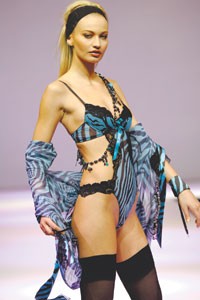
The runway shows, which were staged three times a day next to the lounge, featured a General Fashion Show that highlighted an international selection of brands, a Défile Special Italie for Italian exhibitors, and the Ultra Show, an evening runway event that featured Swarovski-encrusted lingerie. The fashion show culminated with an award ceremony called Trophées de l’Ultra Lingerie, in which brands and designers, as well as textile companies, were awarded prizes for imagination, extravagance and best-executed design. The winners included Jolidon’s silver and black bustier and bikini rendered in fabrics and trims by Sophie Hallette and Swarovski for the Prix de l’Audace Matiere, Lejaby’s embellished black-lace corset created with fabrics by Anya Paris and Sophie Hallette called the Prix l’Extravagance, and the Coup de Coeur du Jury award that went to young designer Elise Anderegg. Her Twenties-inspired beige gossamer slipdress was created with fabrics by Hallette and Paris.
More than 800 guests attended the Ultra Show, as well as a champagne reception. But exiting the event was an issue. Guests were told by security they could not leave by foot and were escorted to the entrance in four golf carts, each of which sat five passengers. By the time people started arriving at the entrance, the coat-check area had closed and many were left coatless. A coat-check employee who did not want to be named said the next day, “The coats were moved to an office, but nobody told the people.”
Iris De Melo, co-designer of a vintage-inspired collection called Le Trousseau de Margaux, said, “I wasn’t even allowed to go back to my stand to pick up my samples. They also closed the toilettes after seven o’clock.” The Ultra affair continued after 9 p.m.
Regarding product and how retailers viewed the show, Mary Krug, vice president and divisional merchandise manager of intimate apparel and hosiery at Neiman Marcus, summed it up this way: “It was rather a quiet show, but we found some nice things.”
Alexander Federov, president of Russia-based Wild Orchid Inc., which operates 110 Wild Orchid shops and 64 boutiques called Bustier, said he was at the salon to buy brands, as well as make contacts with contractors, suppliers and distributors.
“I think the show was fantastic,” Federov said. “I’m thinking of integrating a vertical and retail operation in the future with creatives and production.”
Federov’s company, which generates retail sales of $70 million annually, includes three lingerie liquidation stores called Lingerie Bazaar and two men’s innerwear stores called VI Legion that opened in Moscow in January with first-month sales of $100,000. The company’s yearly advertising budget is $10 million and includes placement in Russian Vogue, he said.
Cindy Johnson, co-owner of Sol, a lingerie boutique in Denver, said she was “very pleased” with the assortment of fashion product at exhibitors’ stands and runway shows.
“Jolidon had a lot of beautiful things in the trend [runway] show and we are starting to do well with Aubade, which we bought again,” said Johnson. “We were very pleased with our Chantelle appointment as far as bras go for an American consumer. We liked the changes, like T-shirt bras in fuller sizes and panties and thongs that fit better.”
Johnson’s partner, Jeanie Peterson, said, “The fashion shows and trends were a step above last year. They put much more time into it, and you could see that.”
Sammy Sasso, owner of Sasso Records, Miami, said he attended the Paris salon because he believed it was an “extremely important” venue to buy lingerie for the first Sasso lingerie boutique. The store is slated to open in July in Miami.
“Young females, urban or suburban, typically are the best consumers of music,” said Sasso. “And lingerie is a very important category for that customer.”
He added that he plans to open five lingerie boutiques in 2006, and has budgeted a multimillion-dollar advertising and marketing campaign that links music with lingerie.