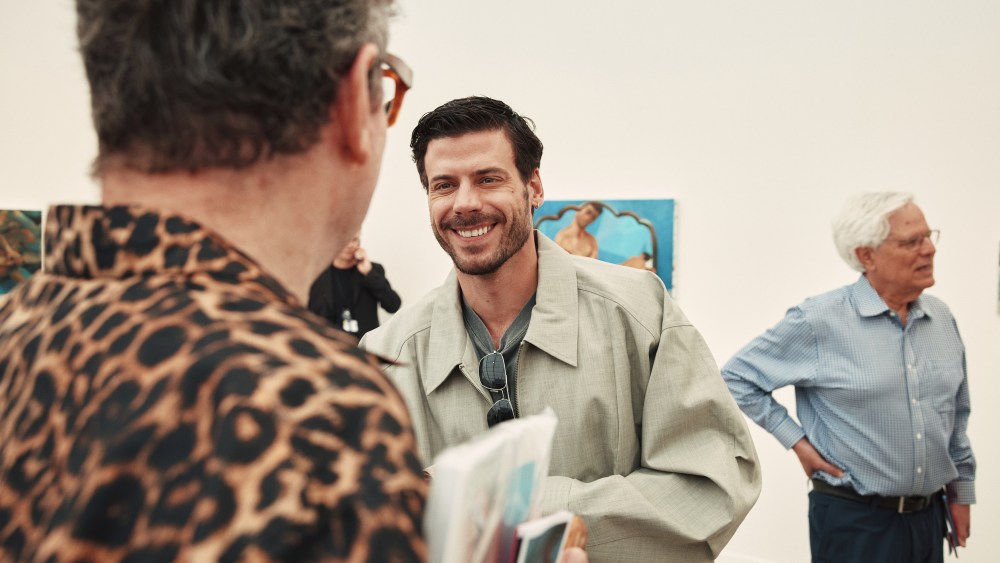
A year after the Los Angeles fires cast a somber tone over the city’s cultural calendar, Frieze Los Angeles opened under clear light and with a noticeably steadier pulse.
The seventh edition of the fair, held again at Santa Monica Airport, gathered more than 100 galleries from 24 countries and welcomed about 32,000 visitors from more than 45 nations from Thursday to Sunday. It drew a mix of collectors, curators, designers and figures from entertainment, including Chris Rock, Rami Malek, Emma Watson, François Arnaud, Jeremy O. Harris, Andre 3000, Kelly Wearstler and Jason Wu, as well as visual artists Doug Aitken, Jonas Wood and Mary Weatherford.
Related Articles

“Collectors engaged with conviction across every section of the fair,” said Christine Messineo, Frieze’s director of the Americas, expressing optimism about the turnout.
You May Also Like
Representatives from 160 museums and institutions circulated the tent and surrounding campus, which extended beyond the commercial booths to include public-facing works like Amanda Ross-Ho’s “Untitled Orbit (Manual Mode).” The specially commissioned performance, visible upon arrival on the adjacent soccer fields, featured the L.A. artist pushing a giant inflatable globe across the grass during the fair’s opening hours.
While conversations in the aisles often turned toward recovery and resilience a year ago, this year the mood shifted toward renewal, reflected in broad engagement and solid sales: David Zwirner sold a mixed-media work by Njideka Akunyili Crosby for $2.8 million and a painting by Lynette Yiadom-Boakye for $1.5 million; White Cube placed three large-scale Antony Gormley sculptures in the 500,000 to 800,000 pound range, and Pace sold James Turrell’s 2021 installation “Carat and Schtik” for $950,000.
Much of the energy gathered around Focus, the section curated by Essence Harden that gives younger galleries and emerging voices a platform on a global stage. For many, Focus has become a barometer of appetite for new work and ideas.
Among them, Hannah Traore Gallery sold out its presentation of paintings by Turiya Adkins, with prices ranging from $5,000 to $11,000. Adkins, who lives and works in Brooklyn, creates layered, figurative compositions that draw on archival research, mythology and speculative cosmology. The works on view marked what she described as a conceptual pivot.
“These works are a departure from my last series, which was about the myths of flying Africans,” she said. “These works are an exploration of the Black Cosmos, so inspired by the Zambian space program and Sun Ra’s Astro Black mythology.” Her reference to Sun Ra nods to the experimental jazz musician’s Afrofuturist philosophy, which imagined outer space as a site of Black liberation and myth-making.
Adkins’ practice unfolds slowly, grounded in research. “I think for a long time, marinating before making the work,” she said. She refers to the paintings as “my Afrofuture myths,” a variation on Afrofuturist narratives.
Having attended the New York edition of Frieze, she noted that L.A. carries “a different energy, a bit lighter energy.” She added, “It’s the airiness of being in L.A., I feel like people’s sensibilities are just a little bit less intense in ways.”
The fair’s physical setting, sunlight filtering through the tent, shaped the experience for artists as well.
“The light here is amazing,” said Loriel Beltrán.
Born in Caracas, Venezuela, and now based in Miami, Beltrán presented new work with Lehmann Maupin that combined luminous fields of color with discarded materials from his studio.
“This work has a couple different ideas,” Beltrán said of “Foam Lexicon” (2025), made of latex paint, styrofoam and plastics on panel. He has been working with complementary colors that “optically blend and create a neutral,” producing what he describes as an “atmospheric effect.”
Beneath that optical harmony, however, the work grapples with pollution and the material consequences of consumption.
“A lot of the white things that you see in the work are the foam cups from the coffee that we drink at the studio,” he explained.
“There’s also thinking of all the things that we’re breathing, the microplastics,” he went on. “It’s like, we’re internalizing the pollution.”
Historically, pigments were traded commodities, he said, while today many derive from fossil fuels. He described the work as “geological, biological and linguistic,” an attempt to give structure to forces that are otherwise intangible.
Beltrán spoke of L.A. as both expansive and disorienting.
“It’s a very nice place,” he said. “It’s also a weird place. It’s a huge city, but it looks very suburban.” Each visit, he added, “takes me a moment to adjust.”
A few aisles away, L.A. artist Sharif Farrag’s presentation at Jeffrey Deitch offered a different kind of material language, one rooted in autobiography and place. Farrag works primarily in ceramics, blending traditional techniques with a distinctly personal iconography shaped by his Syrian-Egyptian-American identity.
At Frieze, he presented an array of works, including sculptural automobiles. One, a white Range Rover, evoked “the West Side Beverly Hills kind of vibe,” he said, while another, a “burger buggy,” nodded to downtown L.A., where his studio is located. The vehicles functioned as cultural markers, playful reflections on geography and class within the city.
Interspersed among them were vessel-based works, a form he has developed over several years.
“They’re something I use as a diary,” he said.
Made regularly, “every couple weeks,” the ceramics serve as intimate records — and were acquired by the Mohn Art Collective (MAC3), a joint initiative between the Hammer Museum, the Los Angeles County Museum of Art and the Museum of Contemporary Art, alongside works by Clarissa Tossin and Zenobia Lee.
“Whatever is in my life,” said Farrag, “I just throw in there.”