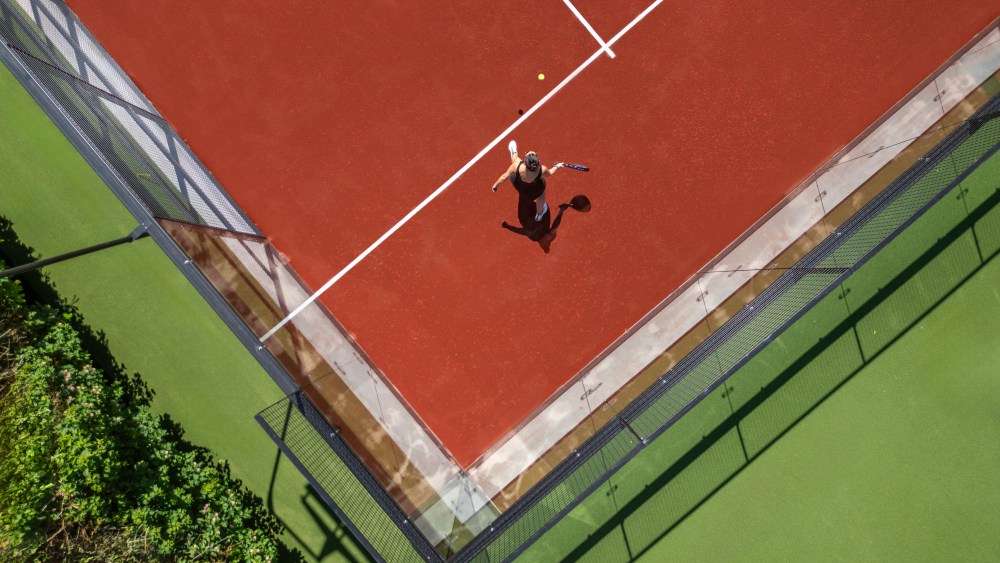
Under the bright desert sun at the Parker Palm Springs, players move quickly across the court, trading shots inside glass walls. Around them, spectators stand with cocktails, some watching the points, others talking over the music.
This is padel, equal parts competition and socialization. Often compared to pickleball, padel is viewed by its players as more physical and engaging.
“Pickleball is a game. Padel is a sport,” smiles Pedro Alonso-Martínez, a padel professional originally from Spain and based in Miami.
Related Articles
He’s in Palm Springs for the luxury hotel’s inaugural Pro-Am weekend, cohosted by Los Angeles-based club Padel Up and agency Fora Travel, and timed to the BNP Paribas Open in March, where professional and amateur players are gathering for matches, clinics and social events centered around the Parker’s newly unveiled courts.
You May Also Like
“Padel has a lot of different components that make it super attractive right now,” Alonso-Martínez notes. “It’s dynamic, it’s social, and from the first day you can play and enjoy it.”

“There’s almost a voyeurism to the sport,” says Andre Brown, cofounder of Padel Up. “You have people right up against the glass, music playing. It’s not like tennis.”
Padel Up is one of a small but growing number of spaces shaping the sport’s early footprint in L.A. The company runs courts at Westfield Century City and an indoor facility in Culver City, part of a broader effort to introduce padel into high-traffic, lifestyle-driven environments rather than traditional club settings.
Originating in Mexico in the late 1960s, padel later took hold in Argentina and Spain, where it became widely played, and is reportedly one of the fastest-growing sports globally, with about 30 million players across more than 100 countries.
In L.A., until recently, much of the sport’s presence was concentrated in private residences, where courts were built into backyards and estates, forming small, invitation-only networks of players.
Now, momentum is building. New facilities are opening across the area, from Sherman Oaks to Carson and San Pedro, while the Los Angeles Padel Club is preparing to debut a clubhouse in Culver City, housed in a restored Hollywood-era mansion by founders and husband-wife duo Steve and Jennifer Shpilsky. There’s also a pro padel league in the city: Los Angeles Beat.
“Learning the glass is something people pick up quickly,” says Caerwyn Evans of Wyn Padel, which runs programming at the Parker, referring to the way the ball can rebound off the court’s glass walls and stay in play. “You don’t need years of training to enjoy it.”
Part of the appeal is structural. It’s played in doubles on a smaller court, which keeps players and spectators in close proximity, often extending into drinks, dinners and informal networking. In some circles, that dynamic carries real stakes. Private matches and organized tournaments can include entry fees that build prize pools, with side bets placed around the court.
“It’s like the new golf in terms of networking,” says Alonso-Martínez.
On the sidelines at the Pro-Am, drinks circulate, including pours from Nosotros Tequila & Mezcal. Its cofounder, Carlos Soto, is among the players, paired with a pro. Teams pay $3,000 to enter, with a $10,000 prize for first place.
“You play, and then you sit down, have a drink and keep the conversation going,” says Soto, based in L.A. “That social side is really what makes it different.”
The blend of sport and social activity is increasingly being taken up by hospitality players. At the Parker, padel is positioned for the long term, with two of its red clay tennis courts converted into padel courts.
“Our guests are sophisticated. They’re interested in lifestyles and that includes sports,” says Kelly Teo, the hotel’s director of commercial strategy. “We weren’t just looking to capture the moment, but to build something with longevity. We see this as a long game.”
The goal of the weekend, Teo says, was “visibility and awareness,” with an eye toward building an annual event that merges sport, design and social programming.
In L.A., where athleisure is ingrained, fashion is extending into racquet sports. Brands including Sporty & Rich and Year of Ours are designing with that sensibility in mind, with pieces that move easily between performance wear and everyday dress. For now, the look is relatively simple: pleated skirts, fitted tanks and clean, athletic staples.
The interest is seen in larger collaborations and broader industry investment. Reebok recently partnered with Gldn Pnt on a collection designed specifically for padel, while Wilson Sporting Goods, which expanded its investment in 2019, is positioning the category as a long-term area of growth.
“Padel has a longer runway and is a significant growth opportunity for our brand,” says Jason Collins of Wilson Sporting Goods, the company’s global general manager of racquet sports, pointing to investments across both equipment and apparel. “We are investing in product innovation and partnerships at the highest levels of the game.”
Wilson’s involvement includes partnerships with top padel athletes like Fernando Belasteguín — known as Bela, who played at the Parker event — and the Premier Padel tour.
“That allows us to gather insights from the best in the game and equip athletes with everything they need to succeed,” Collins explains.
Europe remains the largest market for Wilson’s padel business, followed by Latin America, with the United States a key area of focus.
Across the Pro-Am event, there was a shared expectation that the sport will continue to expand Stateside.
“It’s still early in the U.S., but it’s growing quickly,” Evans says. “Once people try it, they tend to stick with it.”