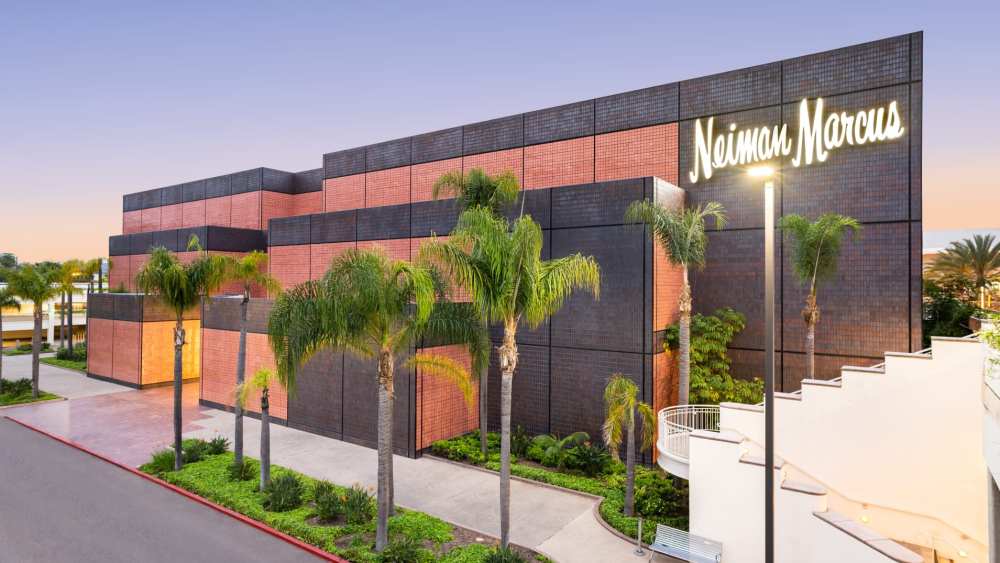
Neiman Marcus Group’s topline turned negative last quarter but the luxury retailer continued to gain ground on its long-term transformation strategy.
That assessment came from NMG’s chief executive officer Geoffroy van Raemdonck during a wide-ranging interview on recent results, Neiman’s sharpening focus on its top-selling designer labels and efforts to lavish greater service and luxury on its biggest spending shoppers.
“We are successfully transforming our business into a relationship business with luxury brands and our luxury customers. If you look at where we were pre-COVID-19 and where we are today, there’s significant growth we’ve derived with our best customers and with the most desirable luxury brands,” van Raemdonck said.
Related Articles
Among the financial results for NMG’s fiscal fourth quarter and year ended July 29, disclosed to WWD:
You May Also Like
- Sales in fourth-quarter 2023 were midsingle-digit negative compared to the year-ago quarter, but were less negative than third quarter 2023.
- Business in fiscal year 2023 was “relatively flat” compared to FY22.
- Revenue in fourth quarter 2023 compared to the 2019 period was up double digits.
- Liquidity at $1 billion for fiscal 2023 was “stable” to the year prior.
- Business with top customers, those spending on average about $25,000 at NMG, rose nearly 20 percent last quarter against the 2019 quarter.
- Inventories were “relatively flat” for fiscal 2023, compared to a year ago, or slightly down when adjusting for earlier fall receipts.
No profit figures were provided. NMG generated about $5 billion in gross merchandise value last year. Bestselling categories were shoes, handbags and women’s ready-to-wear. Some top designer labels at NMG include Chanel, Dior, Gucci, Brunello Cucinelli, Christian Louboutin and Louis Vuitton. Revenue for fiscal 2023 compared to fiscal 2019 was up double digits.
Explaining last quarter’s shortfall, van Raemdonck said, “In the spring and in the fourth quarter we faced pent-up demand from the year before where post-COVID-19 customers really came and bought items that they had not bought for two years. So the comps were midsingle-digit negative. That was aligned with our expectations, because we really knew we were up against a big comp. Around October 2022, we saw that normalization happen. But we’ve been stable and consistently double digits ahead, almost month-to-month, really a straight line, from October 2022 to July 2023, compared to 2019.”
Van Raemdonck also said that the company in its last fiscal year put less emphasis on the segments that were more promotional, and that business was softest with aspirational customers, those inclined to shop the products priced at the lower end of the price spectrum at Neiman’s.

He also said that during the last two years, Neiman’s added 800 points of distribution with designers. A designer adding footwear to a single Neiman’s store would count as a point of distribution. A second point of distribution could be that same designer adding fragrance to a particular Neiman’s location. Certain brands and designers have been reducing wholesale distribution to retailers in favor of the internet or their own stores.
“We have seen some brand partners pull away from distribution,” van Raemdonck acknowledged, though he also indicated that last year nearly 200 new and emerging brands were added to the assortment.
Regarding liquidity, at $1 billion, van Raemdonck said, “It’s very stable. We continue to have very strong liquidity and that’s why we continue to make significant investment in the supply chain. We completed two new distribution centers.” Additionally, store remodels were completed in St. Louis, Atlanta and San Diego, and seven more stores will undergo renovations through 2025. The company allocated $300 million for store renovations, new technology and enhancing the supply chain.
Van Raemdonck observed that business started softening in the second half of October 2022. “From then onward, the number is stable. What happened was the more aspirational customer suffered more, and we gained more with the best customers,” shopping higher-priced products. “So the net-net was a double-digit gain, compared to 2019.
“But we have seen a real softening with the aspirational customer, and increased promotionality to drive business with that customer. Aspirational customers are those with lower incomes and less engagement with Neiman Marcus than luxury customers. And we look at price points. We have been suffering more with the entry price points rather than the higher price points within a category.
“That slowdown went deeper or faster than we thought it would, so we went through the year with more inventory than we wanted,” the CEO noted. “We had said to our investors that at the end of the third quarter we were going to clear inventory in the fourth, and so there was pressure on margin in the fourth quarter and pressure on profitability. Now the outcome of that is that we finished the year, relatively flat [with inventory] to the prior year and slightly negative taking into account the timing of new goods coming in. We are slightly negative to the prior year once you remove the new shipments because we got some of that earlier. We are quite clean when it comes to inventory, and that is a good position to go into this year. But those markdowns combined with increased promotion in the industry put pressure on our profitability in the fourth quarter, and we landed exactly where we thought we would be.”
According to van Raemdonck, 2 percent of Neiman’s customers drive about 40 percent of the volume, and there’s a 90 percent retention rate among top customers — those that spend more than $25,000 annually. Van Raemdonck wouldn’t say how many customers Neiman’s considers as top spenders.
NMG, which let go hundreds of workers this year to cut costs, has a total of about 10,000 employees.
With the luxury transformation, merchants have strengthened their focus on “buying for the audience that engages the most with us.…We’ve adjusted the inventory to meet the demand of the audience that we want,” van Raemdonck said. To that end, NMG merchants are being given greater access to customer data and insights and directed to utilize the information in determining their buys to a greater degree than in the past.
“We’ve built flexibility in our inventory as well, by keeping it ‘open-to buy.’ It is a volatile environment out there,” van Raemdonck said. “We continue to see promotionallity in the marketplace, but we feel well positioned from an inventory standpoint.”
Van Raemdonck said 90 percent of NMG’s best designer partners over the last year provided exclusives in one form or another. “That can be a capsule collection, an activation, a lounge and all of the above. They’re definitely leaning more into doing things with us that are special for our customers. With some of the activations we have we can do a six-, seven-figure [sales] number in one day. And we can pre-sell a lot of that or we can sell a lot of it to customers who are not where the activation is taking place.”
He said that, as of late, e-commerce websites have been far more promotional than retail stores, which makes NMG’s in-store activations and events, as well as personal shopping appointments, all the more important currently.
“We constantly need to be agile. We are seeing change in dynamic and volatility more than ever, and that’s the muscle we developed during our financial restructuring,” van Raemdonck said, referring to NMG’s bankruptcy in 2020. The company emerged from bankruptcy the same year with new owners and without the $4 billion in debt and $200 million to $300 million in annual interest payments that hampered the business for many years. NMG is owned by Pacific Investment Management Company, Davidson Kempner Capital and Sixth Street.