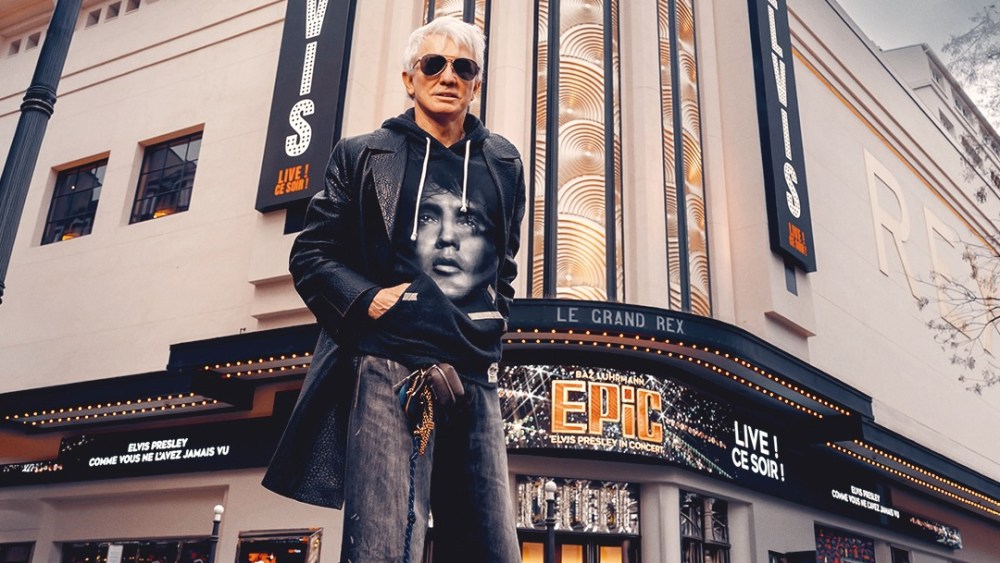
Inside the Palais des Festivals at the premiere of Baz Luhrmann’s “Elvis,” executives from Authentic Brands Group found themselves watching their own intellectual property unspool on the screen.
“We were guests. We were not really involved meaningfully from a producer standpoint, from a creative standpoint, and this was our IP,” said Authentic Studios president Colin Smeeton.
They had licensed the rights to the Elvis IP to Warner Bros. eight years earlier.
Related Articles
As the lights went down in the theater, it was a lightbulb moment for the team. “[We realized] that this was something that we needed to look at internally, that we should be developing these projects and coproducing or producing these projects with other people around our IP. We can no longer just give someone the option of the license,” said Smeeton.
You May Also Like
That realization would lead to the launch of Authentic Studios in 2023 — and with it, a new model for how fashion and lifestyle brands can operate as content creators.
Founded by Jamie Salter in 2010, Authentic Brands Group has focused on an “asset-light” model of brand development, marketing and licensing while outsourcing manufacturing and distribution. It’s the second-largest licensing business globally, behind Disney.
But licensing ceded control over how those brands were portrayed, Smeeton said, and with a wealth of heritage and celebrity-backed brands — including Champion, Reebok, Quiksilver, Nautica, Volcom, Billabong, Aeropostale, Forever 21, Juicy Couture, Sperry, Ted Baker and Brooks Brothers, not to mention Shaquille O’Neal, David Beckham and the rights to the estates of Marilyn Monroe and Elvis — the team realized Authentic could move beyond being a passive partner.
The studio brought together multiple production arms under the Authentic Studios umbrella, including Shaquille O’Neal’s Jersey Legends, David Beckham’s Studio 99, Sports Illustrated Studios and an in-house production unit focused on owned IP.
Now they mine the company’s own brand portfolio for stories. “We don’t need to produce anything for anybody else,” said Smeeton. “We have enough, inside of our four walls. Ultimately we own these brands, so if there is a story to be told that will be compelling, and if it does well, it will have a positive impact on the business.”

The approach reframes their brands not as properties to lease out, but positions each as having the potential to generate films, series, documentaries, digital and short-form content — and long-term brand awareness.
Following the Elvis movie, the studio partnered with Luhrmann on the “EPiC: Elvis Presley in Concert” film, which took in almost $30 million at the box office, and went on to produce the Netflix series “Power Moves” centered on O’Neal taking over the helm of Reebok’s basketball division as president, with Allen Iverson serving as vice president.
Next up is the scripted Muhammad Ali series “The Greatest,” executive-produced by Michael B. Jordan for Amazon, which is due out in the fall. Also in the pipeline are projects built around surf brand Quiksilver, as well as the legendary department store Barneys New York.
Authentic shuttered Barneys’ brick-and-mortar stores after it acquired the bankrupt retailer in 2019, but the brand name remained. Now the studio is developing a drama for Amazon, set against the store’s opening in the 1990s, with “Gossip Girl” creators Josh Schwartz and Stephanie Savage at the helm.
The untitled drama is “a great opportunity to bring that brand back into the zeitgeist with incredible creators,” said Smeeton.
No coincidence then that Authentic Brands Group is reported to be ready to reboot Barneys retail with a small-format store in Florida, as well as reviving its original Madison Avenue flagship.
“It has to be led by story. It can’t just be a commercial. It’s got to be creative content. It’s got to be story first,” said Smeeton. “But if we do our job right, and there is a compelling story there, you know the brand will get the lift.”
Case in point is the 2023 David Beckham documentary “Beckham.”
While Smeeton declined to share specific numbers, the impact of the Netflix series was measurable. “The tail after his documentary was incredibly significant,” he said. Overall, “we are seeing lift in the brands from a revenue standpoint.”
O’Neal’s “Power Moves” series helped reposition Reebok within the athletic market. It hit Netflix’s top 10 in 42 countries and supported the brand’s return to basketball, including signing new partnership deals with key players.
At the core of the strategy is what Smeeton describes as a “flywheel,” linking storytelling directly to business performance.
Importantly, he noted, the ROI is not always immediate or purely transactional.
“There are some benefits that are just great for the property itself from a marketing and branding standpoint. Not all content is going to directly drive sales, but ultimately it is good for the brand.”
A compelling piece of content — which can range from short-form YouTube or social media videos to large-scale productions — drives cultural relevance; that relevance translates into brand heat, and that, in turn, fuels retail performance.
“We think that content, ultimately, is driving commerce,” he said.
For fashion brands in the portfolio, the opportunity lies in unlocking decades, or sometimes centuries, of history. Labels like Brooks Brothers, Champion and Barneys can become part of a narrative built around their IP.
In the upcoming Ali project, for example, “He’s wearing a Brooks Brothers suit. He’s wearing Champion,” said Smeeton, who noted Ali wore Champion in real life. “We are trying to organically have the integrations.”
The emphasis on authenticity rather than overt product placement, as well as enlisting the right talent, is key.
Both audiences and platforms are quick to reject content that feels like advertising. “They’re going to see through it if this is just going to be a commercial for the brand,” he said. “We are trying to tell an honest, compelling story, not just an ad campaign.”
While the projects may involve major streaming platforms or theatrical releases, the strategy is intentionally flexible. Not every brand warrants a large-scale production.
“They don’t all have to be a global Netflix series,” he said. Each brand is evaluated based on its backstory and its cultural potential.
“We weren’t developing it. We weren’t producing it ourselves. We were having to react to any projects that were done around us,” he said of how things were in the past. Now, the company can coordinate storytelling with its broader business, from retail to licensing.
“It took us being at a big, high-profile event [to realize], ‘This is an amazing opportunity — we should be doing more,’” he said.