
NEW YORK — Lydia Burd opened her boutique, Shop, seven years ago on the then-frayed Lower East Side, and even the United Parcel Service delivery man thought she was a little crazy.
The boutique, selling cotton candy-colored clothes with sweet girly patterns, was out of place amid the dilapidated tenements, all-night bodegas and empty storefronts.
Not only did Burd stay, she doubled the size of her store after its first anniversary.
“Things started changing a year after I opened,” she said. “The area started to get a really nice mix of stores doing their own thing — nothing too commercial. Women from the Upper East Side would come down. They’d ask their drivers to wait because they were a little afraid.”
That was then. On today’s Lower East Side, the teeming Manhattan neighborhood where countless immigrants made their first homes in the U.S., directional boutiques and vintage clothing shops are sprouting. They join art galleries and cutting-edge restaurants. And the area reverberates with the construction of condominiums, rental apartment buildings and hotels.
Like New York neighborhoods from SoHo to the Meatpacking District to Williamsburg, the Lower East Side is reinventing itself, the beneficiary of a sizzling real estate market. Bordered by East Houston Street to the north and Canal Street to the South, and stretching from the Bowery to the East River, the Lower East Side overlaps with parts of Chinatown and bumps up against NoLIta.
To be sure, the area has its share of challenges, including many families living below the poverty line.
But that has not stopped entrepreneurs such as Lauren Venetucci, 25, who opened La Di Da at 147 Orchard Street last year after the landlord agreed to take a chance on her. “I chose this location because most of the designers I carry are young and up-and-coming,” she said. “Some of my designers are fresh out of Parsons. People are into more unique stuff here.”
Jeff Ng, the 30-year-old founder of Reed Space, a streetwear store, represents the new generation of business owners. Ng designs a small men’s clothing line called Staple. Through his creative design agency, also called Staple, he collaborates on projects with Nike and Burton.
Related Articles
You May Also Like
“This is still like the true definition of a neighborhood, with regulars, gourmet restaurants, 24-hour bodegas and cool shops,” said Ng, who used a government grant after the Sept. 11 attacks to relocate to Orchard Street. “Unlike SoHo, the Lower East Side is changing more organically.”
The contrasts between old and new abound as high-rise glass towers begin to loom over tenements that date from the 19th century. The Lower East Side is a place where you can find techno rocker Moby’s restaurant, Teany, on Rivington Street across from an old synagogue, and an art gallery that doubles as a tattoo parlor, Invisible N.Y.C.
“For a smaller geographic area, the construction activity is proportionately greater,” said Howard Slonim, a Lower East Side property owner and chairman of the Lower East Side Business Improvement District. “It’s probably because the prices have not taken off as quickly or geometrically as they have in other parts of the city.”
A few chains have noticed. American Apparel has opened on East Houston Street, and Commerce Bank unveiled a branch on Delancey Street. Ratner’s, the kosher dairy restaurant on Delancey Street that helped feed New Yorkers for a century, has been replaced by a Sleepy’s mattress store.
“Some of the nationals are starting to look at East Houston Street,” said Michael Ewing, a partner in Williams, Jackson, Ewing, a Baltimore-based consultant to the Avalon Chrystie Place residential project on East Houston Street. “SoHo has gotten so full and so expensive, they’re all working their way east.”
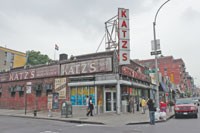
Immigration remains a touchstone in the neighborhood of narrow streets and brick walk-up buildings with fire escapes. Twenty-six percent of residents describe themselves as Hispanic or Latino and 49 percent are Asian, according to the Census Bureau. And echoes of the pushcart era can be found in places such as Katz’s Delicatessen, where salamis hang from the ceiling, and at Russ & Daughters, where shoppers can select from almost every variety of smoked whitefish. Fine & Klein handbags, Harris Levy linens and Sheila’s Decorating also have endured, but other stores have been replaced by younger concepts.
Rents are still relatively low — $60 a square foot on Orchard Street and less south of Delancey Street — and landlords are willing to work with first-time retailers, as opposed to other parts of the city, where building owners want national nameplates.
Beth Greenwald, a real estate broker at Newmark Retail, said the Lower East Side attracts a specialized shopper. “It’s taking more steam from NoLIta than SoHo, because SoHo hasn’t been cutting-edge for a while,” she said. “But it’s a different customer than even NoLIta. They’re different experiences.”
Retail development is going hand-in-hand with residential development.
Avalon Chrystie Place, between Chrystie Street and the Bowery, will have 361 apartments and two floors of retail space, including a 60,000-square-foot Whole Foods Market, the largest in the city.
During a ceremony at the Avalon Chrystie Place site last year, Mayor Michael Bloomberg said that for years the Lower East Side “seemed to be locked in a downward spiral of crime and blight. We’ve changed that and made this a community where families want to live and businesses want to invest.”
The Pomeranc Group, owner of 60 Thompson, a boutique hotel in SoHo, is building a 17- to 21-story hotel and condo project on Orchard Street. The Blue Moon, a hotel catering to a kosher clientele, at 100 Orchard Street between Broome and Delancey Streets, celebrates the tenement lifestyle, albeit with modern amenities such as whirlpool baths. There’s also a 15-story condominium slated for Orchard Street, and a 15-story apartment building is going up on Norfolk Street. At 154 Attorney Street, hungry condo buyers are paying upward of $800,000 for one-bedroom apartments.
Real estate brokers said that some of the ubiquitous parking lots off East Houston Street will eventually be put to residential/retail use.
“They’re selling apartments for over $1 million,” said Joseph E. Cunin, executive director of the Lower East Side Business Improvement District. “We’ll have the largest Whole Foods in the city. Five years ago, if anyone said there would be a high-end food market in this neighborhood, no one would have believed it.”
The development notwithstanding, families living on the Lower East Side have a median household income of $27,368, according to the Census Bureau, compared with the national median of $50,046. In addition, 29 percent of the 85,000 residents have incomes below the poverty level. Cunin attributes this to New York City Housing Authority projects on the southern and eastern ends of the district.
“The Lower East Side is in danger of losing its character to some degree,” said Bob Levy, owner of Harris Levy, the linen shop founded by his great-grandparents in 1894. “We’ve already lost some of the old, established places.”
While Levy laments those losses, he’s not dwelling on the past. He moved Harris Levy to Forsyth Street from its longtime Grand Street address and has added products for young professionals.
“It isn’t bad to have new stores coming in,” he said. “Every generation has played a large part in changing to adapt to the times. I’m excited about what’s going on. This place hasn’t been so vibrant for a long time. I see people putting money into their businesses.”
Almost everyone agrees the new residents and tourists are good for the local economy. “Instead of looking for destination shoppers who come in from Long Island or New Jersey, retailers will be able to cater to locals with greater per capita income,” Slonim said.
Klaus Ortlieb, general manager of the Hotel on Rivington, where rooms go from $255 to $450 a night, noted, “The visitors coming here are very educated. The hotel is attracting people from the creative fields of music, fashion and film and there’s been an influx of Europeans.”
“Stores are benefiting from new residents and visitors, but some folks are uncomfortable with the size and scale of some of the new development,” Cunin said.
The business improvement district, which has 400 stores, is updating the Lower East Side’s image with a new marketing campaign. The former tag line, “The Lower East Side Bargain District,” has been replaced with the more contemporary, “LES Is More. Explore.”
“The new marketing is more inflected with the artistic feel of the LES and encourages people to explore the neighborhood,” said Dara Lahon, marketing director of the business district. “It’s not the mall of SoHo.”
The buzz keeps building. An item on the Web site Daily Candy generated interest at Plum, the store at 124 Ludlow Street owned by Jackie Atkins and Jeannie Goldman. The pair, who opened Plum in October, are targeting $20,000 a month in sales with designers such as Octopi, Lundgrend, Windige and Nicholas K.
Three-month-old Peggy Pardon, at 153 Ludlow Street, is popular with fashionistas and designers in search of inspiration. The vintage store specializes in Edwardian and Victorian whites from the Twenties and Thirties, with some dresses priced at $600 or more.
“In this neighborhood, I have to have something that appeals to a young, trendy customer,” owner Sasha Huetz said. “My customers are designers and Japanese girls, because they’re small and fit into the clothes.”
Ellen Koenigsberg, whose three-year-old boutique, Ellen, is next door to Plum, said her block on Ludlow Street, between Rivington and Delancey, is still working its way up.
“It’s not quite there yet; the first two years were really a struggle,” explained Koenigsberg, whose treasures include a Lanvin Paris patchwork dress, Marimekko shift and Pucci cotton blouse for $685. With “fashion people” and designers as clients, she said she is riding out the transition and hoping that interesting shops will continue to open on her block.
“The neighborhood is diverse,” Cunin said. “On Orchard Street, there’s a 75-year-old corset shop. Forman’s, a discount clothing store, is still here, as is Fine & Klein handbags. We’re really trying to hold on to some of these folks and help them find their niche. I don’t think this neighborhood would be as interesting without them.”