This year’s roller-coaster ride on Wall Street left investors increasingly frantic. The Dow Jones Industrial Average, despite closing up 1.15 percent to 23,327.73 on Monday, was still down 7.7 percent in 2018. The 30-company index would routinely have 1,000-point swings in a single day. With increased volatility the new norm, retail stocks were no exception.
The S&P Retail Index, which tracks both brick-and-mortar retailers and online merchants in the U.S., fell nearly 11 percent in the last year. Sears Holdings Corp. was one of this year’s biggest market casualties, with its stock falling more than 93 percent before the retailer filed for bankruptcy on Oct. 15.
Related Articles
Looking back, here’s a recap of the some of the best- and worst-performing fashion and retail stocks of 2018.
You May Also Like
The Best
Lululemon Athletica Inc.
Lululemon might just be the hottest brand of the year, with consumers willing to pay premium prices for apparel that they will sweat all over. The seemingly never-ending rise of ath-leisure might have something to do with it and investors have been quick to see the potential for further growth. The stock skyrocketed — nearly 53 percent in the last year — closing at $121.61, up from $79.69.
Canada Goose Holdings Inc.
The Canadian company’s luxury outerwear remain the must-have coats of the moment. Shoppers will routinely wait in lines to get one of the quick-to-sell-out coats. Investors like the stock, too. The company’s stock closed 37.5 percent higher, compared with a year ago. Shares were priced $43.72, up from $37.48.

The off-price channel was popping in 2018, with Burlington Stores the top performer in the category. Shares jumped to $162.67 a share, up from $122.24, or 33 percent higher.
Fast Retailing Co. Ltd.
The Japanese company, which owns brands like Uniqlo and Theory, posted record sales and profits in its most recent financial year, with sales in Uniqlo International outpacing sales in Japan for the first time. The company’s stock did well, too, closing the year 21.3 percent higher. Shares, which started at $42 a piece, closed at $50.97.
Amazon Inc.
The e-commerce giant continues to break records, including reporting that 2018’s Cyber Monday was the single biggest shopping day in the company’s history. It also ended the holiday shopping season with the best one to date in the company’s history. While the shares have fallen sharply in the last month, it should be no surprise that investors continue to see the potential. The retail giant’s stock remained up, closing more than 26 percent higher year-over-year. Shares were priced at $1,501.97 each, compared with $1,189.01.
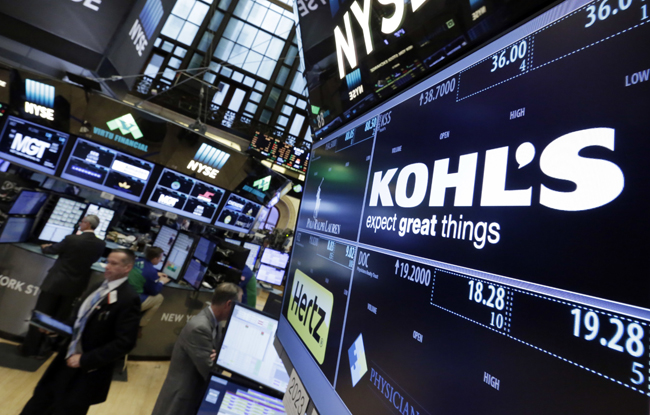
Kohl’s Corp. and Macy’s Inc.
Despite increased competition and consumers becoming increasingly unresponsive to department stores in the digital age, these two stocks saw positive returns in 2018. Kohl’s stock is up nearly 18 percent. Meanwhile, competitor Macy’s beat expectations during its most recent earnings report, giving investors something to be excited about. The stock rose more than 13 percent in the last year.
Nike Inc.
It seems the footwear, apparel and accessories company can do no wrong. Despite a string of bad press in 2018, including the controversial Colin Kaepernick ad campaign, more than one #MeToo-related charge and the departure of former brand president Trevor Edwards, consumers can’t get enough Nike. Neither can investors. The company’s stock rose 16.8 percent in the last year, closing at $74.14 a share, up from $63.49.
TJX Cos. Inc.
The off-price channel, an increasingly popular way for some retailers to off-load inventory, doesn’t show any signs of slowing down in the near future. Another favorite is the TJX Cos. Inc., parent to T.J. Maxx and Marshalls stores. The stock increased 16.6 percent year-over-year, closing at $44.74 a share, up from $38.35.
The stock took a beating in early December, falling more than 26 percent in response to its investor day. Critics were quick to point out the company’s insensitivity amid the #MeToo Movement after reports surfaced in November that the company only stopped expensing executive trips to strip clubs earlier that year. Yet, surprisingly, the company’s stock still closed up 15.7 percent, compared with a year ago. Shares closed at $16.17 apiece, up from $13.97 last year.
Foot Locker
The footwear company has gained the approval of investors as the brand that knows how to curate for consumers what’s cool and what’s not. Company shares closed at $53.20 each, up from $47.89, or more than 11 percent higher.
The Worst
J.C. Penney Co. Inc.
The department store chain continues to struggle. Shares fell 70 percent in the last year, with the stock price even dipping below $1 for the first time ever in December. On the last day of trading in 2018, company shares closed at $1.02 a piece, down from $3.50 a share at the start of last year.
L Brands Inc.
L Brands, parent company to Victoria’s Secret and Pink, hasn’t performed well this year on numerous fronts, including its shares. In fact, almost all of the company’s gains have come from its Bath & Body Works business. The company has unleashed a number of strategies to help bring it back to life, such as closing its Henri Bendel division and selling smaller intimates brand La Senza. It even said it would bring swimwear back to Victoria’s Secret sometime in 2019. But investors have yet to be convinced. The stock fell 57 percent in the last year to $25.67 a share, compared with its 2018 starting price of $59.89 each.
Michael Kors
Luxury fashion group Michael Kors, which just changed its name to Capri Holdings after acquiring Versace, has big plans. They include growing the parent company, which also owns Jimmy Choo, to $8 billion in revenues. Still, the stock has not fared well in the last year, falling more than 40 percent in 2018 to $37.92, down from $63.80 a piece.
China‘s economy is still expanding, just not at the rapid rate it once was. And investors aren’t happy about that. They’re also not happy about the sexual assault allegations against its founder Liu Qiangdong, which were dismissed earlier in December. JD.com, the second largest e-commerce platform in China, fell nearly 52 percent in 2018 as a result. The ending share price was $20.93 a share, compared with $43.51 at the start of the year.
Shoppers are buying jeans, but this retailer, once a leader in the denim category, is not selling many. While the company beat expectations in its most recent earnings report, Wall Street was not impressed. Company shares fell with its negative fourth-quarter outlook. In the last year the stock has not done much better. Shares, originally priced at $9.15 each, fell to just $5.11 apiece, or down 44.1 percent.
Despite high hopes for its initial public offering, the platform for purchasing luxury fashion, which went public in September, has been underperforming ever since. In fact, its shares are down 37.7 percent since Sept. 21, the day the company went public, to just $17.71 a share. That’s a noticeable decline from the original asking share price of $28.45 each.
Another fashion platform that is not doing well on Wall Street. Shares have fallen 31 percent in the last year to close at $17.09 each, down from $24.77.
Tailored Brands Inc.
The men’s specialty retailer, which includes brands such as Men’s Wearhouse, Jos. A. Bank and Moores Clothing, has been in a funk as American men’s fashion — even office attire — becomes more casual. Shares fell about 27 percent after missing on its most recent earnings report. In the last year, the stock has done even worse. Shares fell more than 40 percent to $13.64 each, down from $22.82.
PVH Corp.
PVH Corp., which has the Calvin Klein and Tommy Hilfiger brands under its umbrella, has seen its shares take a hit in the last year, marked by disappointing returns in the heavily-invested Calvin Klein 205W39NYC collection. The recent exit of designer Raf Simons didn’t help either. The stock closed down 33.1 percent in the last year. Shares, originally priced at $138.97 each, closed at just $92.95 on New Year’s Eve.
Despite a shakeup in the retailer’s management team and a recent earnings beat, which caused shares to briefly surge, the company’s stock fell 30.4 percent in 2018. The closing share price was $4.45 apiece, down from $6.40.
China’s largest e-commerce platform continues to grow. But much like JD.com, investors don’t think it’s growing fast enough. The share price is down 25.3 percent in the last year as a result. Shares closed at $137.07 on the last day of trading in 2018, compared with $183.65 at the start of the year.