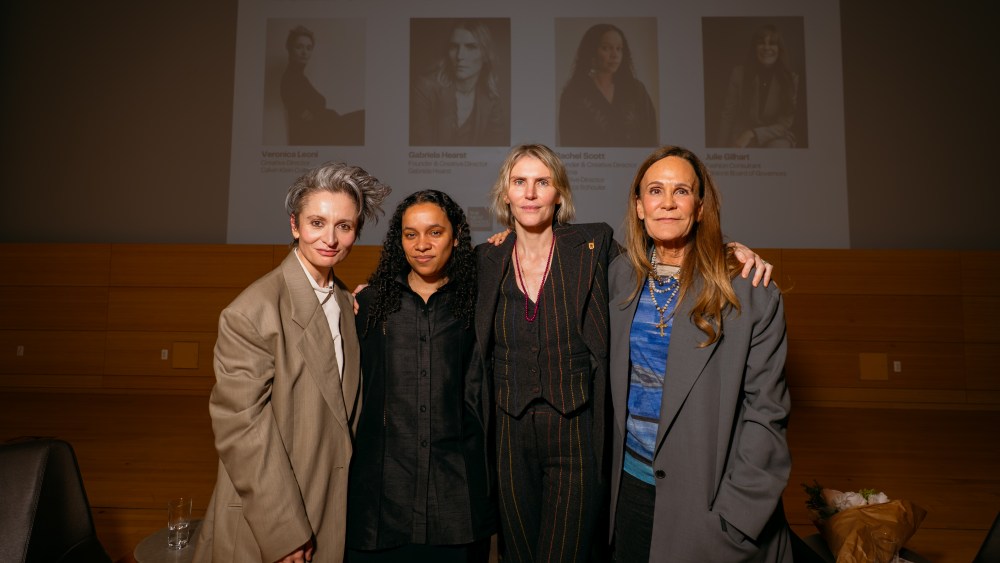
“Do not do this job if you don’t like problems,” said Gabriela Hearst, founder and creative director of her namesake label Wednesday night.
Hearst was speaking about her career to a roomful of students and industry executives at the Parsons School of Design, along with Rachel Scott, founder and creative director of Diotima and creative director of Proenza Schouler, and Veronica Leoni, creative director of Calvin Klein Collection.
The panel discussion, titled “Women Leaders Crafting a New Fashion Future,” was organized and moderated by Julie Gilhart, fashion consultant, and presented by the Gromek Institute for Fashion Business.
You May Also Like
Related Articles
While women make up 75 percent of fashion graduates, the power at the top of the industry presents a totally different picture. Only a small fraction of the industry’s top roles are held by women. The conversation explored how Hearst, Leoni and Scott have built authority in the fashion industry still shaped by unequal power, and how different their paths were. The women talked about hurdles they face every day, even at the top.

Each of the designers shared their back story, and Gilhart asked them when they finished school and were entering their careers, what were their dreams like? And what is something that they did back then that still informs them today?
Leoni, the first woman to serve as creative director of Calvin Klein Collection, said when she was starting out, rather than join a huge company where she would be just a number and would be doing photocopies, getting coffees and running around, she joined “a tiny little brand” that was in the center of Italy. They were a family-run company.
“And I had the chance to kind of learn everything. I still work with the same method…It’s actually the most humble way for me to remain extremely connected to my roots and my training,” she said.
She said she didn’t attend fashion school so she came to the job “with just a huge ambition and some sort of self-trainee approach, and that gave me everything.” While today, Leoni is part of a huge team at Calvin Klein, she said she likes to keep the design team “extremely contained. I like to be accessible. I like to speak to people. I like to not close the fitting room door.” She said she likes to make sure there’s a certain transparency. “I love when the atelier starts to read my mind,” said Leoni.
Scott, the first Black woman to lead a major fashion house in the U.S., explained that she’s from Jamaica and studied arts and French. “I knew I wanted to design and had big ambitions to be a designer as well, but I just had the opportunity to study somewhere other than Jamaica,” she said.
She ended up in Italy studying fashion for a year. “It was a very short, intense program in Milan. And then I ended up getting an internship at Costume National.” She was on the design team working on the show collections. “And a lot of it was just experimentation, play and lots of material manipulation, which obviously stuck with me because I’m quite obsessed” with materials to this day. “I learned everything working there, more than in school. Nothing against school obviously. But I learned so much about the process and craft, and I just gained an enormous amount of respect for craft, for Made in Italy, but not just Made in Italy.” She said that perhaps what lasted the most was the idea that there are these traditions of craft that exist globally.
Hearst said she was grateful to be talking to students and realized that this was the first time she’s ever sat on a panel with three female designers. “I’ve never experienced this so I feel so lucky to be sitting with fellow creative designers that are female,” she said.
She told the audience that she grew up on a ranch in Uruguay “and so the only thing I knew was gauchos, sheep, cow manure and horses.” She said her mother still lives off the grid so now there’s solar panels, but there was no electricity. “There was just a generator that would be there for two hours in the evening, and the water was from the mill, and there was radio, and that was it, so imagination’s my entertainment.”
She didn’t know what to do when she grew up, but she realized, “This is not for me. I need to get out of here, but I knew it had to be something creative, because I kept on drawing all my life. I have full collections of shoes that I actually did at 17, full drawings.” She went to audio visual school, and thought communications and media, “but I knew I wanted to do something that was creative.” She said she moved to New York, and after trial and error and failing, she fell into fashion. “And it was the first time [she thought], ‘I have a grip on this. This is what I like.'” She said she started in sales, doing signs, screening anything she could. She started her first company in 2003 with $700 and two other partners called Candela, which was the foundation of everything.
When asked what Hearst keeps close to her heart today, she said, “Sketching and writing things down, writing objectives down. You can go back to my list and to the dreams and structuring, because I would call them wish lists.” She said she would write down what she wanted to achieve, and what she wanted to do, and put pen to paper, “and you really visualize what you want. It also relieves the anxiety of the unknown, of what obstacles you have.”
Hearst said she was talking the other day about there being so few women creative directors of global fashion brands. “But actually there are lots of women designers who own their own businesses, quite a lot, especially in New York. I almost think that maybe it’s pragmatic, but maybe it’s also this idea that this system isn’t set up for us, and so we just have to figure it out ourselves, and I think that’s true of the three of us,” said Hearst. She said that after World War II, the brands that we know today were also founded by women — Lanvin, Madame Grès, Schiaparelli, Chanel, Chloé.
Asked how they claim their space in a male-dominated industry, Leoni said, “I feel that we do fight every day, with your own venture, with our own brand. It’s actually cultural. I feel there’s a certain male gaze, a certain patriarchy, that is kind of ruling the culture. And I feel that influences everything we do. So I feel that as women in the world, not just women in fashion, we’re just trained to fight, just simple as that every day. So that space around us needs to be claimed with a louder voice and claimed with the strongest idea.”
Scott said if space is not going to be made for you, you have to carve it out yourself. “Being from another country, being an immigrant, being queer, being Black. There’s multiple kind of lines of war that you have to fight against,” she said.
Hearst said it’s important to stick to your values. “We are all obsessive,” she said. With a passion for sustainability, she recalled back in 2018, when she decided to change all of the packaging in her company and they researched biodegradable packaging and developed recycled cardboard hangers rather than plastic ones. When it came time to ship to department stores, one department store said they were going to apply surcharges because they didn’t fit in their manual. Hearst told her head of sales to tell the department store that she would not change the hangers, and the store was not going to charge them. “We realized it was a risk and they may lose the order. It was a very substantial order, but I was going to stand up for my values. And guess what — they accepted the hangers.”
Scott and Hearst were asked how they manage or managed designing two brands at the same time. [Hearst is no longer designing Chloé, and Scott designs Diotima and Proenza Schouler].
Scott said the creative part is one thing and the logistics part is a totally different one. “You have to surround yourself with people that you trust. And I think the daunting parts about being a designer going into business is that you think you don’t have the experience. You don’t have an MBA, but you do actually have relevant experience. I worked in the industry for 17 years before I launched my brand, and so of course, I was thinking about the business side a lot. I think there’s this idea of being an expert in something that can be off-putting to creatives. I think people speak to designers, especially young designers, in a way that makes them feel like they don’t have the instinct or the judgment to be able to run their own company, which I think can be dangerous. I think you know best….anyone can give you advice. You should take advice from everyone, but you should always trust your voice as the final deciding factor,” said Scott.
In running her own business, Scott said, “Every day it’s like something’s on fire. The company’s always on the verge of imploding…. To be a designer and a business owner, you have to have a high level of amnesia, and I think just pure amnesia and lot of obsession and a lot of love for what you do. Because when I say that there’s a problem every day, there is literally a problem every day. It doesn’t matter how well your business is doing,” said Scott.