
NEW ORLEANS — On Canal Street in the Central Business District here, Rubenstein’s, the iconic luxury retailer that has been selling classic apparel since 1924, plans to enlarge its women’s department and add designer lines.
Nearby, at Azby’s, a high-end specialty boutique on Magazine Street, December sales were up 20 percent compared with last year.
As Mardi Gras gets under way almost six months after Hurricane Katrina flooded 80 percent of this city, some specialty retailers and boutiques in areas that were spared devastation are slowly reviving. They are doing so even as basic services, from housing to public schools and health care, are uncertain, and countless small merchants as well as giants such as Saks Fifth Avenue have yet to reopen.
Another hurricane season starts in four months and New Orleans’ levee system is fragile; a mayoral election in April is pitting a dozen candidates against incumbent C. Ray Nagin, a target of much criticism for his crisis leadership; the city’s finances are in disarray; entire neighborhoods face demolition, and it is estimated that fewer than one-third of the almost 500,000 people who lived here have returned.
The stores that have opened report brisk shopping, even with limited inventory and the city’s major industry, tourism, a shadow of itself. Mardi Gras, which typically attracts more than 1 million visitors and generates hundreds of millions of dollars in revenue, will be shortened to eight days from 12. Most of the almost three-dozen traditional carnival krewes are returning, but parading along shortened routes and with fewer floats. The number of tourists who will come is anybody’s guess.
Many famed French Quarter restaurants such as Antoine’s and Galatoire’s are back in business, but only 22,000 to 24,000 of the city’s 38,000 hotel rooms are usable. And about 16,000 of those rooms are occupied by displaced persons, recovery workers and others.
In 2004, the year for which the latest figures are available, conventions and tourism brought in more than 10 million visitors and generated $4.5 billion. This year, 55 of the 70 conventions booked for New Orleans have pulled out, leaving the city with only an estimated $250 million in expected revenue.
New Orleans craves people like Chicagoan Kathy Kanter, who said she made shopping a priority when she arrived to visit her son at Tulane University, which resumed classes for the spring semester.
Related Articles
You May Also Like
“I love New Orleans, and so I made it a point to just buy anything I could,” she said. “If I’m going to buy clothes, I would rather spend my dollars there. I’m trying to talk everyone I know to go to New Orleans — they need the tourist dollars.”
Kanter’s purchases included $2,600 worth of apparel for herself and her daughter, from Rubenstein’s. Owned by brothers Andre and David Rubenstein, the women’s department was managed by David’s daughters, Allison and Hilary Rubenstein, while their Magazine Street shop, Ah-Ha, was undergoing repairs. It was back in business this month.
Rubenstein’s reopened in October stocked with only 40 percent of its normal inventory because new merchandise shipments were delayed. Within three days, 25 percent had been sold. “Even though we didn’t have adequate inventory levels, we just got tired of being closed,” said Allison Rubenstein. “We wanted to help send the message that New Orleans is not under water. It’s back in business.”
And, making an investment in the future, Rubenstein’s plans to enlarge the women’s department to 3,500 square feet from 2,500 square feet by summer and add more designer lines because of the absence of Saks, a 105,000-square-foot anchor of The Shops at Canal Place downtown, which aims to open in the fall.
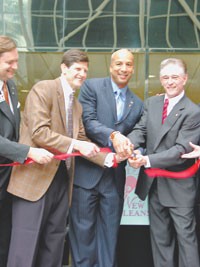
Eighteen of the 24 tenants of The Shops at Canal Place will be open by the end of this month, four more by the spring, and Kenneth Cole by the summer, said co-developers Darryl Berger and Roger Ogden, who officiated at reopening ceremonies with the mayor.
In the business district, only Riverwalk Marketplace has resumed operations; New Orleans Center is closed. The city’s suburban shopping malls — Clearview, Lakeside and Esplanade — seem to be thriving, with the exception of Oakwood Mall, which is still shut, as are its anchors, Sears and Dillard’s. Macy’s at the Esplanade plans to be back in operation in the fall and Old Navy, by spring.
A survey conducted by three researchers from Tulane University and Louisiana State University provides a snapshot of the business climate since the hurricane hit on Aug. 29. The team worked from a list of businesses that operated before the storm and conducted the survey along three commercial corridors. The researchers concluded that Magazine Street — a meandering, 13-mile road lined with 19th-century wood frame homes turned into boutiques, cafes and art galleries — had emerged as the main street of a diminished city. It is where high-end specialty stores and boutiques like Ah-Ha, Azby’s and Mimi reopened. Generally, local businesses resumed operations ahead of national chains, said Richard Campanella, a Tulane geography professor and part of the research team.
Purveyors of Mardi Gras ballgowns were up and running before many home improvement stores, and there were more places to get a facial than to buy a shovel and a crowbar, Campanella said,
Most experts agreed that much of the high-end sales increases are tied to the absence of Saks Fifth Avenue. Considered by company executives to be one of the chain’s highest sales producers because of its emphasis on designer fashion, the New Orleans Saks is fighting back with networking strategies. Saks’ most loyal customers have even taken road trips to Houston, where 15 New Orleans Saks sales associates are temporarily relocated; others customers have flown to Bal Harbour, Fla., to shop at the store, said Kathryn Scurlock, Saks’ assistant manager.
Once a redesign is complete, the New Orleans store will feature designer and contemporary sportswear departments that have been expanded by 20 percent to 25 percent, said Scurlock, who noted that local executives, including Cristina Wysocki, director of the Saks Fifth Avenue club, are staying in touch with customers by phone and e-mail.
And other merchants persevere, as well. Mardi Gras ballgowns are a major item this time of year, so Mimi owner Mimi Bowen telephoned vendors with pleas “to send anything they’ve got on hand.” The category, normally a 15 percent slice of sales during the three-month carnival selling season, now represents 30 percent.
“If a gown is under $1,000, it walks out the door,” Bowen said, adding the eveningwear is selling well for as much as $2,500. “Any inventory is tough to keep.”
At Azby’s, owner Kerry Bruno expects the 20 percent sales increase of December to last through the first quarter, a peak that she has never experienced in her 17 years in business. Still, balancing the merchandise volume at the 2,600-square-foot store for a shifting customer base has been challenging. Post-Katrina, she has inherited a cadre of new clients, many of whom have told her that they used to shop at Saks.
“People are buying in multiples; instead of just one item, they’re buying three and four things,” she said. “I’m a nervous wreck not knowing if I will have too much inventory or not enough.”
Still, for the near term, shoppers in New Orleans are anxious to get back to some sense of normality. Spending an afternoon at The Shops at Canal Place, friends and neighbors Debbie McArthur and Lynn Goddard strolled together. Goddard, who lost most of her wardrobe in the storm, was resigned to waiting to make purchases. Her home is still not repaired, she said wistfully, and she needs a closet first.
“I’m not going to buy anything until I have somewhere to put things,” she said.