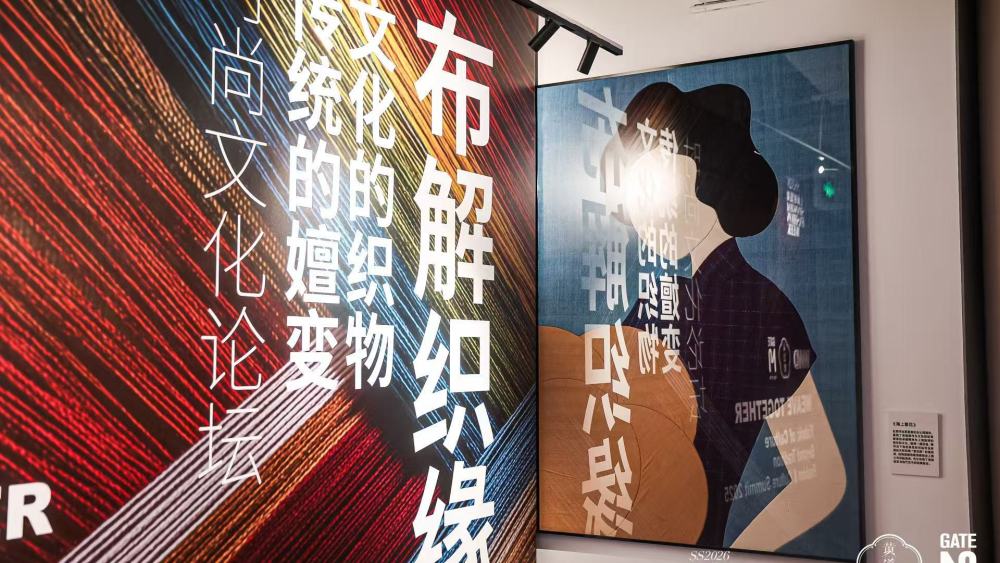
As China’s fashion industry transitions from leveraging its “manufacturing dividends” to exploring the deeper realm of “cultural empowerment,” the question of how to “breathe contemporary life into traditions” has emerged as a shared imperative across the sector.
On Oct. 14, the thematic forum “Weave Together | Fabric of Culture: Beyond Tradition Fashion & Culture” summit 2025, copresented by WWD China and Gate M Huazhimen, concluded successfully.
As one key cultural segment of Shanghai Fashion Week, this forum centered on textiles as its core thread. It explored innovative ways to connect intangible heritage craftsmanship with contemporary design while integrating cultural brands into lifestyle aesthetics.
Related Articles
Through subsequent collaborations with the Huang Daopo Memorial Park and thematic workshops, the forum extended this cultural dialogue into the public’s humanistic ecosystem. These initiatives truly made culture perceptible and traditions more vibrant.
The strategic placement of Gate M Huazhimen in Huajing Town, Xuhui District, is no coincidence. It marks a return to the historic home of Huang Daopo, the revered mother of Chinese cotton textiles. Building on this rich legacy, the forum, presented in collaboration with WWD China, brought this project’s vision of “Where You Weave It All” to life.

The “Weave Together | Fabric of Culture: Beyond Tradition Fashion & Culture” summit 2025 forum centered on textile heritage as its foundation. Through two in-depth dialogues — “design and craft in contemporary expression” and “brands in cultural and aesthetic resonance” — the forum explored how traditional techniques can take on modern forms and how brands can build meaningful cultural narratives.
The discussions also highlighted Gate M Huazhimen’s vision of “Where You Weave It All,” which uses intangible cultural heritage as a vital pathway. In doing so, the forum addressed a critical challenge in China’s fashion industry — the lack of compelling cultural storytelling — while showcasing, through initiatives such as “heritage craft design” and “cultural exhibitions,” how traditional skills can be reconnected with contemporary living.
Weaving the Present — Contemporary Expressions in Design and Craft
The inaugural panel discussion, moderated by Johannes Neubacher, chief content officer of WWD China, centered on three core pillars: redesigning intangible cultural heritage, activating material potential and integrating technology. The discussion directly addressed three key questions: how heritage can serve as a source for contemporary expression, how to balance authenticity and modernity through the use of natural materials, and how the fusion of craftsmanship and technology is redefining the language of textiles.
Under the first thematic dialogue — “The language of Textiles: How Intangible Cultural Heritage Tells a Contemporary Story” — Huang Yaqun, cofounder and executive partner of the product brand center at HZM Capital, shared her insights.
“In a homogenized commercial world, cultural experience is becoming the ultimate differentiator. What we aim to create is not just a physical space, but a realm of meaning — a contemporary place that unites design, memory, wisdom and spirit.”
“At its core, design is about ‘storytelling,’ and intangible cultural heritage provides narrative material rich in emotional resonance,” said Tian Ling, design director of EP Yaying. “The real challenge lies in finding ways to bring these age‑old stories out of museums and reintegrate them into the scenes of modern life.”
Meanwhile, Fang Yun, academic adviser at the Huang Daopo Memorial Park, reflected, “Huang Daopo was not only China’s true ‘great female lead’ — what she wove was more than cloth. It was the very social fabric of an era and the embryonic form of Shanghai’s urban spirit. She transformed skill into a language for women and textiles into a microcosm of civilization.”
Under the second theme, “Material as Statement: Redefining Natural Fabrics and Functional Aesthetics,” Wu Weibo, marketing director of JNBY, said, “At JNBY, we believe that ‘artistic exploration for a better life’ is a way to engage with the world. A piece of fabric that fails to find its proper place in life remains merely a material — not a vessel of culture. Intangible cultural heritage can only survive if it becomes part of everyday life, and this must be built on a foundation of deep understanding and respect. We aim to awaken new sensibilities through fabric, connecting life and culture through textiles.”
“The beauty of intangible cultural heritage lies not only in its patterns and colors,” added Peng Yang, founder of Silkninc, member of the 13th National Committee of the All-China Youth Federation and National March 8th Red-Banner Holder. “It also embodies the spiritual strength passed down to us from ancient times. True inheritance is not just about reinventing the past. It is about leaving the marks and reflections of our generation in contemporary life, enabling heritage to sustain its vitality in a new era.”
In the third thematic dialogue, “The Boundaries of Design: Reshaping Textile Expression Between Craft and Technology,” said Zhang Lei, founder and principal designer of Pinwu and Rong Design Library. “Authentic ‘future tradition’ does not mean treating cultural heritage as collage material. It should be integrated like sugar dissolving in water: invisible, yet perceptibly sweet. When a handwoven textile becomes a building material, and when Huang Daopo’s weaving spirit is interwoven into spatial structures, we are not replicating history but building future cultural spaces inspired by the wisdom of our ancestors.”
From narrative to material and technology, these three interconnected themes together outline a holistic pathway for traditional textiles to “live on in the contemporary era.”
Crafting Identity: Cultural Resonance and Brand Storytelling
While the first dialogue explored “how craftsmanship lives on,” the second shifted its focus to “how brands can carry the torch.” Chaired by Yang Wen, vice chairman of WWD China, the discussion centered on three key pillars: inheriting the artisan spirit, shaping cultural identity and fostering collaborative brand building — together outlining a practical path toward a contemporary future for tradition.
Under the fourth theme, ”custodians of craftsmanship: how designers and brands inherit the artisan spirit,” Zhang Xue, a fourth-generation heir of Xue’s Embroidery and a Young Suzhou embroidery artist, said, “Inheriting Suzhou embroidery goes beyond preserving tradition. It necessitates mastering ancient techniques while embracing cross-disciplinary innovation to revitalize the craft in contemporary life.”
“Craftsmanship and the artisan’s dedication are the very threads that connect commerce to people,” said Zeng Xiukun, partner at HZM Capital and general manager of Gate M Huazhimen. “Moving forward, Gate M Huazhimen will become even more deeply woven into people’s daily lives. ‘Where You Weave It All ’ isn’t just a tag-line — it’s our heartfelt expression of what this project truly represents.”
Guo Xiuling, founder of Sandriver, also noted, “The irreplaceable value of the intangible cultural heritage we’re committed to preserving doesn’t lie in the materials themselves, but in the dynamic, human-inspired art of handcrafting — and that’s what truly keeps a heritage alive.”
During the fifth thematic dialogue, titled “From Aesthetic Style to Cultural Core: How Brands Build an Expressive System With Spiritual Depth,” Guo Shuxuan, founder of Shuxuan G., shared insights from her brand-building journey.
“The Eastern couture we define isn’t about opulence or luxury for its own sake. Instead, it’s a vessel for profound Eastern philosophy — at its core lies an ‘empty’ mindset that embraces all, designed to inspire everyone to unlock their own boundless, unconstrained potential.”
Similarly, Chen Yehuai, founder and chief designer of Grace Chen, said, “Exceptional design shouldn’t be a designer’s monologue. It needs to be an empathetic dialogue with the wearer. We must stay true to the creative ‘original aspiration’ of ‘what I want to create’ and understand ‘why the client turns to me.’”
Wang Tao, creative director of Juizi, also shared her insights on preserving craftsmanship while exploring a new Chinese aesthetic language. “Chinese handcraftsmanship presents the world with tangible cultural sediment and a touchable form of time — and that is precisely what defines true luxury.”
From the passing of the artisan spirit torch to the forging of a cultural core and the deepening of connections within a co-creative ecosystem, the discussions ultimately addressed one core idea: “Contemporary tradition” in Chinese fashion is not a mere replica of the past. Rather, it is a process through which, guided by brands’ stewardship and innovation, tradition evolves into a living aesthetic that truly reflects our time.
After the in-depth discussions at the forum, these insights called for a more dynamic medium to live on. To this end, beginning Oct. 17, Huang Daopo Memorial Park will host the “Weaving the Cotton Legacy Into the Future” exhibition at the Gate M Huazhimen Gallery. In addition, themed workshops will be held on Oct. 18 and 25.
From the “brainstorming” of the forum to the “visual narrative” of the exhibition and further to the “sensory engagement” of the workshop, Gate M Huazhimen has offered a down-to-earth “translation” of cultural communication — making culture tangible and traditions vividly alive. In this way, tradition is no longer a relic of the past but a “living presence” woven into everyday life. This, perhaps, reflects the founding vision of Gate M Huazhimen as a “cultural platform”: not just crafting moments for the present, but forging connections that will endure into the future.