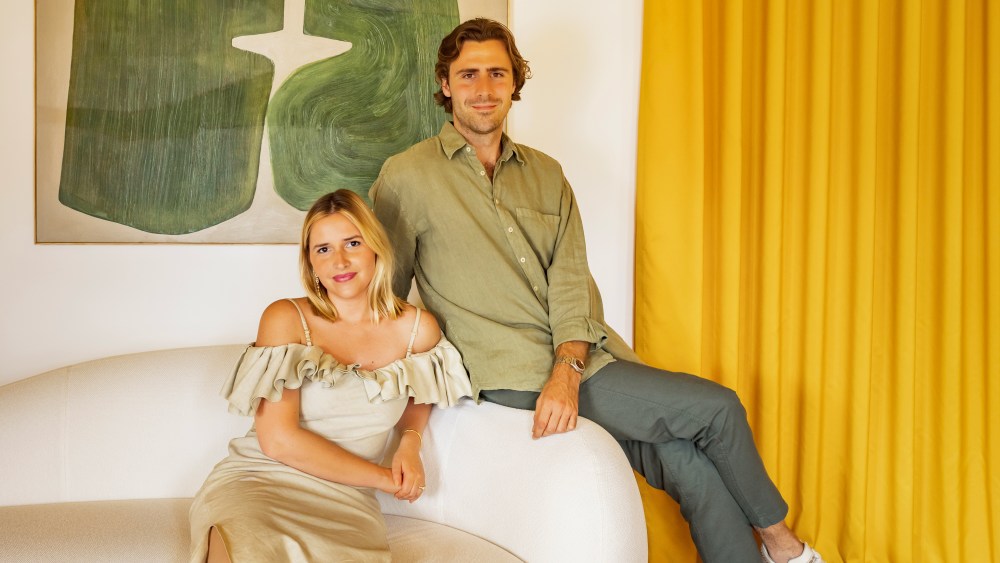
Childhood friends Iris de la Villardière and Thomas Montier Leboucher may have spent numerous hours ogling jewelry as kids, but it took them a decade-and-some before they launched Paris-based fine jewelry brand Viltier together.
By their early teens the pair, who call each other “work spouses” but are not together in life, had lost touch. De la Villardière went into design, studying at Penninghen, a prominent Paris-based art school, before heading to Florence for Creative Academy, the international postgraduate school founded by Compagnie Financière Richemont in 2003. Experiences at jewelers Marie-Hélène de Taillac and Stone Paris followed.
Related Articles
Montier Leboucher headed to London, where he studied at Royal Holloway and the London School of Economics, before joining Cartier, doing a short detour in finance and finally joining the team of a friend, the London-based Brazilian jeweler Fernando Jorge, where he participated in the brand’s development in various territories, including the U.S.
You May Also Like

That’s when their paths crossed again, when de la Villardière spotted Montier Leboucher on Instagram and slid into his DMs to catch up, amazed that they’d both ended up in the jewelry sector.
A coffee catch-up led to several more. They soon realized that not only were their skill sets complementary — design, branding and image for her; commercial development and finance for him, with overlap on the creative front — but their tastes and aesthetics also aligned. Launching a brand was an idea they’d kicked about independently but neither felt they could go at it solo.
“Fine jewelry was having this renaissance moment around the world, but it just wasn’t happening in Paris and we felt there was space there to show that you don’t have to be over 30 to open a jewelry brand,” said Montier Leboucher, recalling how they shook on it in February 2019 and that June, resigned their jobs on the same day.
They came up with Viltier by pairing the start of her name with the last syllable of his. Unfussy, easy to pronounce in most languages but still very French, it felt “very them” — especially since the duo tend to finish each other’s sentences.
Yellow became their signature color because they wanted something “warm, colorful and full of joy,” a far cry from the remote perception of jewelry houses to reflect the fact that “what gets us up in the morning is doing something that is happy, fun, fresh,” said Montier Leboucher.
Using Fairmined gold and producing entirely in Paris using diamonds and semiprecious stones, despite this tacking an additional 20 percent on their cost price, was also a must.
Pandemic notwithstanding, the two years since their spring 2020 launch have been a whirlwind for the brand.
Social media served as a springboard to put their name on the map. Retailers like Net-a-porter and Le Bon Marché Rive Gauche came knocking, attracted to a smartly priced range that goes from 1,100 euros for a ring with a trio of small diamonds to just shy of 13,000 euros for asymmetric earrings featuring an unheated 5-carat topaz.
So did private clients — famous faces like Anne Hathaway, Irina Shayk, Mélanie Thierry and Sharon Stone — and a male clientele, a demographic that initially surprised de la Villardière, who’d toyed with the idea of introducing more masculine designs later.
Within months they’d even opened their Parisian showroom with the support of public investment bank BPI, a sunny space on a quiet street in the tony 7th arrondissement.
By the end of the first year, their turnover was just shy of 1 million euros and for 2022, their second, they expect 250 percent growth.
In fact, the only thing that didn’t pan out at Viltier was their initial idea of offering dainty pieces for every day, affordable and easy to sell. “We just didn’t love the product,” said de la Villardière, noting that both gravitate toward bold gold designs. “And if we didn’t want to wear it ourselves, how could we sell it?”
What they did go with was an oval shape that recurred throughout de la Villardière’s design sketchbooks and became the basis for Magnetic, their first collection — in yellow gold, of course.
Satisfyingly graphic, retro-chic, its shape finished with fluted edges proved ideal to play with hard stone inlays and diamond accents. “And when gemset, it looks like two Us connected by diamonds, like Thomas and I have been connected by jewelry throughout our lives,” she explained.
A flagship will be the next step in Paris, but de la Villardière and Montier Leboucher also have their sights set beyond France.
They’re already making inroads in the U.S., not least because their very first e-commerce order had been from an American client, they revealed.
Participating in the Couture trade show in Las Vegas in 2021 further cemented their belief in the market’s potential for their brand, attracting retailers like Portland’s Twist or Puerto Rico-based Reinhold Jewelers.
Viltier made its debut at Bergdorf Goodman in June and making the first steps in the U.S. soon brought to light a truism of the jewelry world: while French consumers look for daintier pieces, American ones go bold and that’s a direction that suits the duo just fine.
Cue the newly introduced Edge line, with its graduated profile that looks like a skyline. Colored gemstones can be set into the sides, adding discreet flash and plenty of pizzaz. With its starting price around 3,000 euros for a small pendant and stretching up to 39,000 euros for a sizable cuff with diamonds, it’s bringing Viltier into the territory of the jewelry houses they admire.
They’re planning to expand their Middle Eastern presence by taking part in the upcoming edition of the Jewelry Arabian fair in Bahrain and are considering developing in Korea, where they have currently one retailer.
But what they’re proudest about right now is bridal. That category is “where all the work we’ve done to be state-of-the-art paid off, because [bridal] customers come to you only if you have the reputation for doing things right,” he explained.