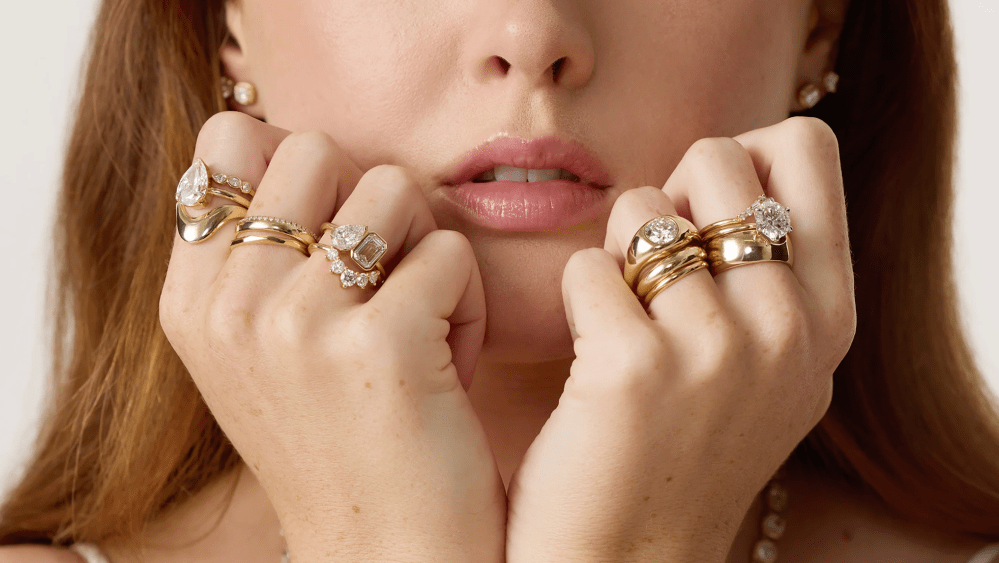
Engagement rings have entered a new era of bold, statement-making personality. From chunky dome styles to east-west settings and sculptural silhouettes, more couples are choosing distinctive designs over the traditional solitaire diamond ring. But as stones grow larger and settings become more unconventional, where does that leave the classic wedding band?
The shift toward more unconventional engagement rings accelerated last summer when Dua Lipa debuted her ring: a chunky gold band featuring a round diamond in a semi-bezel setting. The statement piece helped spark a new bridal jewelry trend, driving spikes in Google searches for cigar bands and chunky ring settings. Later in 2025, Miley Cyrus stepped out with an equally bold style — a thick yellow gold band featuring an east-west cushion-cut diamond in a semi-bezel setting.
Related Articles

It’s not just chunky bands having a moment — floating diamonds, bezel settings, mismatched toi-et-moi stones and east-west designs are also defining the modern engagement ring. Many of these styles, however, can pose a challenge for the traditional wedding band.
You May Also Like
“Engagement rings have become much more expressive lately and that shift has naturally pushed the wedding band to evolve alongside them,” says Jillian Sassone, founder of Marrow Fine Jewelry. “People are thinking more intentionally about how the two pieces work together [through contrast, shape and texture], so it feels cohesive, personal and really unique to them.”
As a result, more couples are rethinking their approach to wedding bands. Once defined by simple, sleek silhouettes — whether in platinum, yellow gold or diamond-set styles — the traditional wedding band doesn’t always complement today’s statement engagement rings and, in some cases, may not pair easily with chunkier designs. Some brides are choosing to forgo a separate wedding band altogether, opting instead for a singular, one-and-done engagement and wedding ring. Others are leaning into more individualized approaches.
“Some clients are opting for a two-in-one engagement and wedding ring, [but] what we’re seeing more of is a shift toward building a stack over time rather than treating it as a one-time decision,” Sassone explains.
Other wedding band alternatives that Sassone notes are gaining traction? “Enamel bands, mixed metals and more design-driven pieces that feel like everyday jewelry first, rather than something strictly ceremonial.”
Rather than designing wedding bands as direct matches to today’s engagement rings, jewelers are increasingly approaching them in more fluid, design-led ways. Brands like Sophie Ratner and Anita Ko are leaning into contoured bands and curved silhouettes that solve for oversized or unconventional center stones. Similarly, engagement ring brand Holden has made open wedding bands and curved designs central to its offering, including a “Yin Yang” ring set designed to nest perfectly together as a two-in-one engagement and wedding ring.
In some cases, Sassone notes the “wedding band” is no longer a single piece at all — but a combination of stacked rings added over time, each marking a new moment rather than a fixed tradition.
“When designing or styling a unique engagement ring, it can be helpful to consider the engagement ring and the wedding band from the start,” Sassone says. “Rather than choosing them separately, many clients are thinking about how the two will sit and interact — whether that’s a flush fit, a custom contour or a specific overall silhouette when stacked.”
She adds that the new approach is far less prescriptive than in the past. “There really are no rules when it comes to stacking your engagement ring, and we’re actually seeing a growing openness to contrast — mixing shapes, metals or textures so each piece feels distinct but still cohesive together. It’s less about matching perfectly and more about creating something that feels balanced and personal.”
As engagement rings continue to prioritize individuality over tradition, wedding bands are evolving in step — less as matching accessories and more as evolving design systems. In today’s bridal jewelry landscape, the “set” is no longer fixed, but fluid, layered and increasingly personal.