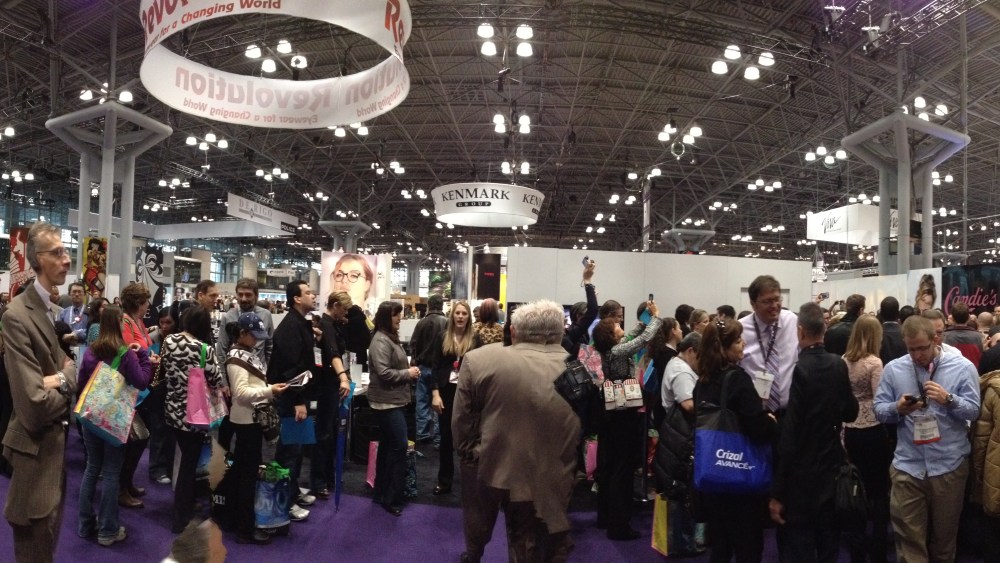
LAS VEGAS — Exhibitors at Vision Expo West were feeling bullish about the back half of 2021, evolving sustainability goals, growing their optical ranges and zeroing in on Gen Z.
The West iteration of the eyewear trade show returned to the Sands Expo Convention Center and the Venetian Resort Hotel Casino last month after pausing in 2020 due to the global pandemic. The latest edition included more than 280 exhibitors, with most of the larger eyewear license companies in attendance.
Reacting to the pandemic, exhibitors used digital-focused solutions to show product, like at Safilo, whose expansive booth included Topology, a San Francisco-based eyewear technology company as a vendor collaborator using its proprietary Touchless Optical Platform. Attendees were able to virtually — and safely — try on both optical and sunglass frames across Safilo’s fall collections.
Related Articles
“We’ve learned from the pandemic that digital virtual meetings can still make a strong impact, and we’ve grasped them, but having a physical presence at events of this magnitude makes a big difference,“ explained Steve Wright, president and chief commercial officer of Safilo North America.
You May Also Like
According to Wright, Carrera, Kate Spade New York sunglasses and readers, Jimmy Choo and Isabel Marant have all experienced significant U.S. growth since 2020. “We just launched Isabel Marant this spring and it’s been a real success story for us, driven mostly by digital and the brand’s strong fashion consumer following,” he explained, with plans to launch the French brand in optical channels for spring 2022.
Historically the trade fair tends to tilt more optical and eye care rather than sun, and many executives saw big strides in the market. “Optical frames account for the most significant portion of our sales, which are beating pre-COVID-19 2019 numbers in the U.S. market,” Wright said, a trend he expects to continue.
“We are recording a strong momentum in prescription frames in all markets and it’s particularly sustained for us in the independent optician channel here in North America,” he said, reporting double-digit growth of prescription frames across brands and markets, which is advancing the group’s strategy for a rebalanced business between product categories.
In the sunglass market, Wright pointed to Carrera which having strong growth through their e-commerce channels. This summer Safilo launched its first U.S. direct-to-consumer e-commerce site for the Italian brand, coinciding with its 65th anniversary. The brand previously had an existing site for Europe, but consumers from the U.S. could only view styles and were unable to make purchases.
On the topic of sustainability — also a hot topic at Silmo, the recent eyewear fair in Paris — Safilo will in January debut sun lenses made of Trogamid myCx eCo, a new high-quality transparent polyamide material with the Boss spring collection. The material will be progressively rolled out across Safilo’s portfolio, “further asserting our commitment to sustainability and efforts to bring more recycled materials to the eyewear industry,” Wright said.

Safilo is also rethinking environmentally sustainable actions as it relates to point-of-sale materials. Almost all POS materials are Forest Stewardship Council certified, meaning they are sourced from sustainably managed forests.
“There has been a lot of discussion in our industry about the impact of the pandemic and whether some of the behavioral shifts we’re seeing are here to stay,” said Fabrizio Uguzzoni, president of North America wholesale at EssilorLuxottica, also pointing toward optical trends. “These behaviors aren’t really new, it’s more like they’ve been supersized and are now visible in every decision the consumer is making.”
Uguzzoni continued, “We’re investing a lot in driving awareness around the importance of getting your eyes checked and we’re expecting the message to resonate with consumers in a different way post-pandemic.”
And the company’s digital transformation? “We’ve literally hit the fast-forward button,” he said, explaining that the company already had a strong omnichannel foundation, “and now we’re doubling down on it to meet consumers wherever they are. The expectation that the consumer will find the same great experience in store, online or within the brand’s social channels is one we work hard to meet every day.”
While the company continues to invest in its licensed brand portfolio and its proprietary brands, like Ray-Ban and Oakley, the executive pointed to Arnette as positioned to capture a younger demographic, starting with the recently launched Zayn collaboration.
It’s this younger demographic that the introduction of Ray-Ban Stories — smart glasses powered with Facebook technology with cameras, audio and sharing capabilities — speaks to. The company used Ray-Ban’s famed Wayfarer for the first generation of the technology, creating a style that weighs only 5 grams more than a classic eyewear frame.
“It starts with understanding what’s important to them — they crave individuality, value and authenticity, and want to know that your brand has a social conscience,” Uguzzoni said when asked how the company works to capture the Gen Z customer.
“Bottom line in connecting with Gen Z consumers means finding common ground with every individual consumer, as crazy as that sounds. Maybe it’s a shared passion like music or a competitive nature, which all of our Oakley consumers have. Whatever that thread is, we want to make it visible and discoverable and then stay true to it,“ he said.
EssilorLuxottica, the world’s largest eyewear maker, introduced a new approach to sustainability, called Eyes on the Planet, in which it focuses on areas like carbon neutrality, circularity and world sight.
“As part of our approach, we made a commitment to achieving carbon neutrality at our operations’ facilities by 2025, starting with Europe by 2023, “ Uguzzoni explained. “There are a lot of moving parts to realizing this. For example, we’re shifting from fossil-based materials to bio-based materials, we’re investing in renewable electricity, introducing sustainable collections and installing solar and biomass heating systems in our plants, all of which are reducing our footprint and have been progressively for years.”
He continued, “Consumers are also seeking out brands that stand for something, brands with a purpose. For years, areas like social responsibility, diversity and sustainability have been front and center. Brands who have this built into their DNA will benefit.”
Up in the suites at the Venetian, four-year-old Thélios, a venture between LVMH Moët Hennessy Louis Vuitton and eyewear maker Marcolin, recently launched Dior and Fendi, which are exceeding the company’s expectations in the U.S. market, said Sara Osculati, chief brand and product officer. The company recently revealed that Givenchy would also join their portfolio, debuting in January 2022.
The fall 2021 collection for the LVMH-owned Fendi was the first under the Italian brand’s partnership with Thélios after ending its licensing agreement with Safilo and executives said Fendi’s performance has been extremely positive, coinciding with the first women’s collection of Kim Jones for Fendi.
Osculati echoed other executives on the optical market, saying it “has been significantly growing” for Thélios, with plans to further strengthen partnerships with selective opticians as well as high-end department stores.
Another trend they are building on are blue block lenses which, she explained, “have integrated as ready-to-wear styles that can be worn as purposeful fashion accessories.”
This year “was really a crucial year for us, as we really brought the company to the next level,” Osculati said. “We started from scratch in 2017 with the aim to become the LVMH eyewear expert. In just a few years, we managed to establish ourselves as one of the leading companies in luxury eyewear through our unique positioning, that covers all aspects of our value chain, from creation to production and selective distribution.”
“Having Stella McCartney, a pioneer in sustainable fashion, at our side is of course a major asset,” she said when the conversation turned to sustainability. “We believe that the main value Gen Z consumers want to hear about is sustainability. I see this evolution as an opportunity for companies to get on this virtuous path as sustainability has become a business driver.”
The initial collection Thélios produced with McCartney was the first eyewear collection to be validated by a trusted independent third-party, Underwriters Laboratories, Osculati said.
The initial Givenchy collection will feature 50 percent of bio-based styles, bio-acetate and lenses. “With every collection, we aim to push sustainable innovation further and gradually infuse these principles into all our maisons’ collections,” she said.
One of the major players who sat out the show due to the Delta variant is Marchon. “2021 is on track to become our best year in the past decade,” said Thomas Burkhardt, senior vice president of global brands, marketing and design at Marchon Eyewear, attributing that to strength in the optical channel.
Burkhardt said the company is extremely pleased about how its entire portfolio has grown in 2021, “not only compared to the very challenging first eight months of 2020, but also to 2019, which was a very strong year to start with,” he said, highlighting licensed brands Nike, Lacoste, Longchamp and Salvatore Ferragamo.
“We have indeed put particular emphasis on the development of our portfolio of proprietary brands,” he said, with Dragon showing significant growth, closely followed by Flexon and Pure brands, as well as Marchon’s most recent launch, McAllister.
Marchon recently revealed a new license agreement with lens innovator Zeiss to design, manufacture and distribute eyewear under their name. “Starting in the U.S. this fall, we will expand Zeiss’ eyewear presence globally in the spring of 2022,” he said.
One innovation in line with brands’ digital leap forward is a tool called Marchon’s Global Eyewear Marketplace, a web-based business-to-business commerce platform that allows sales teams to engage and provide a seamless buying experience with their customers. The tool allows their sales teams to host live meetings with customers via video conference calls to introduce collections and collect orders.
“Tools such as this have allowed us to stay connected to our customers’ needs, meet consumer desire for new product and keep our business growing,” Burkhardt said.
The company has been working on a variety of products leveraging new, alternative materials for its eyewear brands, including upcycled plastic, plant-based resin and Acetate Renew (from Eastman). Upcycled plastic is found in the collections from Dragon and Lacoste, and in July Acetate Renew was introduced into a responsible eyewear collection from Ferragamo.