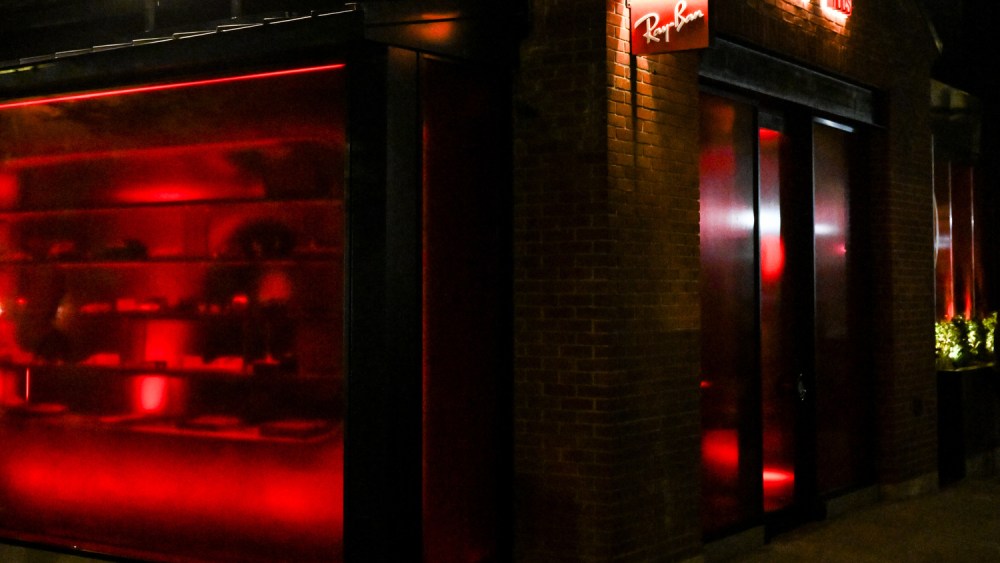
Ray-Ban is pushing beyond traditional retail with the opening of Ray-Ban House in New York, a two-story experiential concept in SoHo that reframes retail as a cultural and social destination.
Located at 62 Prince Street, the approximately 2,400-square-foot town house blends retail, hospitality and programming into what the brand describes as an “urban home.” Designed by parent company EssilorLuxottica’s in-house team, the space expands on conventional merchandising in favor of a more immersive environment, where eyewear is displayed alongside books, vinyl and collected ephemeral objects.
Related Articles

Debuting to serve as one of the after-party destinations tied to the 2026 Met Gala, the space hosted a live performance by Oscar and the Wolf, where global ambassador Jennie joined a cross-section of guests including Ella Emhoff, Ellen von Unwerth and Isan Elba.
You May Also Like
Party aside, the brand stops short of calling the House a flagship, positioning it instead as a hybrid space that blends retail, hospitality and culture, reflecting a broader shift in how brands across categories are rethinking physical retail—from fashion to jewelry to watches.
The new concept is anchored with a food and beverage program, led by Ribalta’s Pasquale Cozzolino, alongside a private upstairs room for appointments and customization of frames.
“I would not frame it as a gap as much as an evolution,” Luigi Ocone, senior vice president and general manager of luxury house brands, Ray-Ban and Oakley retail, told WWD, when asked what gaps they are addressing with the new concept space for Ray-Ban. “The transaction is only one moment. The real value is the time people choose to spend with the brand.”
Last year the brand sharpened its cultural relevance appointing A$AP Rocky as its first creative director and for Ocone, the new retail concept continues to builds on Ray-Ban’s position within the zeitgeist. “Ray-Ban has never been only about eyewear. It is tied to culture, identity and self-expression,” he said, adding that the new concept “brings that idea into physical form. It is the realization of Ray-Ban as a cultural platform.”
That throughline shapes how the space functions. With outdoor patio and fluid seating, the store is designed to encourage longer dwell time.
“Hospitality changes the role of the space,” he said. “It becomes a place people can naturally return to. You can come in for a drink, meet someone, spend time, and naturally engage with the brand.”
Strategy wise, that behavior is the point. “From a business perspective, it increases frequency and depth of engagement, which are the drivers of long-term performance,” he explained. “It requires a more patient approach, but it builds something more durable.”
Within eyewear, a retail evolution has been building, particularly with the category’s independent players. South Korean brand Gentle Monster designs stores as immersive, gallery-like environments that blur the line between art and commerce, while Jacques Marie Mage and Ahlem have leaned into more intimate, high-touch environments, from appointment-driven studios to highly curated retail spaces.
Ray-Ban House positions high-concept experiential retail in the mainstream — backed by EssilorLuxottica’s global retail network.
The SoHo space allows the brand to explore more elevated, intimate retail experiences, including private appointments and one-of-one customization. Upstairs, a hidden VIP room offers clients the opportunity to design custom Wayfarer Puffer Diamond sunglasses, selecting gemstones and frame finishes.
The concept also builds on lessons from Ray-Ban’s partnership with Meta, reshaping how the brand thinks about in-store engagement.
“The broader learning is not only about technology. It is about how people discover new ideas,” Ocone said. “They want context. They want to understand how a product fits into their life, their identity, and the culture around them.”
The executive said the shift has implications for how retail spaces are designed moving forward. “The traditional, linear retail journey no longer fully reflects how people behave,” he said. “Customers move through spaces in a more fluid and intuitive way.”
While the concept marks a departure from standard eyewear retail, Ocone positioned it less as a one-off footprint and more as a broader strategic platform.
“Ray-Ban House is not a format to copy and paste,” he said. “It is a way to understand how the brand can live physically, socially and culturally in different markets.”
Looking ahead, Ray-Ban House is designed to support the brand’s heritage and its future, particularly as eyewear continues to intersect with technology.
“Connected products are an important part of the future of the category, but they need to feel consistent with Ray-Ban,” Ocone said. “They should not exist as a separate experience.”
Instead, the goal is integration — bringing innovation into a cohesive environment rather than isolating it.
“If we do this correctly, customers will not think in terms of categories,” Ocone said. “They will simply experience a brand that continues to evolve with them.”