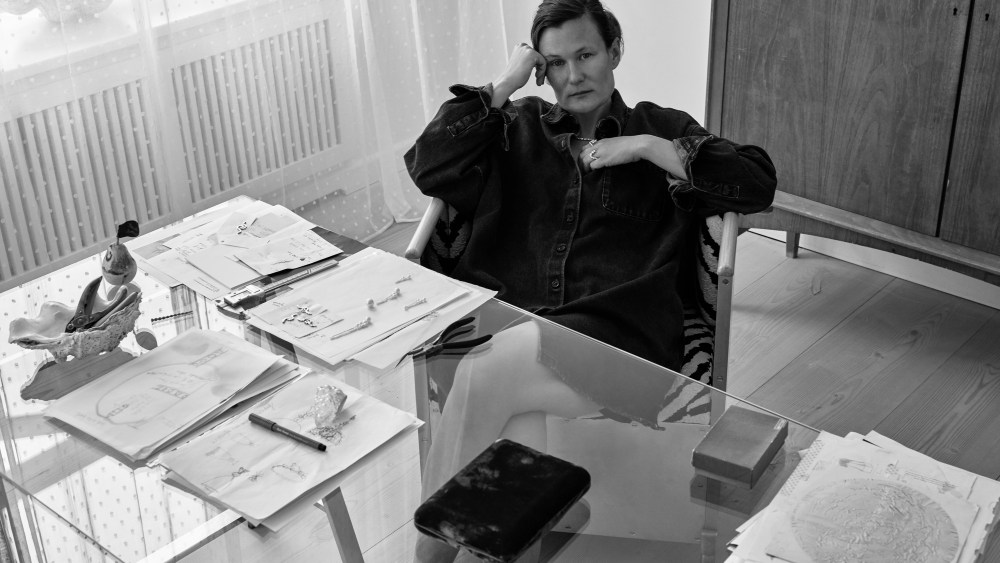
“We don’t own them. We borrow them.”
Sophie Bille Brahe is musing about diamonds, the material that has long defined her thoughtfully restrained, gemstone-led approach to jewelry — a philosophy that has shaped her creations from the beginning. Now, as the Danish designer enters high jewelry for the first time, her ethos remains, but scaled.
Bille Brahe is a jeweler’s jeweler: a creative trained as a goldsmith with a deep admiration for the craft. Her high jewelry debut unfolds less like a big bang but rather a natural extension of her existing universe — helping to mark her brand’s 15th anniversary.
Related Articles
“You need to wear it. It needs to become part of your story,” she said, highlighting how she sees pieces as meant for everyday. “When you have something this precious, you also need to live with it.”
You May Also Like
It’s a code that has defined her work from the beginning, but at the level of high jewelry, it becomes both a technical and conceptual challenge: how to translate rarity and scale into something that still feels intimate. “Even though it’s big stones, it’s light — you can actually wear it,” she said. “It’s very recognizable as me.”

The collection, composed of eight pieces spanning rings, necklaces and earrings, is crafted in 18-karat white gold and set with exceptional diamonds, including round, pear, cushion and heart-shaped stones. Prices range from $100,000 to $1.4 million and the collection will launch exclusively at Harrods’ Fine Jewelry Room in late June, later traveling to the brand’s Copenhagen and New York stores for a series of curated client presentations.
Her entry into high jewelry is rooted in a distinctly old-world methodology, one that places the stone — rather than the setting or narrative — at the center of the design process.
“It’s more like the old school definition of high jewelry, where you base everything around the center stone,” she explained.
That philosophy extends to sourcing: all center stones are fully traceable, with diamonds cut and polished in Belgium and handcrafted in Italy. Unlike larger houses, which often work from extensive inventories, Bille Brahe described her process as highly deliberate, requiring time to source stones that meet her standards, including internally flawless diamonds and precisely matched shapes for her signature graduated compositions.
“I’ve always dreamt of doing this,” she said. “But it’s also about being ready.”
Her readiness is both creative and commercial and the brand’s numbers reflect that shift. Since founding her brand in Copenhagen in 2011, Bille Brahe has been part of a new generation of designers reshaping fine jewelry through a more personal approach to technique and form. Her client roster is serious and includes Madonna, Rihanna, Emma Watson, Gwyneth Paltrow and Keira Knightley, among others.
Today she is a global brand, distributed across 123 doors in 21 countries, including Harrods, Dover Street Market and Bergdorf Goodman, as well as a global e-commerce business and her own boutiques in Copenhagen and New York.
It was the Madison Avenue store in New York that revealed a growing appetite among clients for larger, more significant stones. American customers, the brand’s chief executive officer Anne Sofie Møller noted, approach jewelry differently, often layering and stacking pieces in ways that naturally lend themselves to more substantial designs.
Under Møller’s leadership, the company has undergone a broader structural shift, moving from a wholesale-driven model to a direct-to-consumer business anchored in private sales, retail and digital channels. Today, 65 percent of revenue is generated through private sales — including e-commerce and bespoke client experiences — giving the brand greater control over its positioning and customer relationships.
The shift has coincided with sustained growth. Revenue rose 20 percent in 2025 compared with the previous year, with half of all sales coming from high-value transactions, with the company projecting a tenfold increase in revenue this year.
At the same time, Bille Brahe’s process remains deeply personal and intuitive. Ideas emerge organically, often in fleeting moments, and are worked through with her hands. “I’m not a forcer,” she said. “I’m much more about following the flow of things.”
Her instincts are supported by a technical foundation and her goldsmith training keeps her closely involved in the making of each piece.
“I’m afraid we couldn’t have done this if I wasn’t,” she said of her training. “Everything is done in a much more old-school way.”
In several cases, the wax models carved became the final pieces, bypassing more industrialized processes typically used in fine jewelry production, resulting in a collection that emphasizes handwork and material presence, even as it seeks to soften it.
“Metal is such a heavy material,” she said. “For me, it was about how to make it light.”
That tension — between weight and weightlessness — runs throughout the collection, informed in part by a dialogue with the work of Cy Twombly. His sense of softness and suspension, she said, offered a way of thinking about how diamonds might appear to hover or dissolve into the body, rather than sit rigidly upon it.
References aside, Bille Brahe is clear-eyed about her position within the category and not about competing within the spectacle-driven ecosystem of high jewelry.
“We know we cannot battle with Cartier or Tiffany’s — and we don’t want to,” she said. “We want to do luxury our way.”
Instead, her focus is on intimacy: eight pieces, each distinct, each carrying what she described as its own presence. “They’re like eight personalities,” she said of the collection, “with so much drama.”