VENICE — Jewels can be considered the first form of art, created thousands of years before any art work to celebrate love, observed Jean-Christophe Babin, chief executive officer of Bulgari.
Speaking on Wednesday ahead of the official kickoff of the Venice Biennale Arte 2026 on Saturday, Babin said Bulgari’s role as exclusive partner of the prestigious and influential contemporary art showcase “is a dream come true and perhaps it can span even longer than 2030.”
Bulgari’s support of the next three editions of the Venice-based event — running this year, in 2028 and 2030 — was revealed last year. Titled “In Minor Keys,” this year’s event was curated by the late Cameroonian-Swiss art curator Koyo Kouoh, who died suddenly in May 2025, and is staged at the city’s Giardini and Arsenale venues, as well as in various locations around the Lagoon.
You May Also Like
Related Articles
The executive said the Rome-based jeweler was “proud to contribute to the creation of a dynamic and inspiring environment in which visitors, artists and curators can come together, be creative, engage in dialogue, experiment freely, and collectively imagine and shape the culture of the future. It reflects Bulgari’s dedication to perpetuate art and beauty for an increasingly wider audience.
“By crafting unique masterpieces every day, with gold and gems that are forever, we feel protagonists of the art world,” said Babin.
The partnership with the Biennale “represents a natural extension of Bulgari’s long-standing and continuously strengthening commitment to the arts, continuously strengthened over the years,” said Babin, underscoring the continuity of investments, even during the pandemic.
“A lot of things can be done by animals. A lot of things can be done by artificial intelligence, but arts can be only done by men and women, by human beings. And this is what makes the difference between mankind and technological instruments,” continued Babin. “So that’s why we are so keen to promote our [creations], as permanent reinventions or inventions of things that even a machine couldn’t imagine.”
Babin also enthused about a collaboration between “two Italian excellences, with more than a century of history,” referring to Bulgari’s foundation in 1884, followed by the Venice Biennale, which was created in 1895.
Bulgari inaugurated the Biennale partnership with two art initiatives in Venice: The exhibition by the Canadian artist Lotus L. Kang in the Bulgari Pavilion, and the first exhibition of Fondazione Bulgari staged at the Biblioteca Marciana with site-specific installations by Lara Favaretto, “Momentary Monument — the Library,” and by Monia Ben Hamouda, “Fragments of Fire Worship.”
The latter artist is the winner of the biennial prize established in 2017 by Bulgari in collaboration with MAXXI, the National Museum of 21st Century Arts, now carried forward by Fondazione Bulgari. The foundation is also presenting her sculpture “Ya’aburnee (يقبرني ) — (Untranslated Fragment I and II)” in the garden of the Bulgari Hotel in Milan, which will remain in place for the duration of the Biennale Arte 2026, which closes Nov. 22.

Favaretto is the recipient of the Prize for Young Italian Art 2004-2005, with a work for MAXXI that was presented at the Biennale Arte in 2005.
The MAXXI Bulgari Prize will mark its 10th edition in 2027. Fondazione Bulgari in 2024 also inked a partnership with the Whitney Biennial.
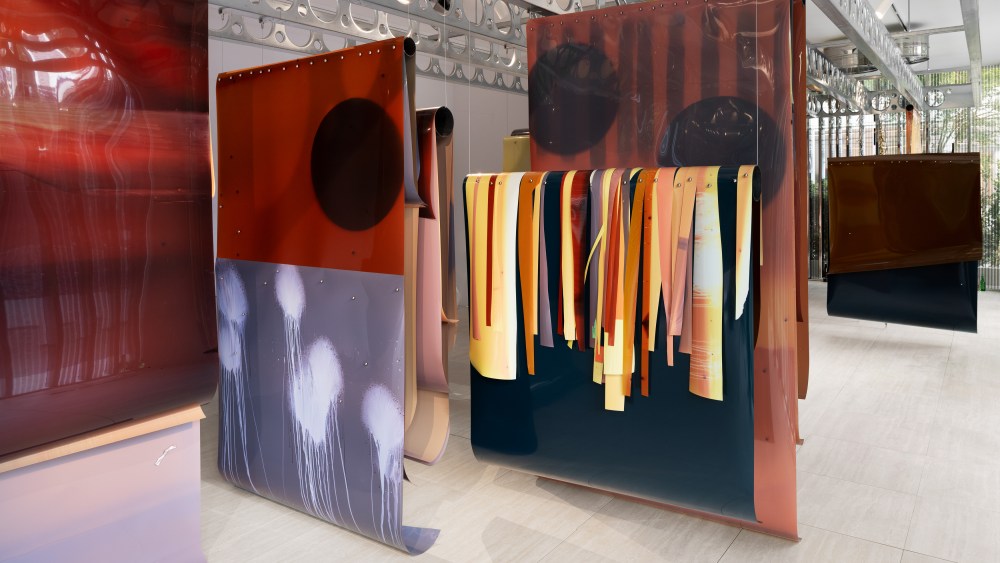
At the Bulgari Pavilion, Kang’s installation,”The face of desire is loss,” continues her enduring engagement with time as unruly and nonlinear.
Throughout the pavilion, lengths of photographic film are suspended from steel joists whose structure echoes that of the lotus root. Named “skins” by the artist, the film will morph over the months, exposed to the light and the humidity of the location. Kang also installed a series of new sculptural works, rendered from tatami mats and cast objects, and she encased the windows with lengths of 35mm film celluloid strips. Around the perimeter of the installation, the artist placed 49 bottles of spirits, a nod to the number of days a soul hovers between death and rebirth in Buddhism.
“In this context it’s exceptional that an event that has such a global impact has only one exclusive partner,” said Babin, praising the organizing body’s decision to stay away from exploiting commercial avenues.
Likewise, he praised both the brand’s parent LVMH Moët Hennessy Louis Vuitton and the Bulgari founding family for “never hesitating, even when the company was very small, to find resources” to champion the arts, supporting for example the Accademia Nazionale di Santa Cecilia in Rome.
There is no doubt Bulgari has invested in antique and contemporary art for years, restoring storied landmarks and supporting Save the Children, among other charities. For example, Bulgari contributed to the restoration of the 16th-century Scala d’Oro at the Doge’s Palace in Venice, called Golden Staircase for its stuccoes in gold leaves, and the paintings by Paolo Veronese in the church of San Pietro Martire in Murano. In the Italian capital, Bulgari restored the Spanish Steps, the polychrome floor mosaics of the Baths of Caracalla and the marbles of the Torlonia Collection.
Bulgari will open a new goldsmith school in Rome in September and Babin said he had high hopes of “making the city the capital of high jewelry.”
Also, while the Museum of the Mausoleum of Augustus in Rome near the Bulgari Hotel isn’t expected to open until 2028, the gardens surrounding the site will open in June, said Babin.