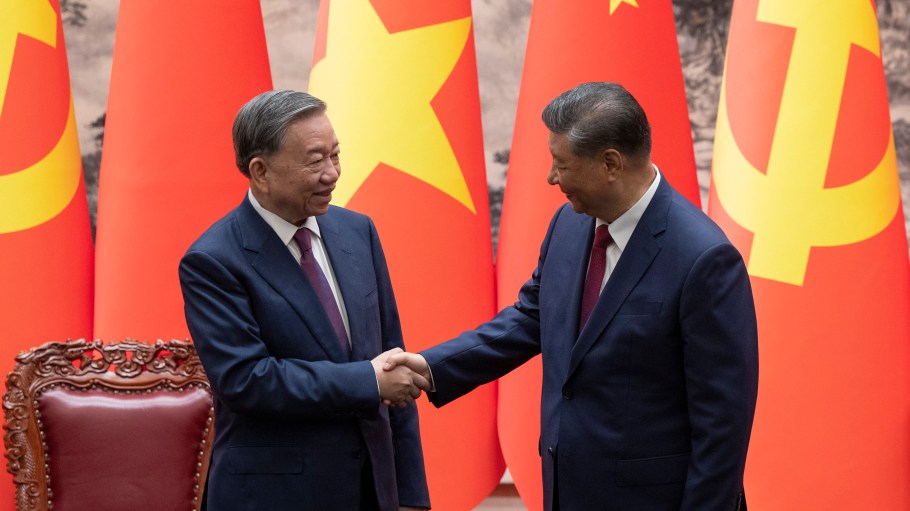
Chinese President Xi Jinping has kicked off his visits to Southeast Asian nations this week with a first stop in Vietnam.
The leaders are expected to speak about a number of issues, including the inevitable: trade and tariff strategy.
Xi wrote a piece for Nhan Dan, the official newspaper of Vietnam’s Communist Party, which was posted before he arrived in the nation Monday. In it, he urges Vietnamese leaders to collaborate with the Chinese government on a variety of issues as partners.
Related Stories
Though he did not directly cite China’s ongoing trade war with the United States, Xi alluded to tariff troubles, which tracks with last week’s tit-for-tat trade battle between the two countries.
“There are no winners in trade and tariff wars, and there is no way out of protectionism,” Xi wrote in the piece, translated to English by the South China Morning Post.
U.S. President Donald Trump announced last week that he had increased tariffs on goods inbound from China to 145 percent, which combines a 20-percent fentanyl-related levy with 125-percent tariffs. Beijing hit back with 125-percent tariffs on goods imported from the U.S. but noted that it would likely stop increasing that number.
Xi’s visit to Vietnam comes just days after the most recent strike in the trade war.
China is Vietnam’s largest trading partner, and the two nations are interconnected economically, particularly via their respective supply chains. Xi said China remains interested in fostering a civil and fruitful partnership with Vietnam.
“Our two countries should resolutely safeguard the multilateral trading system, stable global industrial and supply chains, and open and cooperative international environment,” Xi wrote for Nhan Dan, per Xinhua, China’s state news agency.
Fashion and apparel brands and retailers rely heavily on each of the two nations’ manufacturing infrastructure. Vietnam—and Cambodia and Malaysia, where Xi is set to visit later this week—will need to act thoughtfully when it comes to negotiating with China. Otherwise, the nations risk triggering further tariff volatility from Trump, who has shown he has a distinct interest in U.S. manufacturing and competition with China.
During his “Liberation Day” conference announcing his so-called reciprocal tariffs, Trump imposed a 46-percent tariff on Vietnam, which, at the time, was a major blow to companies that had diversified their sourcing out of China and into the Southeast Asian country. Tariffs on Malaysia hit 24 percent, while Cambodia came in at the highest of the bunch with a 49-percent duty.
For the moment, the duties on goods imported from any of the three countries are paused as Trump and Jamieson Greer, the U.S. Trade Representative (USTR), work to negotiate trade deals with myriad countries—with the notable exception of China.
Reuters reported last week that Vietnam’s leaders were considering a crack down on transshipment of Chinese goods through the country in an effort to appease the U.S. government. Transshipment occurs when goods headed for the U.S. pass through Vietnam first, primarily in an effort to draw lower duties.
But Hanoi risks angering Beijing if it goes all-in as a trade ally with the Western nation, which could jeopardize other deals.
It remains to be seen how, exactly, Hanoi and Beijing will manage an unnerving and fraught global trade environment before Xi leaves to finish his rounds in Southeast Asia.