As Chinese President Xi Jinping embarked on his three-country visit last week, it was clear that China had wasted no time in picking up on the discontent that has exploded in South East Asia after the announcement of steep U.S. tariffs on the region earlier this month.
Xi’s three stops included Vietnam (which was slapped with a 46-percent tariff on president Trump’s “Liberation Day”), Malaysia, hit by 24 percent tariffs, and finally Cambodia, which is faced with a 49-percent duty rate after the 90-day deferral period ends.
Related Stories
The region is still “reeling from the shock,” analysts have noted amid the ongoing negotiations between Asian nations and the U.S. In each of the countries in question, president Xi had a strong message. He extended the hand of friendship, but also opposed the “hegemonism and protectionism” espoused by Washington.
This was president Xi’s first trip out of China in 2025, and analysts commented on the “well-timed” nature of the visit as China handed out promises and promoted a sense of regional solidarity. It was clear that the country also aimed to open avenues for itself in a region where it already has an economic stronghold. As China now contends with a 145-percent duty from the U.S., the visit was seen as the most fiscally significant to date.
President Xi’s last stop in Phnom Penh, which concluded Friday, reiterated the “iron-clad friendship” between China and Cambodia.
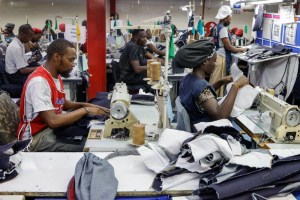
An estimated 50 percent of the apparel manufacturing factories in Cambodia are said to be under Chinese ownership. The International Monetary Fund estimates that one-third of Cambodia’s foreign debt of $11 billion is owed to China, and there is much need for restructuring as the country prepares for a graduation from Least Developed Country (LDC) status in 2029.
The business community has been on edge since President Donald Trump’s tariff proclamation despite the call from the Textile, Apparel, Footwear and Travel Goods Association (TAFTAC) to “stay calm” while the “actual impact of the sudden announcements” were being analyzed.
Over the past year, U.S. retailers have been stepping up imports from Cambodia, with garment, footwear and travel goods hitting $13.78 billion in 2024, up 23.78 percent over the previous year. The sector accounted for more than 50 percent of Cambodia’s total exports of $26.19 billion in 2024, employing more than 750,000 workers.
U.S. brands importing from the country include Under Armour, Lululemon, Black & Decker, Hugo Boss, Eddie Bauer, Dollar General and Bass Pro Shops, according to Customs data.
“The strong relationship between China and Cambodia represents a positive development as it facilitates the growth of the value chain and opens new market opportunities for Cambodia within China,” Herman Leung, vice president of sales and operations for Dakota Group, told Sourcing Journal. He pointed out that the “new and dynamic leadership in Cambodia is demonstrating considerable energy in addressing international challenges.”
While adding that the neighboring countries were also faced with similarly elevated tariffs, he said that Cambodia’s competitiveness would “hinge on its supply chain flexibility, creativity and sustainability.”
“Therefore, I strongly recommend that Cambodia invest in developing a local textile supply chain to prepare for its future graduation from Least Developed Country (LDC) status. This initiative will enhance Cambodia’s capacity and resilience,” he said, citing the establishment of one of Cambodia’s first vertically integrated fabric mills in 2017, which was done “specifically to future-proof” operations from coming changes.
In the past two weeks, industry heads have been conferring quickly and trying to look at possibilities of diversification and ways to cut costs in operations along with other means of survival.
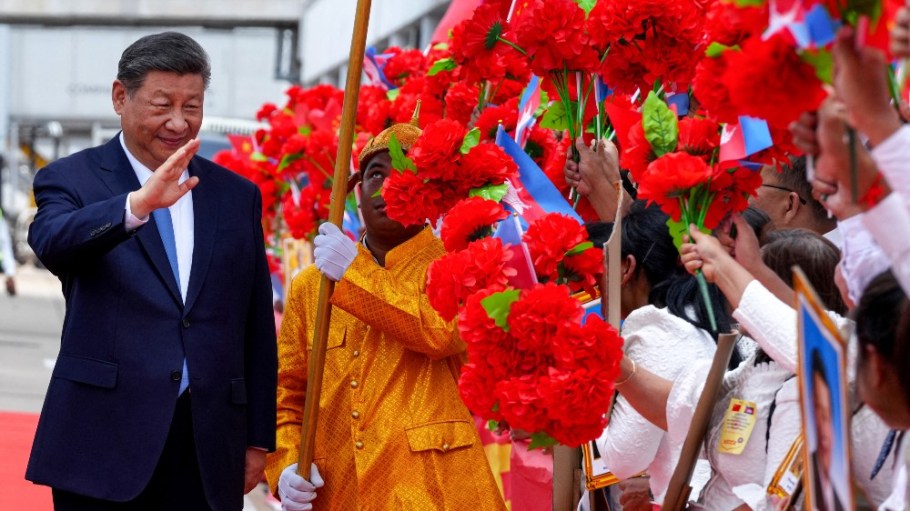
It wasn’t a surprise then, that president Xi was received warmly in Cambodia, with King Norodom Sihamoni and Senate President Hun Sen heralding his arrival at the airport.
The wide ranging discussions included maximizing the potential of existing trade frameworks, including the Cambodia-China Free Trade Agreement, the Regional Comprehensive Economic Partnership (RCEP), and the ASEAN-China Free Trade Area. “These were something of a salve,” Cambodian manufacturers told Sourcing Journal.
Business investments by China have made a crucial difference in the region for years.
In Cambodia, for instance, the Sihanoukville Special Economic Zone, an important industrial hub, has brought in more than 200 international enterprises. Manufacturers said that connectivity within the country has improved with the country’s first expressway, the Phnom Penh-Sihanoukville Expressway.
The trip began on a similar note at his first stop in Vietnam on April 14 and April 15.
President Xi spoke about China’s dedication to “boosting trade and supply chain relations with Vietnam to mitigate the impacts of US tariffs.” Among the 45 bilateral cooperation agreements signed with Vietnam’s president To Lam during his visit, supply chain resilience, infrastructure and digital economy were part of the shared agenda.
In an article published in Vietnam ahead of his trip, Xi noted that there were “no winners in trade wars and tariff wars,” but he made it more amply clear during his visit that it was important to “oppose unilateral bullying” together.
The question of how these “iron clad friendships” in the region affect strong export markets for the U.S. has also been part of the quandary for Asian suppliers.
Vietnam’s exports of textiles and apparel touched $44 billion in 2024. The U.S. was its largest export market, accounting for an approximate 38 percent of the total at $16.71 billion, according to the Vietnam Textile and Apparel Association. Among the large U.S. retailers that manufacture in Vietnam are Nike, which sources more than half its footwear there, Gap Inc., VF Corporation, Under Armour, Levi Strauss & Co. and Columbia Sportswear, among others.
However, China is a strong trading partner too; in 2024, Vietnam imported $144 billion worth of goods from China, while the U.S. imported a total of $136 billion of goods from Vietnam.
A manufacturer from Vietnam who asked not to be named said, “This is being a time of reckoning for us. We need both the Chinese inputs, as much as we need the U.S. markets.”
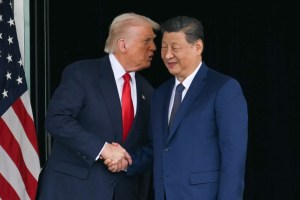
President Trump was evidently not pleased by the visit either, commenting to reporters on Monday that China and Vietnam were discussing how to “screw the United States of America.”
Meanwhile, high-level policy dialogues between each of the countries and the U.S. are in process, with negotiations being key to finding a less damaging path into the future for both the region as well as U.S. consumers, who are now threatened with higher prices.
President Xi maintained the theme of friendship as a forward-looking path for Asia, and it was a theme at his second stop in Malaysia. He was heralded by a signed article in the local media: “May the Ship of China-Malaysia Friendship Sail Toward an Even Brighter Future,” underlining both history, and a “shared future.” That the trip showed results was clear as Malaysian prime minister Anwar Ibrahim and president Xi Jinping concluded on 30 bilateral cooperation documents.
Malaysia has counted on China as its largest trading partner for well over a decade, with an approximate $212 billion in China-Malaysia trade in 2024. The call for industrial supply chains and multilateral trading systems to ramp up left an impression, business leaders noted, buoyed by Xi’s calls to “work together to give fresh momentum to the ship of friendship that has sailed through the long river of history, and ensure that it forges ahead steadily toward brighter horizons.”
Yet, the undercurrents in this long river of friendship are not entirely invisible.
Disputes about territory and the South China sea have been a spoke in the larger wheel, along with warnings of political ambitions inherent in the Belt and Road initiative and the infrastructure investments that have helped progress in the region. Analysts noted that manufacturers needed to be wary of yielding “absolute control, especially given the imports from China that have been essential for apparel manufacturing in the region” as well as of being the middlemen in the rough seas between China and the U.S. Still, the area’s regional strength cannot be ignored: China-ASEAN trade was close to $1 trillion in 2024.
Talks within manufacturers’ associations and informal industry discussions have been erupting across the region. While concerns are being aired in undertones, they have largely been focused on whether friendship and regional camaraderie could outdo the pressure of the changing economic order.
Meanwhile, even as some analysts have been cynical about this “neighborhood diplomacy,” given that the U.S. continues to be a big export market, president Xi’s trip made clear that the sense of solace for the region was rooted in more than friendship. Hard economics are at play; something that the eventual negotiations of tariffs will either sway or cement.
In the immediate instance, Asian relations tend to be leaning more toward camaraderie, as President Xi concluded his visit to each of the countries with a promised vision. A point made in Kuala lumpur on Tuesday but repeated, was that things could now move to a “new level.”