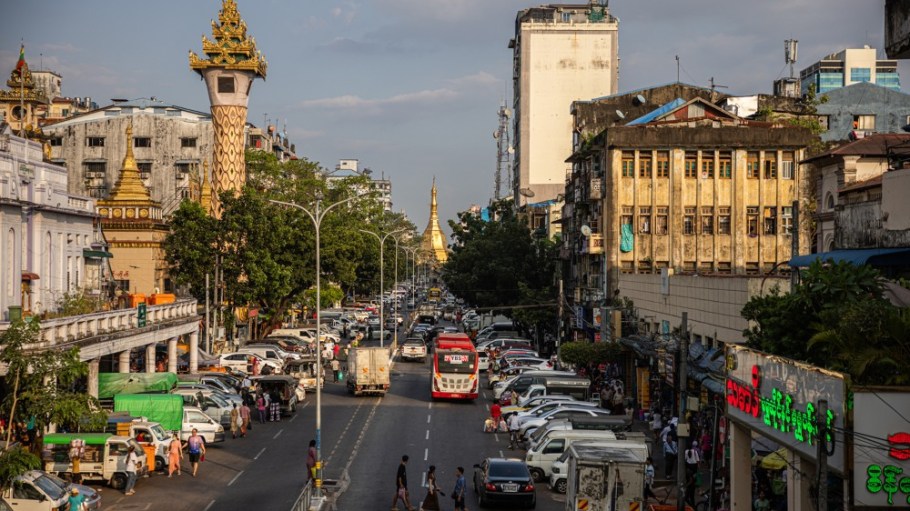
As the Association of Southeast Asian Nations (ASEAN) summit opens in Cebu, Philippines on Thursday, the question of Myanmar still hangs heavy in the balance.
The 11-member bloc is well aware that the legitimacy of Myanmar’s military junta—which has battered the country over the past five years and driven much of global business to exit—remains in doubt.
Min Aung Hlaing, who has run the country for the last five years after a coup in February 2021, was named president on April 10, putting aside his military antecedents. Analysts and media have described this transition as a “civilian veneer to military control,” as his 34-member parliament was sworn in after a three-pronged election process earlier this year.
This has meant giving up his title as Senior General and Commander in Chief of the Myanmar military (Tatmadaw). This transition from active military command is being seen as a calculated move to retain power.
Related Stories
In these past years, Min Aung Hlaing was not invited to ASEAN summits, and this week, despite his new official position, the ASEAN chair has made it clear that he has not been welcomed to the 48th ASEAN Summit either because of a lack of progress on the bloc’s peace plan. The peace plan has called for an immediate cessation of violence and constructive dialogue among all parties, among other agenda items.
Myanmar continues to be rocked by insurgent violence, as groups fighting for democracy continue to hold out. According to local news reports, the new government/military junta has a hold on approximately 20 percent of the country, while resistance forces and ethnic armed organizations control around 42 percent. The rest remains unclear.
The ASEAN summit is scheduled for May 7–9, with heads of state and top ministers of the other countries expected to attend. The poly-crisis in Myanmar is expected to be pivotal in discussions. ASEAN member states include Brunei, Cambodia, Indonesia, Laos, Malaysia, Myanmar, the Philippines, Singapore, Thailand, Vietnam and Timor-Leste.
It isn’t just about politics, however. Economic restructuring and the return of business investments and exports are key to the stability of the country, and ASEAN acceptance is being seen as a cornerstone for rebuilding after years of decline.
As analysts tell it, “Now that many global investors have already left the country, it is much more than just optics. They need to be sure before they return.”
“It’s well past the point of just the military ruling in civil garb,” a Myanmar-based manufacturer who has been expanding and hiring workers in the last month told Sourcing Journal. “It is clear that we have to fight the devastation of the past years, and we need foreign exchange; workers need money. Networking has begun in more earnest, and experimenting with all possibilities has been a focus.”
Aye Mi Shein, managing director of the Myanmar Garment Manufacturers Association (MGMA) told Sourcing Journal, “We have developed the second-term 10-year strategy with a strategic action plan (2025–2034), beyond the first-term 10-year strategy (2015–2024),” while delineating regional engagements and events over the last month.
Myanmar’s apparel exports grew by 9 percent in the first half of the 2025–2026 fiscal year starting April 1, despite high-level challenges. The industry remains a top earner, though it is impacted by labor shortages, power outages, and ethical concerns.
She said that strategic planning over the past month has also brought together industry heads to set priorities and ensure that the industry continues to grow. The plan targets a $15 billion garment industry employing up to 1.6 million workers over the next decade, with a strong emphasis on high-quality, value-added products and responsible production standards, she said. Meanwhile, regular executive committee meetings and exchange sessions with garment clusters are continuing to help monitor and plan growth.
The economic spiral after the February 2021 coup has been immense, bordering on structural collapse, with GDP contracting by a cumulative total of around 20 percent by early 2026, according to industry analysts. More than 3.5 million people are listed as internally displaced as of 2026, with an estimated 16 million in need of humanitarian assistance. Active fighting in over half the country’s townships has broken supply chains, crippled border trade, and caused mass displacement, according to the United Nations and its humanitarian partners.
The World Bank has projected negative GDP for the 2025-2026 fiscal year, with a further contraction of minus 2 percent. The Myanmar kyat has lost roughly three-quarters of its value since the 2021 coup, while official rates have been tightly controlled at around 2,100 kyat per dollar, market rates have been estimated to be approximately 250 percent lower, depending on the source; inflation is projected to exceed 30 percent in 2026.
Clearly, the new government is making overtures toward investors and business heads around the world, while negotiating toward required peace agendas, albeit in a limited way.
As of early May 2026, and well-timed before the ASEAN meet, Myanmar’s military government has released prisoners in several rounds as part of the traditional amnesty period following the presidential swearing-in. Marking the traditional New Year (Thingyan), more than 4,000 prisoners were released, and more than 1,500 on Buddha Day at the end of April, a move seen as aiming for social reconciliation. Many prisoner sentences were also reduced by one-sixth.
There has also been a significant shift in the status of human rights activist and opposition leader Aung San Suu Kyi, who remains a deeply revered figure for many in Myanmar, even though her National League for Democracy, which won the elections in 2021, has been barred from elections. This week, her sentence was cut from 33 years to 18 years, and she has been moved from prison to house arrest.
The steps toward more business inclusion are being thought through as well.
Business heads in Myanmar are unequivocal about the role being played by Chinese business, both in terms of expansion and investment.
Over the last four weeks, Chinese-backed entities have announced highly ambitious, long-term investment goals for Myanmar, including a target to draw approximately $500 billion (3.5 trillion yuan) in Chinese investment between 2026 and 2030. This target is intended to be implemented through the newly established Myanmar-China Investment and Trade Promotion Association (MCITP), launched on Jan. 31, 2026, to boost bilateral trade and investment.
China remains the largest foreign investor in sanctions-hit Myanmar, accounting for most of the new projects approved in the first 10 months of the 2025–2026 fiscal year, according to figures from the Directorate of Investment and Company Administration (DICA) cited by junta media.
The Myanmar Investment Commission approved 67 projects worth more than $398 million during this time, including capital expansions by existing enterprises. While a large share of investors have been from China, there have also been others from Hong Kong, India, Taiwan, Japan, Thailand, South Korea, Samoa, Singapore and the UK.
Last week, Yangon also hosted a Guangdong-Myanmar economic and trade exchange meeting, along with a showcase of investment opportunities in the Guangdong-Hong Kong-Macau Greater Bay Area, and these kinds of conversations are only getting amplified.
But is this mere optics as well?
Jared Bissinger, Visiting Research Fellow with the Myanmar Studies Programme at the ISEAS Yusof Ishak Institute, told Sourcing Journal that it was still “really early days.”
“For most businesses, the country is still a really tough place to operate,” he said, pointing out that “overall not much has changed under the new government.”
“Key economic restrictions like widespread trade licensing, foreign exchange rationing, fixed exchange rates, and capital controls are still in place. These don’t affect the garment sector quite as badly as other sectors. But for garments, they face a situation where the exchange rate (controlled by the regime) has been flat for quite some time, while inflation in-country has been rising. This means that while factories get about the same amount of local currency for their incoming forex, workers’ needs are growing. Over the long run, this is going to create real problems,” he said.
While the real concern is whether ASEAN will accept the new government, he pointed out that this remains unclear as well.
“Thailand has talked about a policy of calibrated re-engagement, but this isn’t unconditional. The Thai foreign minister said this was a two-way street and that Myanmar had to take positive steps, namely addressing issues in the ASEAN five-point consensus. The regime has released some political prisoners, but that’s about it so far,” he noted.
However, the point of the whole election exercise and the appointment of the formerly military—but now civilian—leader is still being dismissed by many as a farce.
The ASEAN meet is being watched closely for this reason: its stance on the Myanmar general elections, which many have dismissed as a “sham,” as well as the steps that need to be taken to engage the new government.
“We need to press for positive progress. We are now in a new phase. If we are trapped in the past, confrontation between ASEAN and Myanmar will continue,” Parnpree Bahiddha-Nukara, chief advisor and special envoy of Foreign Minister Sihasak Phuangketkeow, observed recently.
Global companies that withdrew over the last five years, citing human rights violations and a refusal to work with a military regime, are not hurrying to return. Whether they can actually be wooed back appears to be a major item on the new government’s agenda.
As one Malaysia-based manufacturer put it, “Clearly, business interests have not quite written off Myanmar yet—especially given its low wages and strong apparel export performance over the last decade—but there is still no real sense of assurance of stability.”
He said he and others are “still watching carefully.”