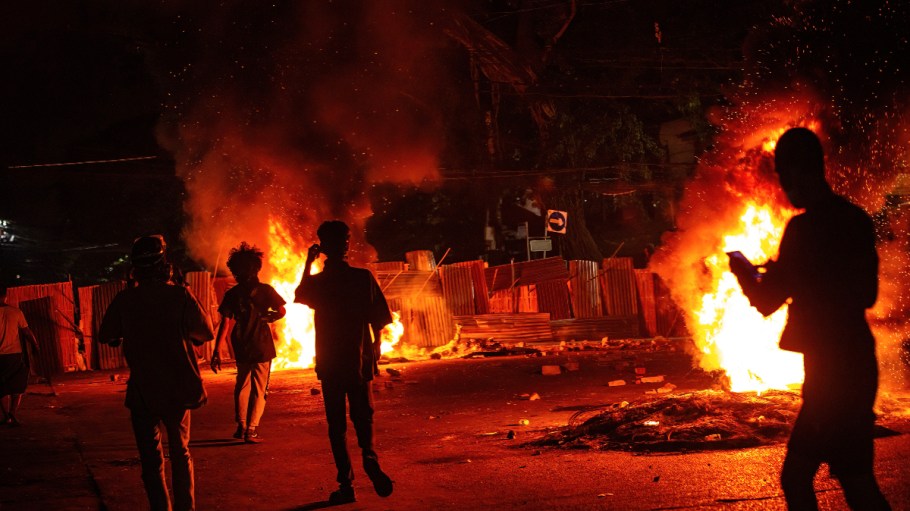
Just a day ahead of the fourth anniversary of the military coup in Myanmar, the government revealed another six-month extension of the state of emergency on Friday.
As the country continues to be torn by turmoil, there is a general lack of belief that elections later this year would be held in a fair and non-partisan manner. In this deteriorating situation, the allegations of serious labor rights abuse have been a recurring concern.
A new report issued by the Business & Human Rights Resource Centre (BHRRC) on Friday noted that garment workers have been faced with a growing amount of abuse. It pointed out that 108 allegations of labor rights abuses—linked to 80 international apparel brands—were tracked over a four-month period in 2024.
Related Stories
Among the brands listed as sourcing from factories linked with allegations of serious rights abuses are major high-street fashion brands including H&M, Frasers Group, Bestseller and Reserved.
Describing the situation, Mayisha Begum, labor program officer, BHRRC, told Sourcing Journal that many of the repeat situations faced by workers included forced working hours—which often meant having to spend nights at the factories—sexual harassment, unhygienic and increasingly difficult conditions for women, and intimidation
“It’s not that these conditions are new,” she said, “but prolonging these conditions has just made it worse.”
Begum shared highlights from the report, which included the fact that brands like Reserved, owned by LPP S.A had more than 21 allegations against it.
Among the responses from the brand addressing the allegations was also a statement that four of the factories where abuses were alleged were not in its supply chain.
BHRRC has been tracking the abuse allegations since the coup, and noted that in the last four years there had been 665 incidents linked to 187 international brands. Through collaboration with partners and allies inside and outside Myanmar, BHRRC is monitoring the significant increase with the Myanmar garment worker allegation tracker.
The report on Friday highlighted the fact that:
— 66 percent of factories had unsafe working conditions
— 62 percent had inhumane work rates and mandatory overtime.
— 55 percent of cases had harassment, intimidation and abuse
— 53 percent of cases saw reduced wages and wage theft:
— 47 percent of cases saw gender-based violence and harassment
Natalie Swan, labor rights program manager, pointed out that this was a “uniquely hostile environment in which to work.”
“Despite these threats to their livelihoods—and often their lives—workers continue to fight for their rights. But brands—and their home states—must do more to avoid being complicit in these abuses. We need to see stronger corporate commitments to heightened human rights due diligence, and where this is impossible, responsible exits from the country,” Swan said.
According to the report, factories were also accused of weaponizing the threat of military intervention to suppress dissent and prevent workers from standing up for their rights.
BHRRC noted that brands continuing to source from the country must “ensure that high-risk abuses are addressed. This includes working with suppliers to ensure the provision of safe transportation to and from work, and maintaining fair purchasing practices that address the prolific allegations of unsafe working conditions, low wages and forced overtime as the norm for the women toiling in Myanmar’s apparel factories.”
Others believe that if they cannot offer protection to the workers, global brands should not be sourcing from Myanmar at all.
“For the sake of millions of Myanmar workers, including members of IndustriALL, living under the oppression of the military junta, we repeat our call to international brands to divest their business in Myanmar. Their businesses are built on the basis of forced labor and workers’ blood in the country. Workers’ rights must be defended and democracy restored in Myanmar,” Atle Høie, IndustriALL general secretary, said in a statement.
In November last year, IndustriALL GlobaI Union filed complaints against three major garment brands—Next, New Yorker and LPP—at OECD’s National Contact Points (NCPs). Despite overwhelming evidence of continuous violations of workers’ rights under Myanmar’s military junta, these brands continue to place orders in the country, profiting from the eradication of labor and human rights.
The Confederation of Trade Unions of Myanmar (CTUM) has raised concerns about the forced overtime as well, saying that garment workers are given unreasonable targets and then forced to work longer. The overtime is being done with without compensation and benefits.
Given the tough economic scenario, it is estimated that approximately half the factories have shut down, and the ones that are functioning are faced with a series of issues.
According to the World Bank Economic Monitor published in December, power shortages remain a major hurdle to business operations, especially in the manufacturing sector. Sixty-five percent of firms surveyed in September/October reported experiencing frequent unplanned power blackouts over a three-month period while about 54 percent of firms reported investing in expensive diesel-based generators to maintain operations.