Even as election results were announced in Myanmar on Friday, business leaders assessing sourcing and operations in the country said they were in no rush to re-establish their stake or grow investments.
The vote results were released just two days shy of the five-year anniversary of 2021’s coup.
Labor groups and resistance fighters prepared to mark the anniversary of “years of repression and dark times.”
Related Stories
As expected, the military backed Union Solidarity and Development Party (USDP) won by a landslide.
Numerous countries, human rights organizations and unions from around the world have dismissed the elections as a “sham,” citing the fact that opposing parties were banned from participating, and that just a little more than half the nation’s geography cast their vote in the elections (55 percent).
There were also reports of forced participation in voting, watched over by the ruling military junta, as well as thousands of pro-democracy believers languishing in jail, and the fact that numerous countries decided against sending observers for the elections, including the Association of Southeast Asian Nations (ASEAN).
Senior General Min Aung Hlaing, who seized power in 2021 is largely expected to be chosen as president when the new parliament comes into force, which is likely to happen in March.
Analysts told Sourcing Journal after the election that the expectation is that the new government which will be formed in April will be “another version of the present hierarchy, except that it will be perceived and branded as legitimate by those who want to restart, or do business in Myanmar.”
Jared Bissinger, Visiting Research Fellow with the Myanmar studies program at the Yusof Ishak Institute (ISEAS) told Sourcing Journal that post-elections things could not be expected to suddenly change.
“I don’t think the election will transform the economy, or lead to major changes in the country’s circumstances—at least in the near future. Gradual change is more likely but by no means guaranteed. Key constraints for businesses, like the multiple exchange rate system, will persist, as will labor-related challenges like wages and working conditions,” he said.
“But there will be some improvements in the business environment, with a few things—like increased power supply—already moving forward. There will probably also be an increase in new investments in the garment sector post-election. Trade with China may increase, but it’s not clear when this might happen or how it would benefit the garment sector,” he observed.
Whether the election results will be endorsed by global partners and whether or not it will help restore political and economic stability has been under intense speculation.
While the junta had reportedly pinned much hope on post-election acceptance by the Association of Southeast Asian Nations (ASEAN) countries, the group has refused to endorse the results. Yet, Myanmar remains a member of the bloc, and it is still unclear if members will continue to take a unified stance on the newly elected government in coming months.
“While obviously ASEAN not recognizing the election is a political blow for the regime, it’s not clear how significant the economic implications of that will be. Myanmar still participates in many working level ASEAN meetings. And recognition of the election wouldn’t by itself make the country any easier for investors or sourcing,” observed Bissinger.
The U.S. has taken a wait-and-watch approach with the U.S. State Department neither acknowledging nor condemning the results but simply stating that “it is monitoring the situation closely and will assess the military regime’s next steps, including whether it eases violence and restores freedoms.” Before the elections, U.S. lawmakers (both Democratic and Republican) urged the Trump administration to reject the elections as a sham.
Meanwhile, other countries like China, Russia, India, Vietnam and Cambodia are seen as more ready for interaction, particularly China which is looking to protect its economic interests.
Labor leaders are deeply concerned.
“The so-called election results are nothing more than the culmination of a sham process designed to entrench military rule,” said Shoya Yoshida, General Secretary of ITUC-Asia Pacific. “Recognition of these results would only embolden the junta and prolong the suffering of Myanmar’s people, including workers who continue to face violence, forced labor, and the destruction of their livelihoods.”
In a statement, ITUC-Asia Pacific observed that since the coup the military has “systematically dismantled democratic institutions and launched campaigns of repression against trade unionists, civil society, and ordinary workers’.”
“Arbitrary arrests, torture, enforced disappearance, forced conscription, and mass dismissals have been widely reported. Trade union leaders, including leaders of the Confederation of Trade Unions Myanmar (CTUM) and sectoral federations, remain imprisoned, targeted, or in hiding, making meaningful political participation impossible for workers and trade unions, which ITUC-Asia pacific considers as vanguards of democracy,” the statement noted.
Other unions too, have been expressing their fear that the elected government would only suppress labor rights further, along with freedom of association.
“The military’s sham elections cannot conceal the reality of repression, forced labor and the systematic denial of workers’ rights. Governments, brands and international institutions must stop doing business as usual and take concrete action to end financial support to the junta,” said Atle Høie, general secretary, IndustriALL.
While reiterating that the union movement stood in solidarity with workers who continue to fight for basic rights, democratic freedoms and decent work, he said that since the coup in 2021, “independent unions have been banned, union leaders arrested and fundamental freedoms obliterated. Under military rule, more than 7,000 civilians have been killed, and millions have been displaced and forced to flee from their homes.”
“At the end of last year, the military launched an election silencing the democratic opposition. The elections have been widely dismissed as a sham designed to legitimize continued military control rather than reflect the will of the people. No credible international observers have been allowed to monitor the vote, and many political parties have been barred or dissolved ahead of polling,” he said.
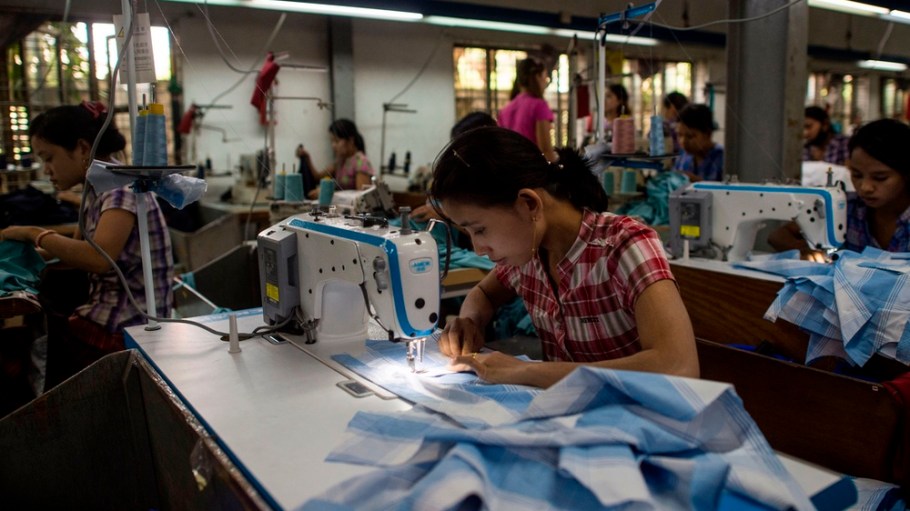
While many global brands who had started looking at Myanmar for sourcing after the 2010 elections have left the country, the shifting geopolitical situation in the region, as well as the low wages in the country, have kept it as an open option.
IndustriALL has renewed its call for brands and companies to withdraw from Myanmar, pointing out that “enhanced due diligence cannot mitigate the inherent risks of operating under a dictatorship that outlaws independent unions, imprisons workers and systematically violates labor rights.”
Unions have also pointed out that the textile and garment industry is a major source of foreign exchange for the regime, helping to fund weapons, ammunition and fuel.
In 2024 IndustriALL Global Union filed complaints with the OECD National Contact Points against major garment brands, including Next, New Yorker,LPP and Sioen, for breaching the OECD Guidelines for Responsible Business Conduct by continuing to source from Myanmar.
The complaints are backed by Myanmar unions CTUM and IWFM, now operating in exile.
According to the complaints, the companies operating in the past years have benefited from widespread violations of workers’ rights under military rule, where freedom of association is impossible and forced labor is reported.
What will happen with foreign direct investment in Myanmar after the elections? How will the broken systems for power, electricity, and transport be fixed to facilitate the restructuring of the thousands of closed factories and the movement of finished goods?
While analysts are still struggling to find answers to these questions, they have noted that business leaders are still waiting and hoping for more clarity as the new policies are announced.
Although many global brands chose to exit Myanmar over the past years, including H&M, Inditex (Zara), Primark and Marks & Spencer, the prospect of business fueling the economy is still a larger dream. A union leaderswho asked not to be named, said wistfully, “We still live in hope. It is not just about elections, but an end to the war which is still raging. We want the results to bring peace.”