The Office of the U.S. Trade Representative has announced the appointment of Katherine White as its Chief Textiles and Apparel Negotiator.
White, who previously served as International Trade Policy Advisor on the House Committee on Ways and Means, will now lead the USTR’s Office of Textiles in international trade negotiations impacting the textile and apparel sector, with an eye toward strengthening the standing of U.S. producers in foreign markets.
Throughout her career in Congress, White helped shape U.S. trade laws and aided in the negotiation and implementation of programs like the United States-Mexico-Canada Agreement (USMCA). She worked alongside industry players in the creation of that legislation.
Related Stories
White sat down with Sourcing Journal to provide insight into her outlook on current and future trade agreements, nearshoring and the resurgence of the U.S. textile sector.
Sourcing Journal: The first thing I want to know is what you envision for the coming years based on the Biden administration’s priorities for textiles and trade policy.
Katherine White: We are keenly aware of the challenges that China’s unfair trade practices pose to U.S. workers and industries, including in the textile and apparel sector, and the threat of those policies to global supply chain resiliency. So, we are undertaking a whole of government effort to proactively strengthen supply chain resilience and mitigate the impact of supply chain disruptions, including the recent Covid-19 pandemic.
USTR held a hearing on this topic just this past week. From a trade perspective, resilient supply chains allow for a range of sources for critical inputs, they’re more adaptable, they rebound and they recover with agility when they’re faced with economic shocks, and they really boost domestic manufacturing and the domestic workforce, which are two drivers of economic growth and American innovation.
SJ: I know you aided in the development and implementation of the U.S.-Mexico-Canada Agreement (USMCA). How do you hope to see that agreement used to its greatest advantage in the textile and apparel space?
K.W.: From my perspective, the renegotiation of the North American Free Trade Agreement, or NAFTA, presented a real opportunity to modernize our trade relationship with two of our most important trading partners: Canada and Mexico.
The USMCA, in my view, reflects the interests and the needs of the United States and our stakeholders including American workers and industries and even environmental groups. In fact, in many ways, the USMCA represents what I would call the floor of what of what current and future U.S. trade agreements could look like.
You may be aware given your role and your reporting that the USMCA region is the most significant U.S. export market for textiles; Mexico is a top buyer of American made fiber yarn and fabric exports. An important part of my job is to ensure that the USMCA and other U.S. trade agreements are working as intended for our textile and apparel industry—as an example, I’m working with my Canadian and Mexican counterparts now to make sure that we have sufficient supply within the USMCA trade area of a certain yarn that goes into fabrics used to make fire hoses.
Another piece of all of this is trade enforcement. That’s really critical to preserving U.S. trade agreements. And that’s why you’ve seen the Biden administration has taken steps to develop and to maintain a really robust and comprehensive enforcement strategy to combat illicit trade and to level the playing field for the domestic textile industry.
From our perspective, we continue to see really great potential for textiles partnerships close to home, given proven success of these trade relationships and their benefits for us textile exporters. The USMCA and the Dominican-Republic Central America Free Trade Agreement (CAFTA-DR) countries remain the most important U.S. textile export markets by region, followed by Asia, Europe and the rest of the world.
SJ: Speaking of CAFTA-DR, it’s another trade agreement that we’ve been following closely. We’re seeing so much growth in that region.
K.W.: As a major employer and source of trade in the region, we recognize the potential of the textiles and apparel industry to drive new worker-centered economic growth and to create good jobs, especially for women and underserved and marginalized populations, in Central America.
Through our dialogue with stakeholders, including U.S. and Central American textile and apparel producers, and U.S. brands and retailers that source from the region, we continue to work to identify ways to increase bilateral trade and to make the most of the opportunities presented by the CAFTA-DR. We have supported the Central America region through capacity-building initiatives, trainings and education to try to really improve the sector’s global competitiveness and to strengthen supply chains and sector employment in the region.
We hear that companies are considering increasing sourcing from the CAFTA-DR region—we applaud that, and we want to work with all of our stakeholders to bring back more production to this hemisphere to bolster regional supply chain support, decent work, and good jobs here at home in the United States and Central America.
SJ: Are there any ways that you believe CAFTA-DR could be strengthened? There’s a lot of discussion about examining the yarn-forward rules of origin, for example.
K.W.: We know how critical the yarn-forward rules of origin are for the success of our trade partnerships, whether we’re talking about the CAFTA-DR or other U.S. trade agreements.
We recognize that investment and business decisions depend on these rules, and on them staying stable and secure. From my perspective, weakening these rules could have a devastating effect on U.S. textile manufacturing and employment as China and other textile exporters, particularly from Asia, capture greater market share.
In U.S. trade agreements, including the CAFTA-DR, they have built in flexibilities for those instances where companies may not be able to source certain textile and apparel inputs from the region. One example of these flexibilities is the short-supply process, which allows for yarns, fibers or fabrics determined not to be commercially available in the United States or in the CAFTA-DR parties to be sourced from third-party countries for the production of goods that will then qualify as duty-free under the agreement.
SJ: The industry is also keenly interested in the Africa Growth and Opportunity Act (AGOA) and whether it will be renewed soon—I know that is something U.S. companies are thinking about as they consider investing in Africa sourcing.
K.W.: The Africa Growth and Opportunity Act or AGOA has contributed to economic growth and development in Sub Saharan Africa, and it’s helped to create jobs in eligible countries that empower workers to successfully compete in the global economy. The United States remains strongly committed to building and enhancing its relationships with countries in Africa and to better using the multilateral trading system for the benefit of underserved groups in our respective economies.
Of course, AGOA is a Congressionally-authorized program. I know from my previous job working for the House Ways and Means Committee that my colleagues there are already thinking about AGOA reauthorization and what that might look like since the program expires next year, in September 2025.
SJ: Another issue that I know is important to our readers is the Uyghur Forced Labor Prevention Act (UFLPA). I would love to hear your thoughts on how enforcement efforts could be strengthened.
K.W.: We’re fully committed to utilizing all of the tools of our trade policy to combat forced labor in global supply chains, whether that means close collaboration with like-minded trade partners or the full enforcement of the Section 307 Forced Labor Import Ban or full enforcement of the UFLPA.
I think that we still have room to improve when it comes to enforcement of the UFLPA, and I know that CBP has recently announced an enhanced strategy to combat illicit trade and to try to level the playing field for the American textile industry.
SJ: There’s a perspective within the industry that the de minimis trade rule is allowing a lot of goods into the country, especially from China, that could be in violation of UFLPA. What are your feelings on that, and de minimis trade more generally. Do you think it’s a trade loophole that should be closed, or something that should be reformed?
K.W.: We’ve seen an explosion of U.S. imports under de minimis since the threshold was increased from $200 to $800, which makes it harder for CBP to enforce U.S. trade laws, including the Section 307 Forced Labor Import Ban and the UFLPA. We recognize the negative impacts of de minimis on some manufacturers and retailers and we’re fully aware of the concerns raised by stakeholders, including those in the textiles and apparel sector.
You may be aware that the enforcement of the de minimis provision is being discussed through a robust interagency process. CBP also, again, recently announced the textile enforcement actions to crack down on illicit trade, including through the de minimis environment. We also understand that a conversation in Congress has started on reforming de minimis particularly as it relates to imports from China.
SJ: That’s something we’ll continue to follow closely. The last question that I want to ask you is a broader one: where do you see the biggest opportunities for the United States textile and apparel sector?
K.W.: Let me just start by saying that the U.S. is a major, globally-recognized player in this industry. The domestic textile industry suppliers and customers are a really important component of the U.S. economy and they’re found in every region of the country.
We know that the industry provides much-needed jobs, especially in rural areas, and it functions as a springboard for workers from poverty into good paying jobs for generations. We know that the industry is a contributor to our national defense, and supplies over 1,000 products a year to our men and women in uniform.
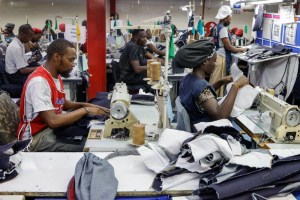
During the pandemic, we clearly did not realize that surgical masks medical green gloves, and ventilators were strategic. And so, I think we have let the sourcing of a lot of that move outside of the United States. In the early days of the pandemic, that that really hurt us a lot. We saw the U.S. textile industry repurpose their capabilities and step up to start producing some of the things that we were deficient in during the pandemic, and the production of those items helped save lives here at home.
We also know that the industry is a force for stimulating high-tech innovation. We now see textile products as major components in everything from heart valves to stents to aircraft bodies and advanced body armor. We know that the U.S. industry is the second-largest exporter of textile-related products in the world.
So, I think there are plenty of opportunities. From our perspective, we’re committed to using our trade and investment policy tools to support them and to defend the domestic textile industry.