Taiwan has agreed to remove 99 percent of tariffs on the United States as the result of a newly completed reciprocal trade agreement announced by the Office of the U.S. Trade Representative (USTR) on Thursday.
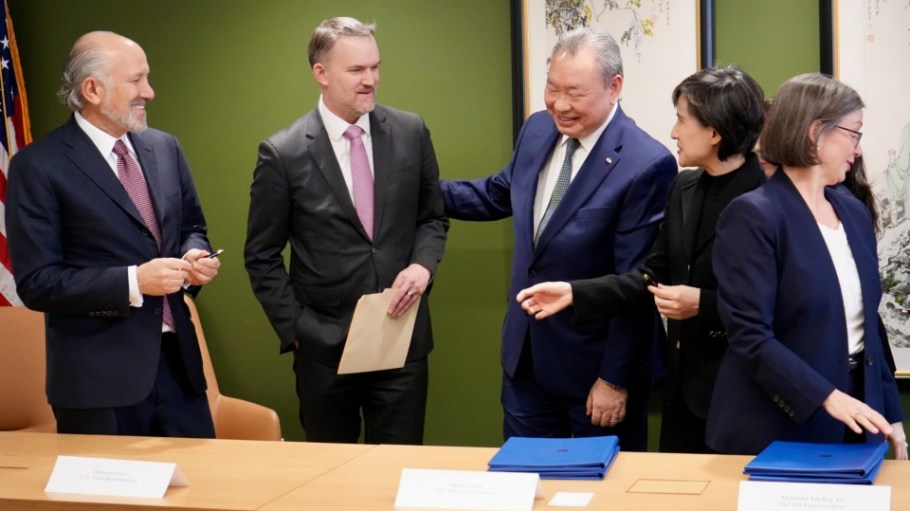
USTR Ambassador Jamieson Greer and Commerce Secretary Howard Lutnick attended the signing of the Agreement on Reciprocal Trade between the two nations under the auspices of the American Institute in Taiwan and the Taipei Economic and Cultural Representative Office in the United States. Taiwan’s Vice Premier Li-chiun Cheng and Minister without Portfolio Jen-ni Yang also attended the signing.
Related Stories
Under the terms of the trade deal, which would see virtually all duties on U.S. imports jettisoned, Taiwan will also provide preferential market access for American industrial products like cars and auto parts, chemicals, seafood, machinery, health products, electrical products, metals and minerals.
The country will draw down tariff barriers and provide preferential treatment for U.S. agricultural exports like beef, dairy, pork, dog and cat food and peanuts. When it comes to non-tariff barriers, Taiwan has agreed to jettison quantitative restrictions on American cars and accept U.S. FDA authorizations for medical devices and pharmaceuticals without additional requirements.
As a result of these actions, the U.S. has committed to reduce its tariffs on Taiwan-originating products to the higher of either the U.S. Most Favored Nation tariff rate or a rate of 15 percent comprised of the MFN tariff and a reciprocal tariff. Taiwan has faced 20 percent tariffs since August.
In addition to addressing tariff rates and barriers to trade, the U.S. and Taiwan said it would facilitate mutually beneficial cross-border investment, with the U.S. agreeing to support investment financing in Taiwan with U.S. private sector partners.
Under a previously signed memorandum of understanding, Taiwan promised to work with the U.S. to build industrial parks and clusters of industry that will help America up its capacity for domestic production, particularly in semiconductors, electronics and energy, which the administration said would usher in $500 billion in new investment into U.S. infrastructure and industry.
“President Trump’s leadership in the Asia-Pacific region continues to generate prosperous trade ties for the United States with important partners across Asia, while further advancing the economic and national security interests of the American people,” said Ambassador Greer on Thursday following the signing.
“The Agreement on Reciprocal Trade with Taiwan will eliminate tariff and non-tariff barriers facing U.S. exports to Taiwan, furthering opportunities for American farmers, ranchers, fishermen, workers, small businesses, and manufacturers,” Greer added.
This Agreement also builds on our longstanding economic and trade relationship with Taiwan and will significantly enhance the resilience of our supply chains, particularly in high-technology sectors. I want to thank my counterparts from Taiwan for their strong commitment to achieving fair and balanced trade with the United States,” he said.