President Donald Trump’s Section 122 tariffs—applied to United States trading partners in the wake of the Supreme Court’s kneecapping of his previous tariff strategy—took effect at 12:01 am on Tuesday. Much to the relief of countries like the United Kingdom and the European Union, they were lighter than anticipated.
Despite boosting his across-the-board tariffs to 15 percent over the weekend, the president’s baseline tariff has kicked in at just 10 percent, sparing trading partners from the full weight of the duty burden that was threatened.
Related Stories
The shift is no doubt a welcome surprise or many, but it only adds to the confusion felt by overseas governments and firms wondering how long the respite will last.
“While a new 10 percent U.S. tariff rate, instead of the threatened 15 percent, will provide some relief it shows how difficult it is for businesses to plan ahead,” William Bain, head of trade policy at the British Chambers of Commerce (BCC), said Tuesday. “It is far from clear what will happen next, and whether a higher tariff rate is still on the way. Despite the immediate reprieve, there is fresh uncertainty for UK firms exporting goods to the U.S.”
Bain said the about-face will present a challenge for firms looking to understand the tariffs’ impact on margins, as well as the prices they’ll be able to charge for goods that are currently in production for export over the coming months. “Inevitably this will have an impact on their sales and hit the economy,” he added.
Trump’s 10 percent tariffs, imposed through executive order on Friday, are due to remain in effect until July 24 unless renewed by Congress or by the president himself once they expire. Bloomberg reported Tuesday that White House officials are in the process of drafting a secondary executive order that would raise the rate in earnest to 15 percent.
The BCC has provided the UK government with a six-point plan to guard against adverse economic ramifications in the event of higher tariffs, including further negotiations with the Trump administration, engagement with the U.S. Congress, an uplift in UK Export Finance capacity and a review of the UK’s tariffs on other nations.
“The risk of further tariff pain to come is still real and the government must do everything it can to prepare for the worst,” Bain said.
In Europe, Bernd Lange, chair of the European Parliament’s International Trade Committee and standing rapporteur for the U.S., met with disgruntled senior trade lawmakers, referred to as “shadow rapporteurs,” from the EU’s 27 member states on Monday.
Calling the Supreme Court’s Friday ruling on president’s use of the International Emergency Economic Powers Act (IEEPA) “clear and unequivocal”, Lange said the implications of the decision “cannot be ignored, and business as usual is not an option.”
“A key instrument used on the U.S. side to negotiate and implement the Turnberry Deal is no longer available,” Lange added, referring to IEEPA. “The situation is now more uncertain than ever. This runs counter to the stability and predictability we sought to achieve with the Turnberry Deal.”
Section 122, which will replace IEEPA at least temporarily as Trump’s (shorter, less effective) tariff saber, applies to all countries trading with the U.S. “indiscriminately,” Lang argued—and the tariffs imposed through the statute will be stacked on top of Most Favored Nation (MFN) rates.
“As a result, imports from the EU into the U.S. would be subject to an applied rate exceeding the 15 percent threshold,” which is a “clear departure” from the terms of the agreement hashed out between European Commission President Ursula von der Leyen and Trump last summer.
According to Lange, shadow rapporteurs representing a majority of EU member states have agreed that work on the Turnberry deal should be put on hold “until clarity, stability and legal certainty in EU–U.S. trade relations are re-established.”
The EU Parliament, which was due to vote on the deal in committee on Tuesday, canceled the vote. Lange said the group will “reassess the situation next week.”
Meanwhile, China’s Ministry of Commerce is said to be assessing countermeasures to the new tariffs to be taken “in due course.”
“China has consistently opposed all forms of unilateral tariff measures, and urged the U.S. side to revoke its existing unilateral tariffs and refrain from imposing additional ones,” the Ministry of Commerce said on Tuesday.
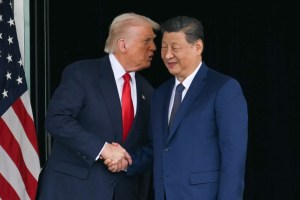
Asked whether Trump still plans to visit Beijing for a scheduled sitdown with Chinese President Xi Jinping in late March, Ministry spokeswoman Mao Ning demurred to answer definitively.
“Heads-of-state diplomacy plays an irreplaceable role in providing strategic guidance for China-U.S. relations,” she said during a Tuesday morning briefing. “China and the U.S. are in communication regarding President Trump’s visit to China.”