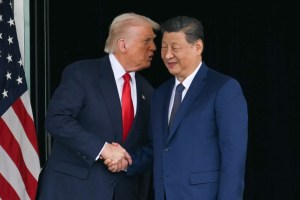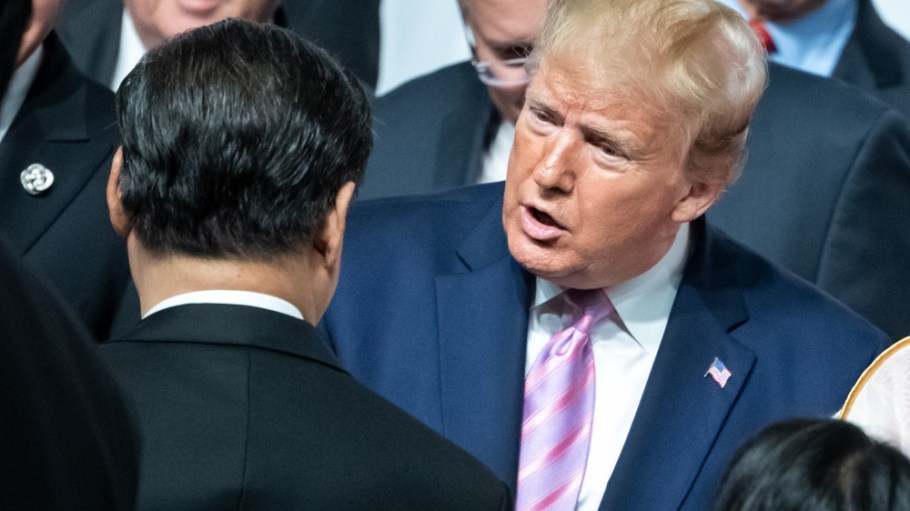
President Donald Trump and Chinese President Xi Jinping have formalized a date for their meeting on trade and tariffs.
The heads of state will meet on Thursday next week at the APEC Summit in South Korea, according to the White House.
Trump told reporters in the Oval Office Wednesday that he sees the long-awaited sitdown as the likely conclusion to months of negotiations. “We’ll make a deal on, I think, everything,” he said, citing soybean purchases by China (which have tapered off throughout 2025).
Related Stories
Trump also spoke about de-escalating nuclear tensions, pointing to a call he had with Russian President Vladimir Putin. “I think we’ll probably add China into the mix,” he added. A planned meeting between Trump and Putin was shelved on Tuesday, as the Russian leader reportedly rejected an immediate ceasefire in Ukraine.
China Foreign Ministry spokesperson Guo Jiakun confirmed the plans for next week’s meeting on Wednesday, adding, “Heads-of-state diplomacy plays an irreplaceable role in providing strategic guidance for China-U.S. relations.”
According to Guo, Trump and Xi “maintain close exchanges and communication.”
While both sides are outwardly expressing confidence and hopeful expectation that a deal can finally be brokered, with Trump even saying a protracted trade war with China is “not sustainable,” actions by the White House this week may serve to ratchet up tensions between the U.S. and China even further.
According to reporting from the New York Times, the administration is gearing up to launch a trade investigation into China for not meeting the terms of the Phase One trade deal negotiated during Trump’s first term in office.
A source familiar with the investigation told the Times that the probe could inflame already boiling tensions and even result in more tariffs. The timing of the filing may be significant—an attempt to gain a tactical advantage over China ahead of the upcoming meeting between the leaders—the first in-person sit-down since 2019.
The Times reported that the investigation may be initiated by the U.S. Trade Representative (USTR) on Friday under Section 301 of the Trade Act of 1974. The law, which Trump leveraged during his first term to levy hefty tariffs of up to 25 percent on China-originating products, allows the Commander in Chief and USTR to wield a number of authorities, including the imposition of tariffs, in order to enforce America’s rights under trade agreements or respond to unfair trade practices abroad.
China, for its part, has also stoked the flames of discord in recent weeks, first by announcing new global export controls on rare earth minerals, key components in technologies and weaponry. The action prompted swift blowback from the U.S. Treasury Department and the USTR, which threatened further tariffs.
Earlier this month, on the same day the U.S. began fining Chinese-owned and built ships new fees to dock at U.S. ports, China launched its own review of the Section 301 investigation that prompted the fees (and sanctioned several segments of Korean shipping company Hanwha which are tied to the U.S.).
China’s Ministry of Transport said at the time that various government agencies are looking into how industrial supply chains have been impacted by Washington’s Section 301 investigation. It said that based on the results of its investigation, the Chinese government will introduce “corresponding measures” against the U.S.
This week, USTR Ambassador Jamieson Greer clapped back at China for initiating the inquiry and sanctioning companies with American connections.
“China’s recent retaliatory actions against private companies across the globe is part of a broader pattern of economic coercion to influence American politics and control global supply chains by discouraging foreign companies from investing in America’s shipbuilding and other critical industries,” Greer said Monday.
“Attempts at intimidation will not stop the United States from rebuilding its shipbuilding base and responding appropriately to China’s targeting of critical industrial sectors for dominance,” he added. “We remain committed to defending our companies, securing supply chains, and encouraging allied investment in America’s industrial future.”