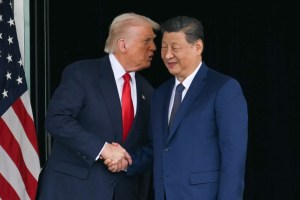
A phone call between President Donald Trump and Chinese President Xi Jinping on Wednesday touched on topics like trade and geopolitics, including China’s potential purchase of more agricultural and energy products from the United States as the nations work to repair frayed trade ties.
Tensions between the global superpowers have eased in recent months on the back of a landmark meeting between the heads of state in October wherein a trade framework was established. Calling this week’s “long and thorough” discussion “excellent,” Trump confirmed plans to visit China in April, presumably to hash out more plans for cooperation with the country that was once the primary focus of his tariff regime.
Related Stories
In a post to Truth Social, Trump said a range of subjects were discussed, including the war in Ukraine, the situation percolating in Iran, and the sovereignty of neighboring Taiwan—a longstanding point of contention between the U.S. and China that continues to vex Xi. According to the Chinese Foreign Ministry, Xi related in no uncertain terms the position that “Taiwan is China’s territory,” expressing displeasure about an $11-billion arms sale the U.S. made to Taipei last month.
“President Xi emphasized that the Taiwan question is the most important issue in China-U.S. relations,” the ministry said. “The U.S. must handle the issue of arms sales to Taiwan with prudence.”
But according to Trump, trade also remains a top-level concern, and China has made concessions to U.S. interests. China’s government is considering upping its purchase of oil and gas from the U.S. and even augmenting its uptake of soybeans to 20 million tons for the current growing season. As a part of the framework laid out last fall, China committed to the purchase of at least 25 million metric tons of the crop each year from 2026 through 2028.
“The relationship with China, and my personal relationship with President Xi, is an extremely good one, and we both realize how important it is to keep it that way,” Trump wrote. “I believe that there will be many positive results achieved over the next three years of my Presidency having to do with President Xi, and the People’s Republic of China!”
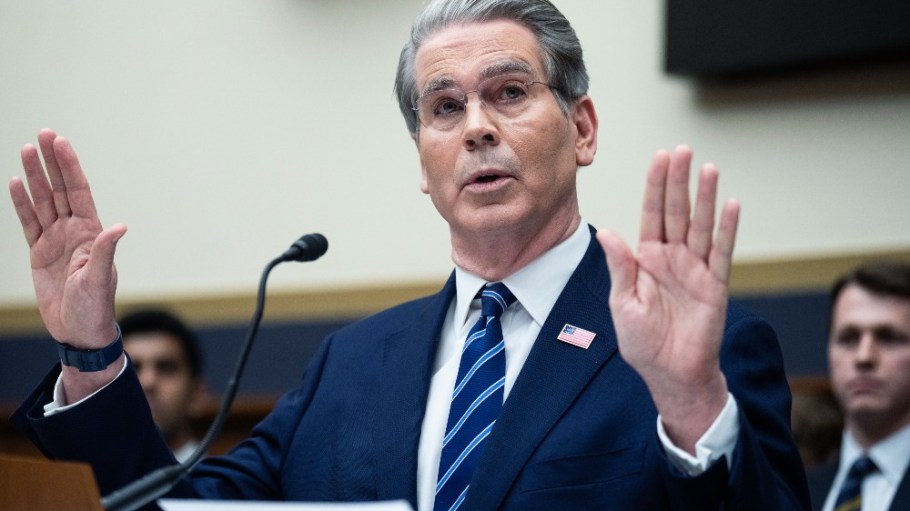
While Trump appeared buoyant over the discussion of the future of U.S.-China trade, Treasury Secretary Scott Bessent faced scrutiny from Congress over the administration’s trade and tariff policies and their impacts on the American economy—as well as his own evolving opinion on the issue.
Bessent faced harsh questioning during a House Financial Services Committee hearing from Rep. Maxine Waters (D-Calif.), the committee’s ranking Democrat, who pointedly queried the cabinet member, asking, “Are tariffs inflationary?”
“According to the San Francisco Federal Reserve with 150 years of data, tariffs do not cause inflation,” Bessent answered.
“Will you be the voice of reason in the administration and urge Trump to stop waging a war on American consumers?” Waters asked.
Bessent replied that Waters seemed “confused as to the definition of inflation.”
Waters pointed to rising prices on food products like coffee and bananas, and said that tariffs have even made homes in America less affordable. “One clear reason the housing crisis has grown worse is that you and the rest of the Trump administration levied tariffs on housing production goods like lumber and steel,” Waters said.
She pressed him on previous statements that he reportedly made via email to his hedge fund’s investors in February 2024.
“Tariffs are inflationary and would strengthen the dollar—hardly a good starting point for a US industrial renaissance,” the email said, according to the Wall Street Journal. Bessent also characterized tariffs as a potential point of leverage rather than a bonafide revenue driver for the federal government, saying, “The tariff gun will always be loaded and on the table but rarely discharged.”
The exchange devolved quickly, with Bessent speaking over the Congresswoman, who pointed to his previous testimony in front of a Senate committee last summer wherein he claimed that “there is no inflation, tariffs are not being passed on to consumers.”
But by a wide margin, Americans tend to disagree.
Research released by the Pew Research Center on Wednesday showed that 60 percent of Americans disapprove of the administration substantially increasing tariffs, including 39 percent who said they strongly oppose the measures.
According to the group’s polling, conducted 8,512 U.S. adults from Jan.20-26, the public’s view of tariff increases have remained consistently unpopular since April, 2025 when the sweeping “reciprocal” duties were first announced, and a marked partisan divide persists.
The majority (71 percent) of Republicans and Republican-leaning independents approve of the increased tariffs, while 28 percent indicated disapproval of the policy. By contrast, 93 percent of Democrats and Democratic-leaning independents believe tariffs are taking the country in the wrong direction with 70 percent said they “strongly disapprove.”
About half of those surveyed said the Trump administration’s tariff wielding will yield negative results for the U.S. and for them and their families over the course of the coming years.
And there’s evidence that even Republicans are backing off of their optimism from 2025. Roughly half (49 percent) of Republicans queried said they believe tariffs will benefit the country, while one-third expect to see mixed impacts, and 36 percent said they think tariffs will have mostly positive effects on them and their families going forward.
Meanwhile, 43 percent said the personal impact will be mixed, and 20 percent said they think it will be negative. “While Republicans’ views are only modestly different than they were last summer, they have become more likely to say the long-term effects for both the country and them personally will be mixed.”
On the Democrat side, Americans “overwhelmingly” believe the long-term impacts of tariff policy will be negative for the country as a whole and for them and their families (84 percent), while 10 percent say the effects will be mixed.