The tariffs are coming.
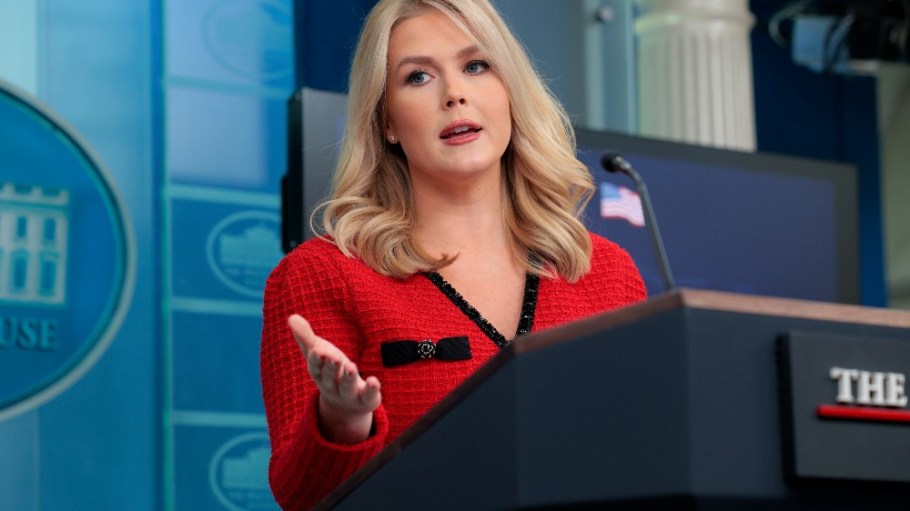
That was the unequivocal message relayed by White House press secretary Karoline Leavitt on Friday as she corroborated President Trump’s stated plans to impose 25-percent duties on Mexico and Canada—and a last-minute addition of 10-percent duties on China—starting Saturday.
“I was just with the president in the Oval Office, and I can confirm that tomorrow, the February 1 deadline that President Trump put into place in a statement several weeks ago, continues,” Leavitt told reporters during a scheduled briefing.
Related Stories
The countries are being targeted “for the illegal fentanyl that they have sourced and allowed to distribute into our country, which has killed tens of millions of Americans,” she added. “These are promises made and promises kept by the president.”
Leavitt did not expound upon the scope of the tariffs and was unable to tell reporters whether the duties would include oil.
Asked whether the administration could guarantee that the added duties would not increase prices for U.S. consumers, she said, “Americans who are concerned about increased prices should look at what President Trump did in his first term: he effectively implemented tariffs, and the average inflation rate during the first Trump administration was 1.9 percent.” The press secretary said moving forward, Trump “is intent on ensuring that he effectively implements tariffs while cutting inflation and costs for the American people.”
Canadian Prime Minister Justin Trudeau has said in recent days that if the U.S. were to impose tariffs, he would respond swiftly and proportionately. Asked whether this development represents the beginning of a trade war with the nation to the North, Leavitt said, “I don’t think so. I think the President is going to implement those tariffs tomorrow, and he will respond to Mr. Trudeau’s comments in due time.”
Leavitt implied that there’s not much the impacted parties can do to avoid the duties at this point. “Tariffs are incoming tomorrow…And the reason for that is because both Canada and Mexico have allowed an unprecedented invasion of illegal fentanyl that is killing American citizens—and also illegal immigrants—into our country,” she said.
The industry has been primed for the confirmation of Trump’s tariff plans since he took office, and its reaction was swift.
“While we welcome the President’s commitment to quickly address the border and fentanyl crises, these widespread tariff actions are the wrong tool to accomplish those objectives,” American Apparel and Footwear Association president Steve Lamar said. “They put the U.S. in the crosshairs by injecting massive costs into our inflation-weary economy while exposing us to a damaging tit-for-tat tariff war that will harm key export markets that U.S. farmers and manufacturers need.”
“We should be forging deeper collaboration with our free trade agreement partners, not taking actions that call into question the very foundation of that partnership,” he added.
Often sympathetic to the use of duties as a means of safeguarding U.S. industry, the National Council of Textile Organizations (NCTO), which represents American textile producers, applauded Trump’s decision to penalize China for its “predatory and often illegal trade practices.”
The Washington, D.C. trade group’s president and CEO, Kim Glas, said it is “grateful that President Trump fully recognizes the devastating impact that China has had on global markets.”
“As a result, we strongly support punitive action on China through a penalty tariff arrangement,” she added, noting that NCTO would like to see the duties specifically targeted to finished apparel and textile exports.
However, Glas said, “we are extremely concerned by the imposition of 25 percent tariffs on Mexico and Canada, which represent an important export market for U.S. textiles.”
Doing so would undermine the United States-Mexico-Canada Agreement (USMCA), which allows for duty-free trade between the three nations on a range of products.
“The U.S. textile industry ships 53 percent, or $12.5 billion, of its total annual exports to Mexico and Canada—our largest export market—that come back as finished products duty-free to the United States under the USMCA,” Glas explained. “Raising tariffs on these imports from Mexico and Canada will only serve to fuel the offshoring of a critical industry to China and Asia and hurt the U.S. domestic textile industry at a time when the industry has lost 26 plants in the last 18 months.”
While Glas said the group recognizes that the tariffs on Mexico and Canada are “to a degree non-trade related matters,” in that they’re designed to resolve issues like fentanyl trafficking and porous borders, she believes the action “will not only harm the vital North American coproduction chain which supports 500,00 U.S. textile jobs nationwide but also exacerbate migration into the United States.”
“We fully support the President’s efforts to resolve those issues as quickly as possible so that we can get back to more normalized trade,” she said.
Meanwhile, Footwear Distributors and Retailers of America (FDRA) president and CEO Matt Priest said he’s wary that the threat of duties (which he believes Trump is using as a bargaining chip to achieve his political goals) could land the U.S. and its trade partners in a “trade purgatory” where tensions remain elevated and solutions remain elusive.
Priest said the Friday briefing on Trump’s tariff decision raised more questions than it answered. “How is it going to work? What products are impacted? Are we a part of that? If there’s an exemption process, what does that look like? These are billion-dollar decisions that have no detail attached to them, and they drive uncertainty for business.”
The FDRA has long decried Trump’s tariffs—first, on China during his first term, and now, as he prepares to take on the rest of the world—due to the impacts on American footwear firms, and ultimately, U.S. shoppers.
“Over the past few years, hardworking Americans have faced high inflation and high costs across the board. Many families continue to struggle to pay for essential items they have to buy as a necessity—food, groceries, clothing, and shoes,” Priest said.
The FDRA lead said he’s holding out for Hail Mary resolution that keeps tariffs at bay. “That’s my hope, because that’s what he did with Colombia,” he said, referring to the president’s short-lived tariff skirmish with the Latin American nation over the return of migrants.
If Trump moves forward with his duty scheme, Priest said it could jump-start a chain reaction with significant consequences.
“Down the road you get into retaliation. You get into defensive posturing on the part of our trading partners, and then there’s no exit ramp for anybody,” he said. “I think that’s the danger we’re in right in this moment. So we’ll see what the response is from our from our friends, our allies, and our and our adversaries, because all three are involved.”