A weekend defined by tariff tumult may have few lasting impacts. The storm abated by Monday, underscoring a trend that has become all too familiar in recent months.
The Chinese government’s announcement last week that it would be tightening export controls and putting restrictions on the usage of rare earth minerals sent President Donald Trump into a Truth Social tailspin on Friday, culminating in an evening announcement from the Commander in Chief that the country would be hit with 100 percent tariffs beginning Nov. 1.
Related Stories
Trump accused Beijing of attempting to “hold the World ‘captive’” by leveraging rules surrounding highly coveted magnets and elements largely mined in China. Markets tumbled on the back of the president’s tariff threat, with the S&P 500 and the Nasdaq each clocking their worst days since April.
But less than 48 hours later, the message from the president shifted dramatically. “Don’t worry about China, it will all be fine!” he Truthed. “Highly respected President Xi just had a bad moment. He doesn’t want Depression for his country, and neither do I. The U.S.A. wants to help China, not hurt it!!!”
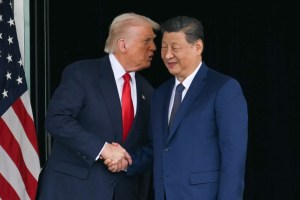
The president’s surrogates quickly assumed their positions. Vice president JD Vance took to Fox News on Sunday, saying that Trump “is always willing to be a reasonable negotiator” with China, touting the president’s “friendship” with Chinese President Xi Jinping.
Monday morning saw Treasury Secretary Scott Bessent grace the network with his own well-choreographed tempering of tensions. “The relationship, despite this announcement last week, is good. Lines of communication have reopened, so we’ll see where it goes,” he said. Bessent noted that the “100 percent tariff does not have to happen” if Washington and Beijing are able to hash out their differences.
A planned meeting between the heads of state at the Asia-Pacific Economic Cooperation (APEC) forum in South Korea later this month is still a go, he indicated. “I believe that meeting will still be on.”
News of the White House’s softening stance prompted Wall Street to claw back about half of Friday’s losses—a narrative that is becoming par for the course (to leverage the lingo of the president’s favorite pastime).
The pattern: late-week Truth Social threats give way to weekend double-downs, stoking market anxieties and prompting responses from the objects of the president’s ire. On Sunday, though, he shifts tack, saying a resolution or trade deal is on the way. Proxies and acolytes are deployed to the networks to underscore the strength of the president’s stance while subtly watering down threats and reassuring investors. Rinse and repeat.
The trend isn’t going unnoticed. New York-based cryptocurrency-based prediction market Polymarket on Monday showed that just 13 percent of traders believe Trump’s threatened 100 percent tariffs will remain in effect on Nov. 1, a supremely low vote of confidence down from the already skeptical 54 percent who made the same bet on Friday after the potential new tariffs were first revealed.
China, long the subject of Trump’s tariff ambitions (the president first levied Section 301 duties on China citing anti-competitive practices and a pervasive trade imbalance with the U.S. during his first term) is not taking the vacillations in the same stride as hobbyist bettors.
The country’s Commerce Ministry on Saturday released a statement defending its export control measures, calling them “normal actions” taken in accordance with laws and regulations as a “responsible major country.” The Ministry characterized the U.S. retaliation as a reflection of a “double standard,” saying America “has been overstretching the concept of national security, abusing export control, taking discriminatory actions against China, and imposing unilateral long-arm jurisdiction measures on various products” for some time.
In fact, over the past 20 days since the U.S.-China trade talks in Madrid, the American government has introduced new restrictions on Chinese trade, including adding entities to the Entity List and Special Designated National List—actions the country said have “undermined the atmosphere of bilateral economic and trade talks” during a time where both parties have supposedly been grasping for consensus.
“Willful threats of high tariffs are not the right way to get along with China. China’s position on the trade war is consistent: we do not want it, but we are not afraid of it,” the Ministry wrote. Underscoring Washington’s slipping leverage with the global superpower, Monday numbers show China’s exports have accelerated at their strongest rate in more than a year despite the precarious nosedive in trade with the U.S.
“If the U.S. insists on going the wrong way, China will surely take resolute measures to protect its legitimate rights and interests,” the Ministry added.