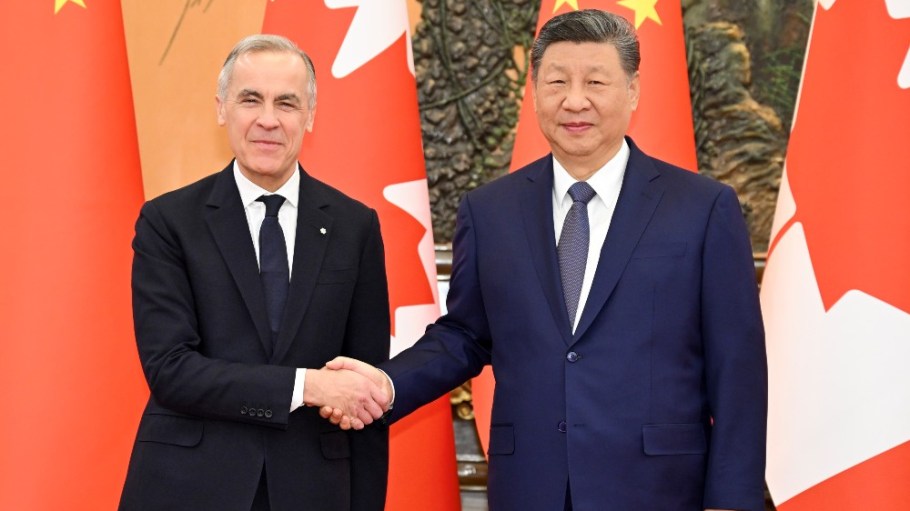
President Donald Trump has taken a sharp U-turn on previous comments made about Canada’s strategic partnership with China.
The Commander in Chief earlier this month called the recent negotiations between the two nations “a good thing” and appeared to back Canadian Prime Minister Mark Carney’s efforts to make a deal with Beijing, saying, “That’s what he should be doing.”
But on Saturday, Trump changed his tune, threatening America’s northern neighbor with 100 percent duties if it finalizes an agreement, which would draw down bilateral trade barriers on Chinese electric vehicles and Canadian agricultural products. Resurrecting a nickname once reserved for former Canadian Prime Minister Justin Trudeau, Trump attempted to subordinate Canada’s current leader by referring to him as “Governor Carney.”
Related Stories
The president levied the threat via Truth Social, saying that if Carney “thinks he is going to make Canada a ‘Drop Off Port’ for China to send goods and products into the United States, he is sorely mistaken.” Trump has accused both Canada and Mexico of acting as “backdoors” to the United States market for countries without free trade agreements, like China. Meanwhile, Treasury Secretary Scott Bessent said last week that negotiations for a U.S.-China trade deal are progressing.
The re-escalation in tensions between Trump and Carney comes after the latter’s landmark address at the World Economic Forum in Davos, Switzerland, wherein the prime minister implored the world’s “middle powers” to come together in cooperation as the traditional world order—led by “hegemons” like the U.S.—crumbles under a breakdown of the “rules-based order.”
Carney said Canada now seeks to “diversify to hedge against uncertainty,” hence the deal with China and ongoing negotiations with India, ASEAN, Thailand, the Philippines and the Mercosur countries.
But on Sunday, Carney denied that Canada is pursuing a free trade agreement with China.
“Canada respects our engagements, our commitments…We have commitments under [the U.S.-Mexico-Canada Agreement] not to pursue free trade agreements with non-market economies without prior notification,” he explained. “We have no intention of doing that with China or any other non-market economy.”
Carney said the current framework for the China trade relationship was developed to “rectify some issues” that have developed in recent years regarding the sale of China-made electric vehicles in Canada. The agreement is “entirely consistent” with the rules of the USMCA, he said, “and we’ll continue to work that way.”
On Monday, Carney attempted to position Trump’s comments as typical bloviating, though perhaps strategically deployed ahead of the USMCA review that will take place in July. “The president is a strong negotiator,” he told reporters when asked about Trump’s attacks. “Some of these comments and positioning should be viewed in the broader context of that.”
China appeared to back Carney’s sentiments on Monday, with Foreign Ministry Spokesperson Guo Jiakun saying the deal “does not target any third party” and that it “serves the common interests of the people of both countries.”
“China and Canada have established a new type of strategic partnership, and made some specific arrangements on properly handling the economic and trade issues between the two countries” to their “shared benefit,” he said.