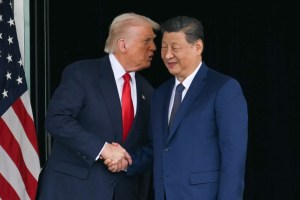
“Well, you’re in one now,” was President Donald Trump’s response to a reporter who asked whether China and the United States are on the road to a protracted trade war on Wednesday.
While not a revelation, the admission is just the latest in a bout of contradictory statements and actions from the president and the administration when it comes to the country’s relationship with China.
Trump announced 100 percent tariffs after Beijing declared new export controls on rare earth minerals last week, only to temper the heated threat days later with a Truth that read, “Don’t worry about China, it will all be fine!” Surrogates swooped in to reassure the public that the U.S. maintains the upper hand in negotiations—and that Trump’s relationship with China’s leader, Xi Jinping, remains on solid footing.
Related Stories
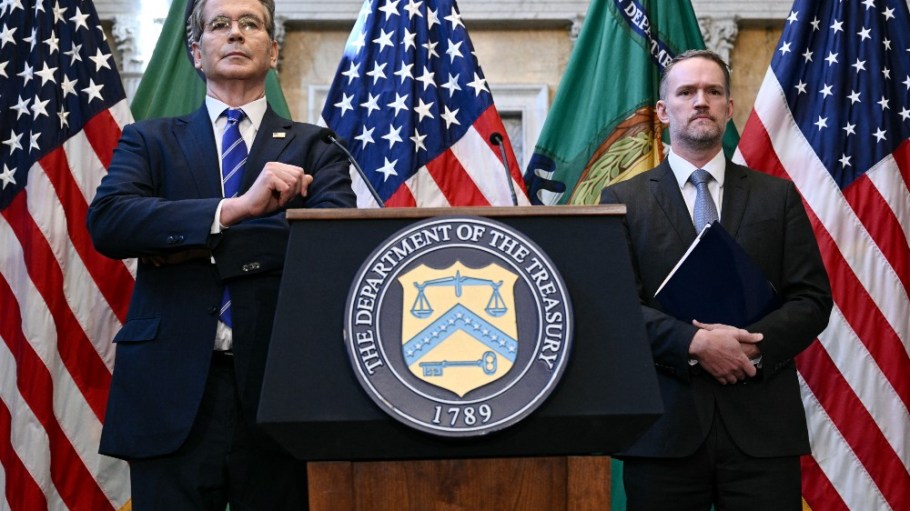
But things seemed far from friendly at a joint press conference hosted by Treasury Secretary Scott Bessent and U.S. Trade Representative (USTR) Ambassador Jamieson Greer on Wednesday. The officials slammed China’s government for the export controls, saying the actions violated the Geneva trade deal brokered with the U.S. this spring. Greer characterized the action as a “supply chain power grab.”
“It’s a clear repudiation of everything we’ve been working toward for the last six months, which was a stable tariff situation and a continued flow of rare earths,” he said.
“Make no mistake, this is China versus the world,” Bessent added, referring to the export controls. “China is a command and control economy, and we and our allies will neither be commanded nor controlled. They are a state economy, and we are not going to let a group of bureaucrats in Beijing try to manage the global supply chains.”
Amid the tough talk, though, were indications from the officials that the U.S. government doesn’t want to alienate China. “If China wants to be an unreliable partner to the world, then the world will have to decouple. The world does not want to decouple,” Bessent said. However, he held firm in asserting that the U.S. should lessen its dependence on the sourcing superpower. “We should work together to de-risk and diversify our supply chains away from China as quickly as possible,” he said.
Though much of the hot rhetoric centered on the topic of export controls, Greer later in the conference admitted that he doesn’t believe they’ll go into effect at all, and that the 100 percent tariff threat will become a moot point. “These are drafted or in draft, so this is quite real, but our expectation is that they won’t implement this, and that we’ll be able to be back to where we were a week ago—where we had the tariff levels we’ve agreed to, and we have the flow of rare earth magnets we agreed to,” he said.
Bessent reiterated statements he made earlier this week about the president’s intention to meet with Xi later this month at the APEC Summit, hinting at a sit-down between the two leaders that could cool some of the lingering tension. He also hinted that the 90-day pause on bilateral duties, set to expire in November, could be extended. “Right now, we are currently in a 90 day roll on the tariffs. So is it possible that we could go to a longer roll in return for a delay, perhaps, but all that’s going to be negotiated in the coming weeks before the before the leaders meet in Korea.”
But in nearly the same breath, he also expressed, on Trump’s behalf and at his instruction, U.S. intent to continue to penalize China for its purchase of Russian oil and even up tariffs to 500 percent in order to create a so-called Ukrainian Victory Fund with the revenue. The president has deployed Greer and Bessent to mobilize European allies in that effort, he said.
The Treasury lead also defended the president’s hotly contested us of the International Emergency Economic Powers Act (IEEPA), oral arguments for which will be heard in the Supreme Court next month. “I think that we see with this Chinese provocation why it is very important to for the President to have emergency powers to implement tariffs, because he needs to be able to use this to push back against this Chinese overreach against the world,” he said.
With such a consequential decision looming, Trump told reporters from the Oval Office that he may attend the proceedings.
“We have a big case coming up in the Supreme Court, and I will tell you, that’s one of the most important cases in the history of our country,” he said Wednesday, noting that if the tariffs are deemed unlawful (now for a third time), “we will be a weakened, troubled, financial mess for many, many years to come.”
“That’s why I think I’m going to go to the Supreme Court to watch,” he said.