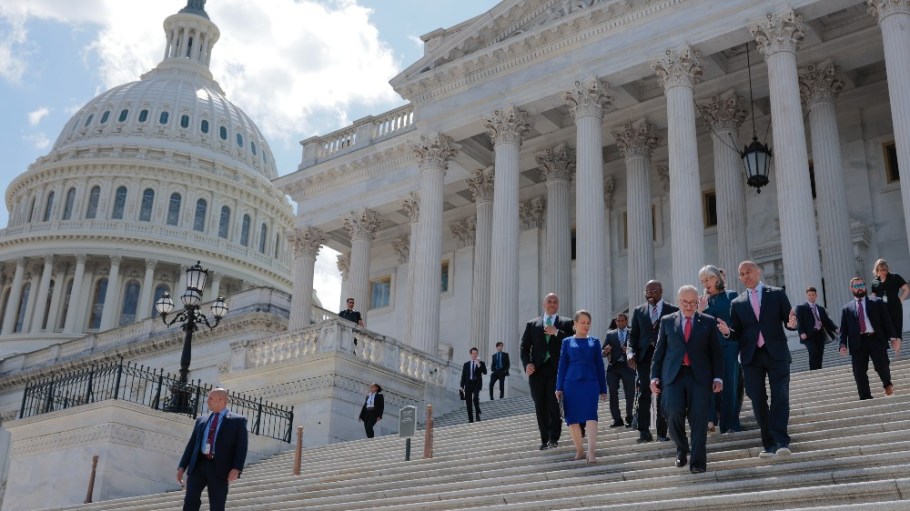
A narrow vote late Wednesday dashed Congress’ hopes of reining in President Donald Trump’s universal and reciprocal tariff schemes, with a bipartisan bill struck down by a 49-49 margin.
Senators Sheldon Whitehouse (D-R.I.) and Mitch McConnell (R-Ken.) were absent from the vote on S.J. Res. 49, which aimed to limit the president’s power to impose sweeping 10-percent to 50-percent duties on most U.S. trading partners. Introduced by Senators Rand Paul (R-Ken.) and Ron Wyden (D-Ore.), the bill would have invalidated President Trump’s use of the International Emergency Economic Powers Act (IEEPA) as a means of imposing the wide-ranging tariffs.
Related Stories
Two other GOP lawmakers—Senators Lisa Murkowski (R-Alaska) and Susan Collins (R-Maine)—voted in favor of the bill alongside Paul, its Republican sponsor. McConnell has been vocal about his opposition to the president’s trade strategy, with a spokesperson saying, “The Senator has been consistent in opposing tariffs and that a trade war is not in the best interest of American households and businesses.”
While the senator made no public statements about his support for this particular bill, his absence, along with Whitehouse’s, frustrated constituents who believe their votes could have spurred the bill’s passage.
However, it’s unlikely that a majority of “aye” votes in the Senate would have advanced the issue; earlier this month, the House approved a rule allowing it to block a vote on a resolution that would impede the president’s authority to impose duties. And the White House has said that President Trump would veto any bill standing in the way of his duty scheme.
Following the failed resolution, Paul intimated that more Republicans might yet come out against the tariffs, which have rattled the markets and retail alike.
“Most Republicans are just going along with it, but many of them are quietly still on the other side of this,” the senator said, according to Politico. “They just aren’t willing to say anything yet. But I think if we went through another quarter of negative growth and or another scare in the marketplace, I think there will be more visible voices against the tariffs.”
The president, for his part, remains undeterred by the outcry against the tariffs, even from members of his own party. At a cabinet meeting at the White House on Wednesday Trump remarked to reporters that Americans can do without products from China.
“You know, somebody said, ‘Oh, the shelves are going to be open.’ Well, maybe the children will have two dolls instead of 30 dolls, you know? And maybe the two dolls will cost a couple of bucks more than they would normally,” Trump said. “But we’re not talking about something that we have to go out of our way. They have ships that are loaded up with stuff, much of which, not all of it, but much of which we don’t need.”
But the U.S. Chamber of Commerce isn’t convinced. On Thursday, the largest business advocacy group in the country delivered an open letter to Treasury Secretary Scott Bessent, U.S. Trade Representative Ambassador Jamieson Greer and Commerce Secretary Howard Lutnick pushing for the administration to implement an exclusion process for the forthcoming duties.
“The Chamber requests that the administration take immediate action to save America’s small businesses and stave off a recession,” the missive read. The group requested that small businesses be automatically excluded from any new tariffs, as these operations don’t have enough margin or capital to pay the new duties or quickly rejigger their supply chains.
The Chamber also pushed for automatic exclusions for any products that can’t be produced stateside, and for a process that allows businesses to obtain exclusions “expeditiously” in the event that they can demonstrate that the tariff poses a significant risk to their ability to employ workers.
With members of U.S. industry (and reportedly, members of the president’s cabinet) wringing their hands over the impact of the tariffs, the Trump administration has repeatedly alluded to discussions with China that might lead to a resolution. But as of Thursday, that hadn’t happened; in a morning briefing, China’s Foreign Ministry spokesperson, Guo Jiakun, said, “As far as I know, China and the U.S. are not engaged in any consultation or negotiation on tariffs.”