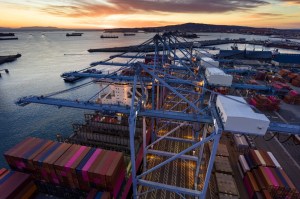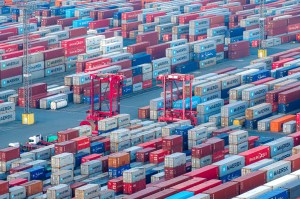
As of December, the federal government has collected $129 billion worth of International Emergency Economic Powers Act (IEEPA) tariffs from 301,000 importers across 34 million entries into the United States, according to Holland and Knight law firm. But a looming Supreme Court decision will determine whether the federal government gets to keep that revenue or whether it’s forced to return the funds to importers.
Should the high court validate two previous rulings from lower courts—which found the president’s tariffs to be illegal—importers should be prepped and ready to assert their rights to refunds, according to the firm’s trade lawyers, who hosted a webinar on the subject on Wednesday.
Related Stories
According to partner Andrew McAllister, who specializes in sanction and trade remedies and litigated at the Court of International Trade (where Trump’s tariffs were first challenged last spring), importers that have been paying tariffs should be focused on the state of their tariff liquidation—”a term of art under customs regulations meaning the final computation and ascertainment of duties on entries.”
Customs policy and procedure is typically to liquidate entries within approximately 314 days, McAllister said, and there’s a reason for the extended time frame.
“Let’s say you’ve brought an import in on March 1 of this year…. At that time you would declare to customs the country of origin, the valuation and the import classification… you would essentially pay estimated duties on that entry,” he explained. The entry remains “unliquidated” for a period of time while certain details are resolved—an importer may need to correct an entry error, for example, or customs may want certain questions about an entry answered before it adjusts details within its electronic system that determine the ultimate tariff rate.
The first entries tariffed under IEEPA were liquidated on Monday. Once an entry liquidates, an importer wishing to contest a tariff payment must undergo an administrative process known as a protest. Importers have 180 days from the date of liquidation to file.
“What this all means is that your liquidation date really matters,” litigation attorney Ashley Akers said. “That’s when your duty bill becomes final and conclusive, and there’s only very limited ways to undo that.”
Many companies are on the ball; about 350 cases have been filed with the Court of International Trade (CIT) to stop liquidation, the majority since Dec. 12. The lawyers expect that by the end of this week, another 350 cases will have been filed.
“These are lawsuits that are being asserted against the government seeking refunds of their IEEPA tariffs, so assuming the Supreme Court strikes them down, companies are affirmatively coming in and saying, ‘I’m entitled to a refund,’” Akers explained. Due to the high and growing volume, the lawsuits are now being consolidated.
Recently, some plaintiff importers (Costco among them) argued to the CIT that once the duties are liquidated, they could forfeit their rights to refunds. They pushed for an injunction to immediately stop customs from liquidating the tariffs while the Supreme Court case plays out.
“The government argued to the court in this case and in related cases, ‘We… will not object to the court re-liquidating the plaintiff’s entries’” in the event that the Supreme Court strikes down the IEEPA tariffs. The CIT ultimately accepted the government’s position that re-liquidation would result in a refund of all duties determined to be unlawfully assessed—with interest. “And so that is the [CIT] telling plaintiffs, ‘If the Supreme Court rules in your favor, there’s a mechanism in this court for a refund,’” Akers said.
However, according to Ron Oleynik, co-head of the firm’s International Trade Practice, firms should be proactive about filing lawsuits with the CIT to make sure that happens.
“Our view is the most conservative, the most prudent approach is to get up, get in front of the court, to file a lawsuit in order to preserve your rights,” he said. “Because otherwise, if the importers win at the Supreme Court, if it comes all the way back down to the courts, to the customs service, and they start handing out refunds and you didn’t file a case, you may be in a position of trying to explain to your senior management, to your board, to your owners, shareholders, why everybody’s getting their money back and you’re not.”
According to Oleynik, filing is actually a fairly simple process. “We have boiled this down; there’s not a lot of litigation,” he said. The incoming complaints may be consolidated with other similar lawsuits by lawyers or by the court itself.
“We’re encouraging our clients to file quickly for two reasons,” Akers added. “The Court of International Trade has said that it has authority to re-liquidate entries, but we need to assert the right in the court before they actually liquidate,” she said. “That will provide you the greatest protection the best arguments later when you’re asserting your right to a refund. So the quicker you go, the more protected you’ll be.”
The second reason Akers called out was that plaintiffs that get ahead of the Supreme Court ruling put themselves in the best position for speedy refunds. Some trade experts and even members of the administration, including Treasury Secretary Scott Bessent, believe that a decision could be handed down as soon as Jan. 9.
“There’s over 300,000 importers who may be seeking refunds for the IEEPA tariffs that they’ve paid. You don’t want to be the 299,000th plaintiff in this lawsuit,” Akers said. “You want to assert your rights early, get on record, get your complaint to the court, have it assigned to the judges before it liquidates and before, hopefully, the Supreme Court, for the importers sake… affirms the tariff ruling and holds the President has no authority here.”
There are still many unknowns about how the refund process will take shape should the tariffs be invalidated, Oleynik said—especially if some tariffs have already been liquidated and others have not. Clawing back already-liquidated tariff payments may be more complicated, but putting a complaint on record now may put a firm in a better position to see their payment re-liquidated.
He recommended that firms keep meticulous documentation on the dates of their entries and the tariffs paid so they are aware of when their tariffs will be liquidated by customs. That kind of information will be essential to any trade counsel that has to go up against customs in a battle for refunds.
“[Customs] could cut a check to every importer the day after the Supreme Court rule. But in our experience, customs service doesn’t work that way,” Oleynik said. “They’re going to put out hoops that you have to jump through, filings, entry certifications, and we just want to make sure you’re preserving all those documents so that we can get it out of customs, and get it out fast.”