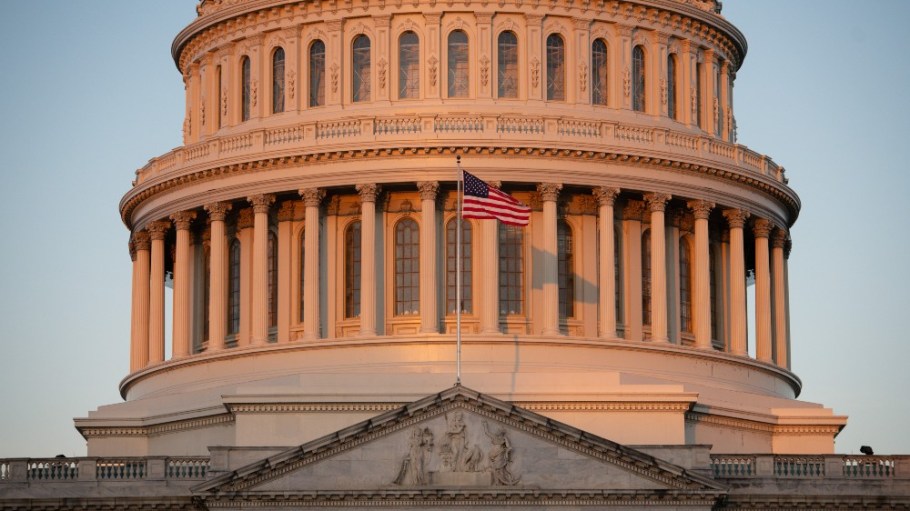
In a major blow to President Donald Trump’s trade agenda, lawmakers in the House of Representatives voted down a bid by Republicans to block challenges to his expansive tariff scheme, and in the wake of that decision, moved to end the “national emergency” that prompted the imposition of punitive duties on Canada.
The rejection of the proposal, which was introduced by Speaker of the House Mike Johnson (R-La.), came as 217 House members voted against it Tuesday afternoon, including all Democrats and three Republicans: Thomas Massie (Ken.), Kevin Kiley (Ca.) and Don Bacon (Ne.). The margins were slim but decisive, with 214 legislators voting to approve the rule.
Related Stories
The proposed prohibition of tariff challenges was couched within a measure that would have spurred debate on three unrelated pieces of legislation, and it would have blocked challenges to the tariffs until July 31. Lawmakers already invoked the procedural last year, using it to block the forcing of a vote in March 2025 on the legitimacy of the national emergency the president invoked in order to levy duties on China, Canada and Mexico. It was extended in September.
But with consumer and constituent sentiment around the tariffs and their impact on the economy trending sharply downward, even conservative lawmakers are being pushed to claw back control over the situation.
“I don’t think that the House should be limiting the authority of members and enlarging the power of leadership at the expense of our members,” Rep. Kiley said, according to Politico.
“Congress has Article One Constitutional responsibilities on tariffs. We cannot & should not outsource our responsibilities,” Rep. Bacon wrote on X. “As an old fashioned Conservative I know tariffs are a tax on American consumers. I know some disagree. But this debate and vote should occur in the House.”
“Tariffs have been a ‘net negative’ for the economy and are a significant tax that American consumers, manufacturers, and farmers are paying,” he added.
“My goal is to defend the Constitution and to represent the people,” Rep. Massie wrote on the social media platform. “Taxing authority is vested in the House of Representatives, not the Executive.”
The rejection of Speaker Johnson’s proposal cleared a path for Democrats to challenge Trump’s tariffs, and they did so expeditiously.
House lawmakers voted 219-211 on a resolution introduced by Congressman Gregory Meeks (D-N.Y.) that aims to invalidate the national emergency that Trump used as justification for imposing a slew of tariffs on Canadian imports in February 2025. The president claimed at the time that Canada failed to stop the smuggling of drugs like fentanyl into the U.S.—an “unusual and extraordinary threat” to U.S. national security. Tariffs on Canada currently stand at 35 percent.
Six Republicans—Reps. Kiley, Massie, Bacon, Hurd (Colo.), Brian Fitzpatrick (Pa.) and Dan Newhouse (Wash.)—voted alongside Democrats in support of the resolution. A single Democrat, Rep. Jared Golden of Maine, voted against the measure.
“In the last year, tariffs cost American families nearly $1,700, and that cost is expected to increase in 2026. Since these tariffs were imposed, U.S. exports to Canada have fallen by more than 21 percent,” Rep. Meeks, Ranking Member of the House Foreign Affairs Committee, said on the House floor Wednesday ahead of the vote.
“When I go home, my constituents aren’t telling me they have an extra $1,700 to spare. They’re asking me to lower grocery prices, lower the price of healthcare, and make life more affordable,” he added.
“These tariffs are bad for American workers, bad for businesses, and bad for working families. Instead of addressing the affordability crisis, which the President has called a hoax, Republicans have spent a year blocking this vote to protect Trump rather than doing the job the American people sent us here to do: lower costs,” Rep. Meeks said. “That ends today.”
Although the measure is approved in the House, it must now make its way through the Republican-majority Senate and onto the president’s desk, where it will be surely and swiftly jettisoned.
Trump weighed in quickly on the decision, taking to Truth Social to deliver a rebuke against tariff defectors within his party. “Any Republican, in the House or the Senate, that votes against TARIFFS will seriously suffer the consequences come Election time, and that includes Primaries!” he wrote.
“Canada has taken advantage of the United States on Trade for many years. They are among the worst in the World to deal with, especially as it relates to our Northern Border. TARIFFS make a WIN for us, EASY. Republicans must keep it that way!” he added in a subsequent post.
But the American Apparel and Footwear Association, which represents retailers and brands across the country, applauded Congress’ actions this week.
“Today’s vote sends a clear bipartisan, bicameral message, reinforcing Congress’ Article 1, Section 8 authority under the Constitution on tariffs and trade policy. This is especially important following a year of tariff whiplash, mirroring what the American public already understands: tariffs are put on the tab of American businesses and consumers, not foreign governments,” said AAFA CEO and president Steve Lamar.
“High tariffs, and constant uncertainty, hurts American businesses, hurts American investment, hurts American workers, and hurts hardworking American families,” he added. “We hope this will be a first step to bring about greater Administration/Congressional consultation that, together with all stakeholders, can lead to a more durable and predictable trade policy.”
This article has been updated to reflect the results of this afternoon’s vote in the House of Representatives and the subsequent reactions to it.