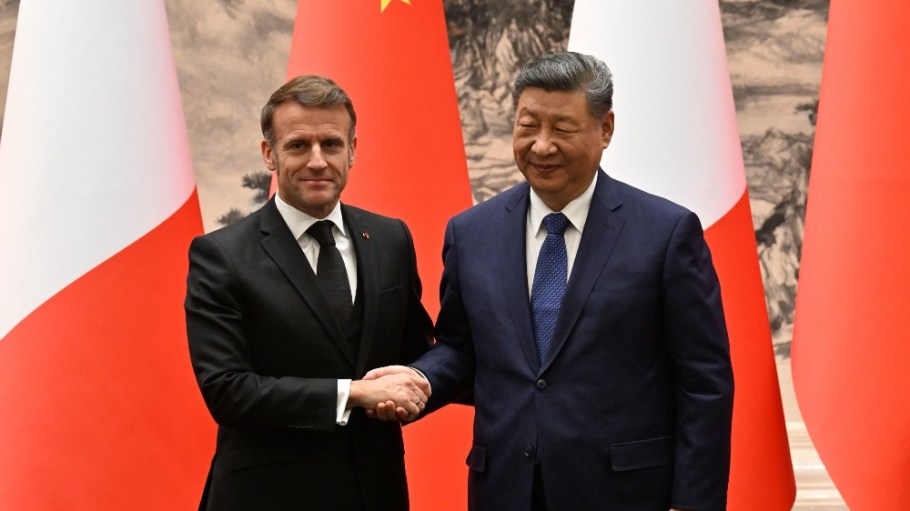
Days after a state visit to China, French President Emmanuel Macron said he threatened to hit the country with punitive duties unless the widening trade gap between China and Europe is addressed. “These imbalances are becoming unbearable,” he said during the trip.
In an interview Sunday published by French media outlet Les Echos, Macron said, “I told [China] that if they don’t react, we Europeans will be forced to take strong measures in the coming months.” Drawing inspiration from Washington’s global trade agenda, he noted that such actions could include “tariffs on Chinese products, for example.”
Related Stories
The European Union had a 300-billion-euro ($350 billion) trade deficit with China last year, and while the trade bloc’s individual 27 member states must decide as a group how to levy new duties and broker trade agreements, the French president is intent on mobilizing action against China.
Macron said getting the member nations on the same page would be a challenge, noting that some countries, like Germany, which have deep business ties to China, are “not yet entirely aligned with our position.”
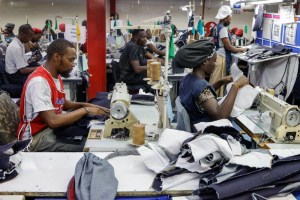
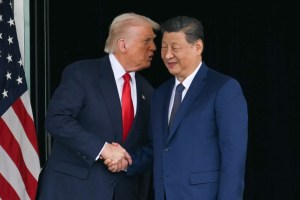
He also pointed out that President Donald Trump’s 47 percent duties on China-made goods have led to a disruptive shift in the way goods are distributed across the globe. Now that American importers have begun to aggressively diversify away from the so-called World’s Factory, China is “massively” rerouting shipments of goods to the European market.
That’s a problem for Europe’s industrial base, according to the French president. “We are caught in the middle today,” he said. “This is a question of life and death for European industry.”
In addition to rebalancing goods and services trade with China, Macron said Europe should accept more Chinese investment—though he cautioned that Chinese firms shouldn’t be allowed to behave as “predators” within the European business community.
Macron’s enthusiasm about the prospect differs slightly from the wider EU, which announced in November that it would review its framework for foreign investment and is considering tightening the rules surrounding Chinese investment specifically. The bloc is also mulling implementing “Made in Europe” targets of up to 70 percent domestic content on certain products, with the aim of bolstering the region’s manufacturing sectors and reducing reliance on China.
Macron was accompanied by about 40 French business leaders during last week’s visit, calling on China to share clean technology and batteries with France in a bid for “more tech neutrality,” according to the Financial Times. “This is not at all aggressive or protectionist. The Americans and other players in the North American market do it, the Chinese do it,” Macron said. “The major risk for Europeans is accelerated deindustrialization.”
At a regular press conference on Monday, China Foreign Ministry spokesperson Guo Jiakun alluded to Macron’s visit and a potential forthcoming visit from Germany’s foreign minister, saying, “China and European countries have had close high-level exchanges this year.”
“Leaders of the two sides reached important common understandings on and provided strategic guidance for further growing the strategic partnership and deepening mutually beneficial cooperation,” he added. “Amid the increasingly turbulent international situation, closer strategic communication and deeper dialogue and cooperation between China and Europe serves the interests of both sides and the wider world.”
In addition to saying that China stands ready to work with Europe on this front, Guo reiterated the country’s oft-repeated warnings about the dangers of trade protectionism, saying, “The two sides need to jointly uphold multilateralism, support free trade, defend the postwar international order and international rules, oppose unilateralism and bullying moves, jointly address global challenges such as climate change, and improve global governance, so as to benefit the people of both sides and provide greater stability and certainty to the turbulent world.”