A controversial agreement more than two decades in the making aims to solidify trade relations between the European Union and four Latin American nations.
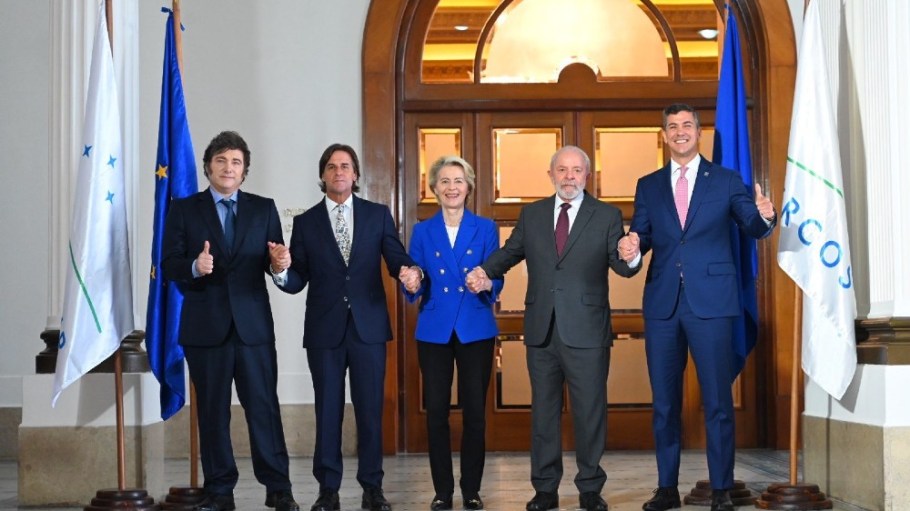
Argentina, Brazil, Paraguay and Uruguay—known as the Mercosur countries—agreed to the formation of a free-trade pact with the EU on Friday.
At a summit in Montevideo, Uruguay’s capital, European Commission President Ursula von der Leyen announced that the “ambitious and balanced agreement” represents a “truly historic milestone.”
Related Stories
If finalized, it will lower trade barriers and make it easier for EU firms to sell goods and services—and invest— in Mercosur countries, according to the European Commission. It will give the EU access to sustainable raw materials, further integrate value chains and help industries on both sides of the agreement compete on a global stage.
It will also remove bilateral tariffs on about 90 percent of traded products like textiles, chocolate, wine and spirits, cars, machinery and technology, eliminating about 4 billion euros worth of duties annually.
While the EU is Mercosur’s second-largest trading partner, accounting for nearly 17 percent of its total trade last year, the region’s economies are “highly protected,” and European firms “face many trade barriers when exporting there, which makes it hard for them to compete under fair conditions,” the Commission said Friday.
High import duties and technical regulations that deviate from international standards have impeded further growth. “There is huge potential for EU firms to export even more to this large market of over 273 million people,” it wrote.
At the summit, von der Leyen said it was important that democracies find reliability in each other in “an increasingly confrontational world.”
“This agreement is not just an economic opportunity, it is a political necessity,” she said. According to von der Leyen, the goal of the agreement is the formation of a cohesive new market of over 700 million consumers across the EU and Latin America.
Speaking on behalf of the Mercosur nations, President of Uruguay Luis Lacalle Pou was more restrained and succinct. “There are no magic solutions, there are no bureaucrats or governments that sign off on prosperity. It is an opportunity,” he said.
The Mercosur countries collectively rank as the EU’s 10th largest trading partner.
While von der Leyen said the deal would result in “more jobs—and good jobs,” along with “more choices and better prices” for all, there may be a long, rocky road ahead to finalizing the EU-Mercosur agreement.
France has been the most vocal opponent, with the Elysee, the official office of President Emmanuel Macron, releasing a statement on X calling it “unacceptable” in its current state. Italy and Poland, too, have publicly repudiated the deal in its present form.
Farmers across Europe worry that the deal will allow cheaper, non-compliant agricultural imports like beef to make their way into the EU market and undercut their earnings.
COPA-COGECA, a union comprised of two of Europe’s largest agricultural organizations, has long resisted the formation of a trade agreement. “For years, we have expressed firm opposition to this outdated and problematic agreement. While we recognize the EU’s need to deepen trade relations in the current geopolitical context, this must not come at any cost,” the group wrote over the summer in a press release re-posted on X Friday morning.
According to the group, opening up free trade with Mercosur countries “will exacerbate the economic strain on many farms already grappling with high input prices and challenging climatic conditions.” The Latin American nations “do not meet the production standards required of EU agriculture, whether in terms of plant protection products, animal welfare, or sustainability practices,” it added.
“Mercosur nations also operate under lower labor and safety standards, enabling them to produce at lower costs, which makes fair competition impossible.”
While the EU-Mercosur agreement has no shortage of detractors, other EU nations like Germany, Spain and Portugal are throwing their weight behind it.
“Today, the European Union has achieved a historic agreement with Mercosur to establish an unprecedented economic bridge between Europe and Latin America,” Spanish Prime Minister Pedro Sanchez wrote on X. “Spain will work to ensure that this agreement is approved at the (European) Council, because trade openness with our Latin American friends will make us all more prosperous and resilient.”
Portuese Prime Minister Luis Montenegro similarly praised “the historic conclusion of the negotiations of the EU-Mercosul Agreement” on social media. “We have to move forward quickly to create the largest free trade zone in the world, with 700 million consumers, creating opportunities for our cities and companies,” he said.