One of President Donald Trump’s once-stated goals around tariffs has been increased domestic manufacturing.
But, at times, the end goals—and the industries the president wants to impact most—have been convoluted. Trump seems to have a vested interest in competing with China, increasing domestic manufacturing and securing favorable deals in negotiations with other countries. But as the administration continues to negotiate, what’s been the impact on domestic manufacturing?
Related Stories
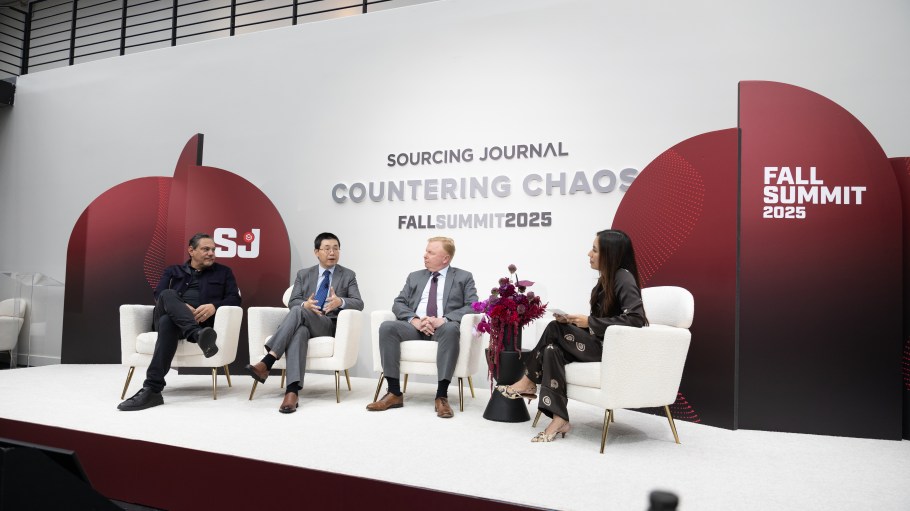
At Sourcing Journal’s annual Fall Summit, Joseph Ferrara, co-founder and CEO of U.S.-based Ferrara Manufacturing; Sheng Lu, professor & graduate director of fashion & apparel studies at the University of Delaware and Bill McCann, executive director of the United States Footwear Manufacturers Association (USFMA), joined Kate Nishimura, senior news & features editor at Sourcing Journal, to discuss the outlook for made in the U.S.
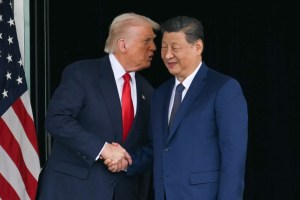
Much of the conversation around nearshoring and onshoring has been onslaught by Trump’s at-times aggressive strategy toward China. While the tariff rates have temporarily flattened out, Trump at one point levied a triple-digit duty on Chinese goods inbound into the U.S. That strategy spooked brands and retailers that have high reliance on the Asian nation, but Lu said it hasn’t yet caused an uptick in U.S. exports or manufacturing, as far as his data shows.
Part of the reason for that, he said, is that many domestic factories lack the same capabilities that Chinese factories have built up in recent decades.
“If you want to be considered China’s alternative, you will need to offer similar kinds of products [to those] China currently puts on [the] market. But remember, China is not a place from where U.S. companies source T-shirts, source basic items. Instead, brands and retailers, they source a great variety of products from China—but this is not what Western hemisphere suppliers can mostly do,” Lu said.
Lu said part of the problem is the lack of lead up. Trump’s tariffs have been a whirlwind that has seen a slew of brands and retailers considering changing their typical sourcing strategies. While many companies may have an interest in purchasing U.S.-made products, the lack of scalability for certain items can make it hard to justify large-batch purchasing.
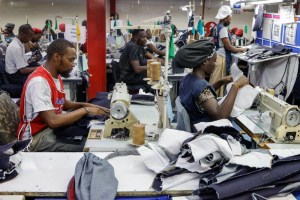
“Two-thirds of U.S.-based apparel mills, they have fewer than 10 people. You can think about all these contracted factories in Bangladesh, in Vietnam, they typically have 1,000, 2,000 or even 5,000 workers. My point here is, yes, domestic factories, they can do prototyping, do sampling, but when you ask them to scale up, there’s so much they can’t do,” Lu said.
In recent months, Trump said he wants to focus domestic manufacturing on high-value industries like defense and technology.
“We’re not looking to make sneakers and T-shirts. We want to make military equipment. We want to make big things,” he told reporters in May. “I’m not looking to make T-shirts, to be honest. I’m not looking to make socks. We can do that very well in other locations.”
But Ferrara argued that apparel manufacturing could be the perfect springboard into more technically complex domestic manufacturing. Because it’s less complex than some higher-value industries like defense, Ferrara said, apparel is an excellent way to “train the workforce that we need to dominate manufacturing in the next 100 years.”
“We’re training the workforce that we need to make those tanks, those high-value industries, and we can’t do it starting with tanks. We have to start with something, and apparel happens to be a great petri dish for testing these ideas in the marketplace,” he said.
One of the ways onshoring has found a bit of traction is through contracts with the federal government. The Berry Amendment, passed by Congress in 1941, gives preference to a variety of domestic commodities, including textile and apparel products, when being purchased by the Department of Defense (DoD).
McMann said that amendment continues to benefit domestic apparel and footwear producers.
“It’s set up to keep certain industries warm, and apparel and footwear are part of those industries,” he told the audience. “It’s a bedrock part of our national security policy.”
The USFMA has a partnership with the U.S. Army on automation, which allows it to use technology to compare against the status quo for worker safety, efficiency and throughput in manufacturing initiatives. It has also advocated for the elimination of a loophole in the Berry Amendment that would enable the DoD to make sub-$150,000 purchases from offshore apparel and footwear manufacturers.
McMann and Ferrara said the macroeconomic environment has brought around a unique opportunity to invest in technologies to empower the future of work. Ferrara said that while tariffs have benefitted the high-value, specialized apparel business his company does, they have made technological investment more expensive. Ferrara said his factory has more than 70 robots to help with minor manufacturing processes, but he’s hoping to double the investment, looking longer term.
The two said now is the time to invest in artificial intelligence, robotics and other technologies.
“I caution that tariffs are something that may not be around forever, and market forces still will dominate, and so we should not squander the opportunity to use these tariffs to our advantage, to invest in the future,” Ferrara said.
McCann agreed and said that the domestic apparel manufacturing industry has already fallen behind. Attracting further investment could help bridge gaps, he posited.
“Five years ago, we all lived through supply chain disruption. Our nation’s inability to produce basic goods was exposed, and so I can’t think of a better time, with the confluence of AI with automation in factories, to be investing,” he said. “We are in a competition around the world with China on so many fronts that go well beyond apparel and footwear. This is the time to double down on making things in the United States and strengthen our supply chain.”
But Lu had a bit of an opposing point of view. While he believes in the power of long-term investment and advocated for policymakers and industry practitioners to work together on the goals such investment should be headed toward, he said the timing may not be right.
“I do agree with Joseph, that we need more investment, and especially long-term investment, to strengthen the local textile manufacturing capability. Unfortunately, I personally do not feel this is the right moment to attract a lot of long term investment,” Lu said.
Lu said that the uncertainty over tariff rates, the fact that exports from the U.S. are going down, consumers becoming less willing to spend on clothing and continued disagreement on how to attract investment could be barriers for investments to be best sought after and applied once secured.
One of the oft-cited barriers to U.S. manufacturing has been the added cost of labor; in many current sourcing strongholds, labor is less costly than it would be in the U.S. But Lu said that’s not a good enough reason to write off American manufacturing.
“Look at Europe. The wage level is even higher, but…the leading apparel manufacturing nations in Europe are these Western European countries, like Italy, Germany, [the] UK. If they can do that, why not in the U.S.?” Lu said. “We should look at factors beyond just the cost itself, like how to find a niche market.”
Lu said vertical manufacturing and educating young generations about the impact of manufacturing will also play a part in making domestic production more enticing.
Ferrara said the growth of the domestic apparel manufacturing industry can only happen if brands and retailers are willing to buy American—even in very small quantities. According to the American Apparel and Footwear Association (AAFA), about 97 percent of apparel sold in the U.S. is made offshore.
He called on brands and retailers to more thoroughly consider domestic manufacturing.
“If you dig deeper into that [figure], you find that over 60 percent of retailers and brands have zero manufacturing in the United States—100 percent of what they source is from another country,” Ferrara said. “My argument, my big unlock, is for the 60 percent of brands and retailers out there that have 0 percent of manufactured products in the United States in the apparel sector, go to 1 percent. Make it from zero to one. Just 1 percent.”