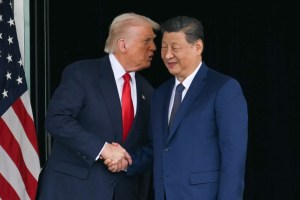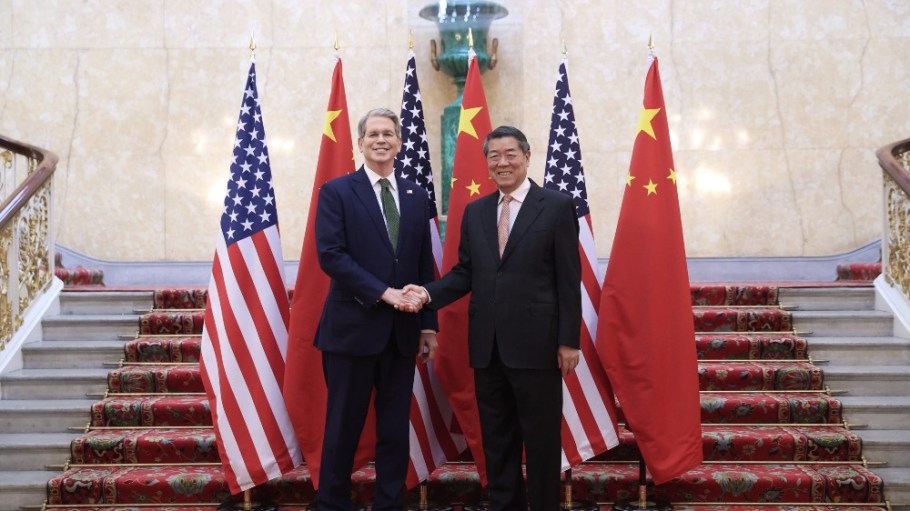
The United States and China have agreed to a “handshake” deal that will enable the two superpowers to resume the terms of their provisional trade agreement.
Following two days of talks between senior state officials in London, Commerce Secretary Howard Lutnick told reporters on Tuesday that the parties had “reached a framework to implement the Geneva consensus and the call between the two presidents,” referring to a discussion between the leaders that took place last week. China Commerce Ministry international trade representative Li Chenggang echoed that a consensus had been reached “in principle.”
Related Stories
Lutnick, Treasury Secretary Scott Bessent and U.S. Trade Representative Jamieson Greer traveled overseas to meet with the Chinese delegation, following up on the call between President Donald Trump and Chinese president Xi Jinping on Thursday. Trump wrote on Truth Social last week that he had spoken to Xi for more than an hour on a “very good phone call” where they discussed “some of the intricacies” of the recent deal.
The heads of state sought to mend fences following an escalation in trade tensions over the course of recent weeks, wherein both China and the U.S. accused the other of violating the terms of a provisional trade deal brokered in Geneva in mid-May. During the Switzerland talks, the U.S. and China delegations hashed out an agreement to suspend for 90 days the implementation of reciprocal duties which were drastically rolled back to much lower rates.
Heading back to Washington following this week’s meetings, Lutnick said he and Greer will convene with the president to ensure that he approves of upholding the terms of the Geneva truce. If Xi also approves the conclusions arrived at during the talks, “We will implement the framework,” the Commerce Secretary said.
The original three-month agreement came crashing down on May 30 when Trump Truthed that China “totally violated” its terms. At the time, Greer elucidated that China was “slowrolling” compliance with the deal and accused Beijing of placing U.S. companies on blacklists and restricting the export of rare earth minerals used in American industries like automotives and robotics.