China’s exports continued to break trade surplus records for the sourcing superpower to kick off the new year.
Across January and February, China’s exports jumped 21.8 percent to $656.6 billion, with the country managing a trade surplus of $213.6 billion during the two months, according to the country’s customs authority.
China’s General Administration of Customs typically combines trade data for January to February each year to account for seasonal impacts from Lunar New Year, which falls on different days each year.
Related Stories
Export growth in the two-month stretch considerably outpaced the median forecast of 7.1 percent projected from a Reuters survey of analysts. The growth trajectory also far exceeded the 6.6 percent export increase seen in December, which was pulled down by a 30 percent decline in shipments to the U.S.
U.S.-bound cargo for January and February saw a more manageable decline of 11 percent to $67.2 billion, in an easing from last year’s full-year drop-off of 20 percent.
Last year’s annual decline was largely a result of tariffs the Trump administration placed on China, which at one point during 2025 escalated as high as 145 percent on goods exiting the country.
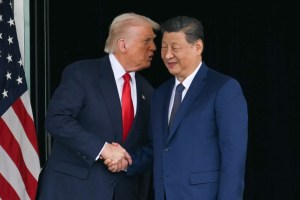
The overall tariff rate on China shrunk after an October meeting between Presidents Donald Trump and Xi Jinping resulted in the U.S. cutting the punitive fentanyl-related tariff from 20 percent to 10 percent. That meeting appeared to cool trade tensions with the countries, with the U.S. also postponing port-calling fees on Chinese vessels for one year.
In February, the Supreme Court struck down the International Emergency Economic Powers Act (IEEPA) duties that Trump levied on U.S. trade partners, removing many of the duties placed on China.
Trump responded by pulling another tariff lever, imposing a 10 percent across-the-board duty on imports under Section 122 that will be in effect for 150 days. The U.S. president has said he intends to expand the duties to 15 percent.
Presidents Trump and Xi are slated to meet in Beijing from March 31 to April 2.
“While the recent pace of gains is unlikely to be sustained, exports are likely to remain robust given the recent decline in U.S. tariffs and strong demand for semiconductors,” Zichun Huang, a China economist at Capital Economics, wrote in a note.
Markets across Southeast Asia and Europe have continued to bring in wider orders of Chinese goods, more than picking up the pace where the U.S. fell off.
Exports to the 10 countries within the Association of Southeast Asian Nations (ASEAN) soared 29.4 percent in January to $112.6 billion, while those to the E.U. rose 27.8 percent to $110 billion. Within ASEAN, Vietnam took in $31.2 billion of these exports, a 26.4 percent annual increase. Thailand brought in $18.9 billion and Malaysia imported $18.6 billion, representing a 35.6 percent and 32.1 percent jump, respectively.
Shipments to South Korea also accelerated 27 percent to $26 billion in the two-month span, while those to countries across Africa skyrocketed 49.9 percent to $42.8 billion.
China forecasts slowest GDP growth since 1991
China’s export engine is buoying the country’s overall economy, which is now forecasting historically slow growth rates in 2026.
The sourcing superpower is targeting for gross domestic product (GDP) growth of between 4.5 percent and 5 percent this year, marking the lowest growth goal for the country since 1991. The figure also represents the first formal downgrade since 2023, following three straight years in which the country’s officials called for GDP growth of roughly 5 percent.
China saw 5 percent GDP growth in 2025.
The lower GDP target comes as China’s economy contends with muted consumer spending, deflationary pressures and a poor housing and real estate market.
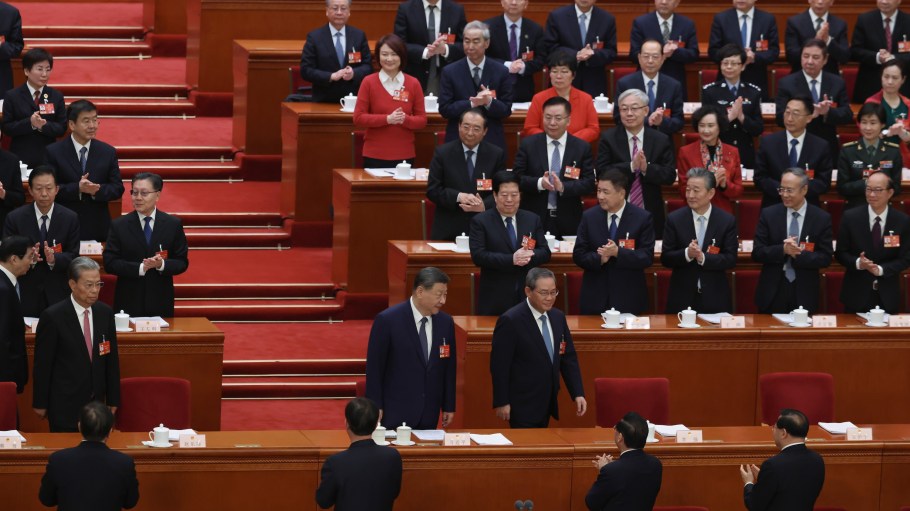
Chinese Premier Li Qiang said at the government’s annual “Two Sessions” legislative meetings last week that the new target was designed to allow room for structural reforms and risk control rather than pushing for aggressive expansion via stimulus programs.
And despite the mass exports, China’s factory activity declined more than expected amid the subdued domestic demand.
The official manufacturing purchasing managers’ index (PMI) fell to 49 last month from 49.3 in January, according to China’s National Bureau of Statistics (NBS). The index was the lowest in four months, and failed to reach estimates of 49.2 from economists polled by Bloomberg.
NBS statistician Huo Lihui blamed the longer-than-usual Lunar New Year holiday for the softening manufacturing activity. Factory closures during this year’s holiday period ran from Feb. 15 to Feb. 23, compared with eight days spanning late January to early February last year.
“Companies’ production and operations were affected to some extent and manufacturing activity declined,” said Lihui.
That marks a second straight month of contraction, with PMI reading matching October and April 2025 levels.