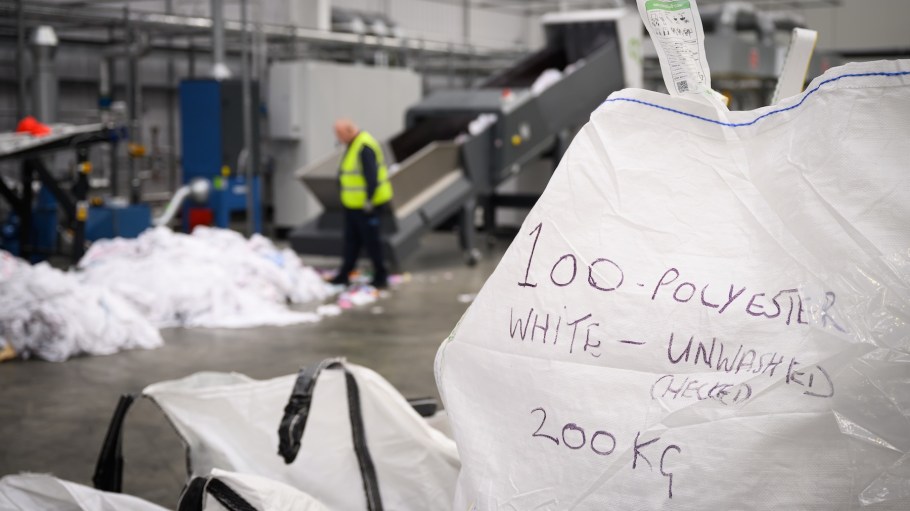
Currently, less than 1 percent of global fiber production relies on textile-to-textile, also referred to as T2T, recycling. Only a small share comes from post-consumer waste. Fragmented demand, limited financing, weak recycling infrastructure and a lack of policy support hinder progress.
Innovation platform Fashion for Good and The Fashion Pact, a CEO-led sustainable fashion group, have launched the Circular Fiber Collective (CFC): a cross-industry initiative to accelerate the adoption and scaling of T2T recycled and next-generation fibers.
Related Stories
With input from the Ellen MacArthur Foundation, CFC addresses barriers to scaling T2T materials across the fashion industry. The CFC will focus on coordinating action across the value chain, including aggregating demand signals, supporting financing and policy development, and providing tools to facilitate material adoption. Estimates from Boston Consulting Group and Fashion for Good suggest that, if fully mobilized, the initiative could help scale up to 2 million metric tons of T2T and next-generation material capacity, increasing its share of global fiber production to around 8 percent by 2030.
“We’ve been working with brands on next-generation material adoption long enough to know that good intentions don’t move markets—shared engagement does. The Circular Fibre Collective is built on that premise,” said Katrin Ley, managing director of Fashion for Good.
The Fashion Pact’s executive director Eva von Alvensleben added that the CFC demonstrates the power of collective action.
“Together, we can bring a strong, unified voice to accelerate the scaling of textile-to-textile recycled and next-generation materials,” she said. “By sending a clear market signal through CEO leadership, we believe this will drive both investment and adoption across the industry.”
The collective’s two pillars focus on adoption enablers and practical adoption tools. These include efforts such as facilitating demand, supporting commitments and exploring policies—providing tools, such as Fashion for Good’s Fiber Club and T2T Recycled Materials Cohorts, to overcome barriers. To that end, the CFC prioritizes T2T recycled materials and next-generation fibers, focusing on areas with the most market failure.
“It was great to have supported the design of this initiative. The vision of a circular economy for fashion and textiles is clear. The past decade has built real momentum,” said Joe Murphy, chief strategy and innovation officer at the Ellen MacArthur Foundation. “Now is the time to move to implementation at scale, and initiatives such as this are an important step on the long-term journey.”
A consultation with 25 fashion brands and research from Fashion for Good and BCG informed the initiative. The initiative also builds on prior research that projects up to 13 million metric tons of next-gen and T2T materials will enter the market by 2030.
“Scaling low-impact materials is not just about technology. It needs collective effort. Without credible, long-term demand, suppliers cannot invest. Without supply, brands cannot commit,” said Leyla Ertur, chief sustainability officer at H&M Group. “Balancing both sides takes collective action across the value chain, shared definitions of ‘circular,’ and a solid business case for each actor. That’s how we move from pilots to resilient systems at scale.”