President Donald Trump is wasting no time in unraveling his predecessor’s legacy by withdrawing the U.S. from the Paris Climate Agreement for a second time.
Within hours of taking office, Trump signed an executive order pulling the nation from participation in the 2015 climate accord, which unites countries across the globe in the shared goal of slashing greenhouse gas (GHG) emissions in an effort to combat climate change.
Trump withdrew the U.S. from the pact during his first term, but the decision was quickly reversed by President Joe Biden in 2020. America is now among just four nations including Libya, Yemen and Iran not engaged in working toward limiting global warming to 1.5 degrees Celsius.
Related Stories
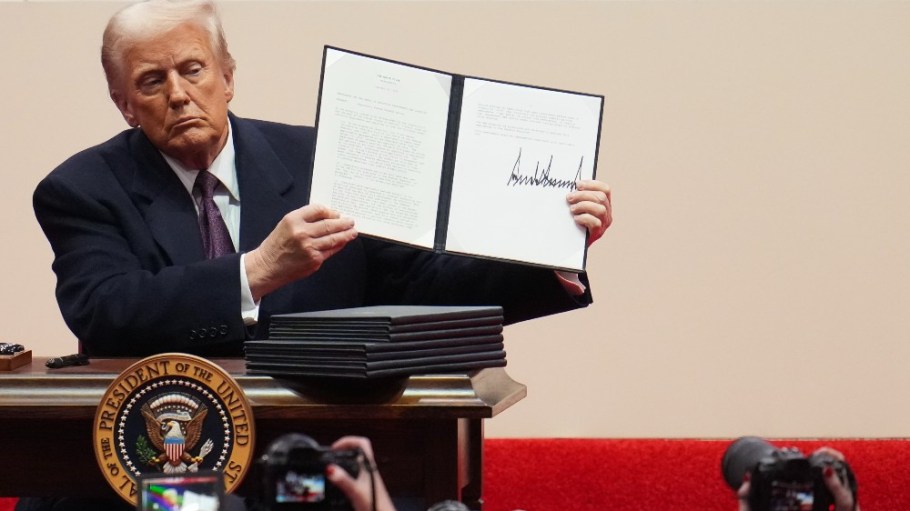
Trump, who signed the order at Capital One Arena in Washington, D.C. in front of a crowd of supporters, said, “I’m immediately withdrawing from the unfair, one-sided Paris climate accord rip-off.”
“The United States will not sabotage our own industries while China pollutes with impunity,” he added. China is currently the world’s biggest GHG culprit, accounting for 31.1 percent of global emissions, according to intergovernmental body the International Energy Agency.
The U.S., by contrast, accounts for about 13 percent of global GHG output. In December, Biden said the country would accelerate its climate mitigation strategy by slashing emissions by 61 percent to 66 percent by 2035, a goal that has now been abandoned.
The withdrawal announcement was accompanied by a signed letter notifying the United Nations of the decision, which will become official one year from Monday.
The president made several other speedy moves to dismantle programs and policies related to climate and the environment, including revoking the Biden administration’s U.S. International Climate Finance Plan, which directed that a focus on climate change “shall be an essential element of United States foreign policy and national security.”
The plan, which mobilized financial resources to help developing countries reduce GHG emissions and build more climate-resilient infrastructure, saw an allocation of $3.3 billion for fiscal 2025 under President Biden. Within hours of the announcement, the landing page for the program was removed from the White House website.
Trump also signed an order to temporarily halt the sale of offshore wind energy leases in federal waters as well as pausing approvals, permits and loans for onshore and offshore wind projects beginning Jan. 21.
Meanwhile, a directive entitled “Unleashing American Energy” instructs the heads of government agencies to immediately review any and all existing policy that could “potentially burden the development of domestic energy resources” like oil, natural gas, coal, hydropower, biofuels, critical minerals and nuclear energy. Within 30 days, agency heads will be required to report to the Office of Management and Budget (OMB) and the National Economic Council (NEC) with plans to “suspend, revise or rescind all agency actions identified as unduly burdensome” to the administration’s energy interests. The executive order also aims to do away with electric vehicle mandates, including emissions waivers and subsidies for the makers of non-gas-powered cars.
The moves threaten to grind to a halt any middling progress the U.S. has made in recent years with regard to emissions reduction and climate impact. As of November 2024, the Climate Action Tracker (a collaboration between Climate Analytics and New Climate Institute) ranked U.S. progress as “insufficient.”
Biden’s Inflation Reduction Act (IRA) mobilized historic levels of investment in clean energy, but the U.S. “will still be far from meeting its domestic climate target—let alone aligning its emissions with a 1.5°C trajectory—without additional, drastic emissions reductions measures,” the group said.
“To meet its domestic target, the U.S. would need to bolster its policy packages at the sectoral level to address the rising demand for electricity across sectors,” though 2022 analysis showed the country “moving in the wrong direction regarding its international support for fossil fuels.” In fact, the U.S. remains the biggest crude oil producer on earth and the country achieved record-level production in 2023. “The country is also the worlds’ largest fossil gas producer and, in 2022, became the world’s largest exporter for liquified natural gas (LNG).”
With U.S. climate stagnation as a backdrop for Trump’s return to office, the rapid rollback of Biden-era policies and rollout of an agenda focused on bolstering, not limiting, the production of fossil fuels has stunned world leaders, climate advocates, industry trade groups and political opponents.
“It’s a truly unfortunate development that the world’s largest economy, and one of our closest allies in the fight against climate change, is withdrawing from the Paris Agreement,” said Wopke Hoekstra, European Commissioner for Climate, Net Zero and Clean Growth.
“Despite this setback, we remain committed to working with the U.S. and our international partners to address the pressing issue of climate change,” he added. “The Paris Agreement has strong foundations and is here to stay.”
Hours after Trump’s announcement at the World Economic Forum in Davos, European Commission President Ursula von der Leyen proclaimed, “The Paris Agreement continues to be the best hope for all humanity. So Europe will stay the course, and keep working with all nations that want to protect nature and stop global warming.”
“China is concerned over the U.S.’ announcement of withdrawal from the Paris Agreement,” China Foreign Ministry spokesperson Guo Jiakun said at a press conference on Tuesday. “Climate change is a challenge facing all humanity, and no country can stay insulated.”
“Now is not the time to let up in our efforts to promote and secure a harmonized approach to the effective stewardship of our planet,” Steve Lamar, president and CEO of the American Apparel and Footwear Association (AAFA) told Sourcing Journal. Lamar vowed that the group “will continue to engage at the local, state, federal, and international level to advocate for sustainability policy that fits.”
As Southern California begins a recovery from multiple raging wildfires that ravaged Los Angeles and its suburbs for over a week, Governor Gavin Newsom, a frequent Trump critic who has fingered climate change for California’s worsening weather conditions, also responded to the news that Trump pulled the U.S. out of the accord.
“If you don’t believe in science, believe your own damn eyes,” he wrote on X Monday evening, accompanied by two photos of firefighters nearly engulfed in flames while battling the blaze.
Earlier in the day, during his inaugural address, Trump claimed that governmental mismanagement, not climate change, contributed to the devastation wrought by the fires, saying that Los Angeles endured the disaster “without even a token of defense.” The president noted that the natural disaster affected “some of the wealthiest and most powerful individuals in our country, some of whom are sitting here right now. They don’t have a home any longer.”
“That’s interesting,” he added.